



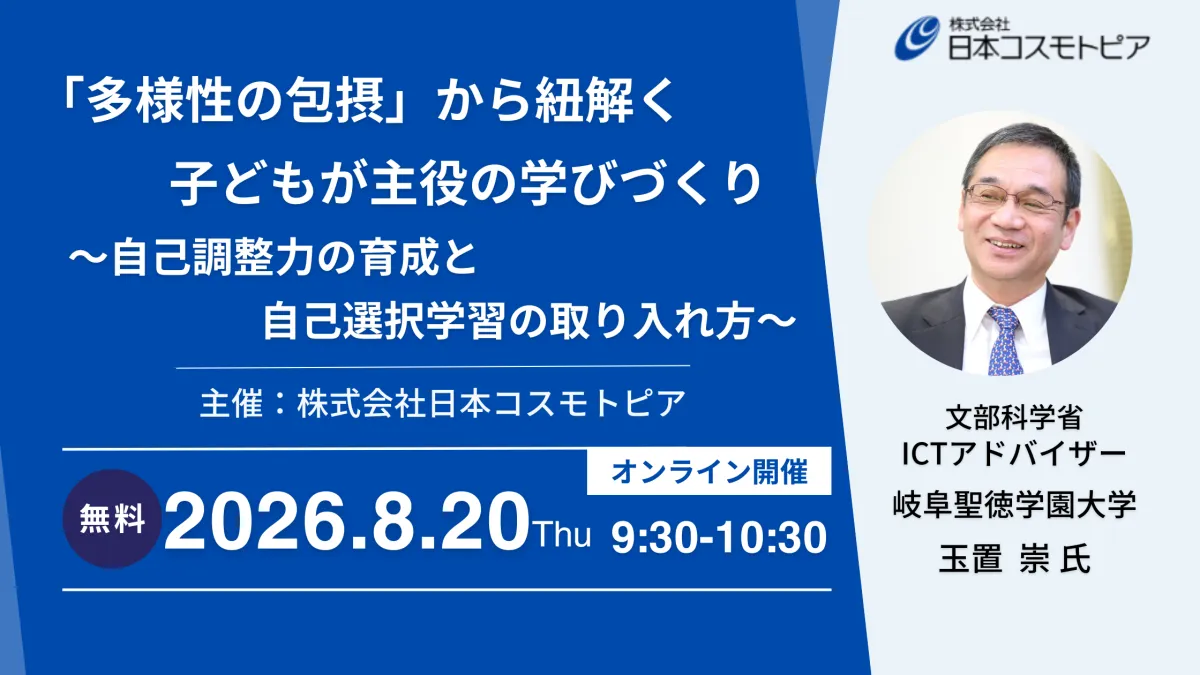
Exploring Diversity and Inclusion in Education: The Future of Learning
Upcoming Online Seminar on Educational Diversity and Inclusion
On August 20, 2026, Cosmotopia Co., Ltd., headquartered in Osaka, will hold a free online seminar titled "Creating Student-Centered Learning through Diversity and Inclusion." The seminar will feature Takashi Tamaki, an ICT advisor for the Ministry of Education, who has been instrumental in educational reform across Japan. This event aims to discuss key aspects of the 2030 educational curriculum, particularly focusing on how to encourage autonomous learning and lifelong education.
Background of the Seminar
In recent discussions held by the Central Council for Education at the Ministry of Education, there has been a strong push toward developing a new curriculum set to be fully implemented by 2030. This new framework emphasizes nurturing the ability of students to thrive in an unpredictable society. A crucial aspect of these discussions is the concept of "Equity," which recognizes the diverse backgrounds and abilities of each student, ensuring that no child is left behind.
The curriculum aims not only to support education but also to develop students' agency, enabling them to make their own choices and collaborate with others in their learning processes. However, meeting the varied needs of diverse students and fostering their self-directed learning remains a challenge in schools.
Agenda of the Seminar
This seminar will guide participants through relevant research and practical strategies, specifically structured to foster understanding and application of the new educational framework. The following key points will be covered:
1. Understanding Equity in Education: Insight into what diversity and inclusion mean within the educational context and their essential role.
2. Promoting Self-regulated Learning: An exploration of why nurturing self-regulation in students is vital today.
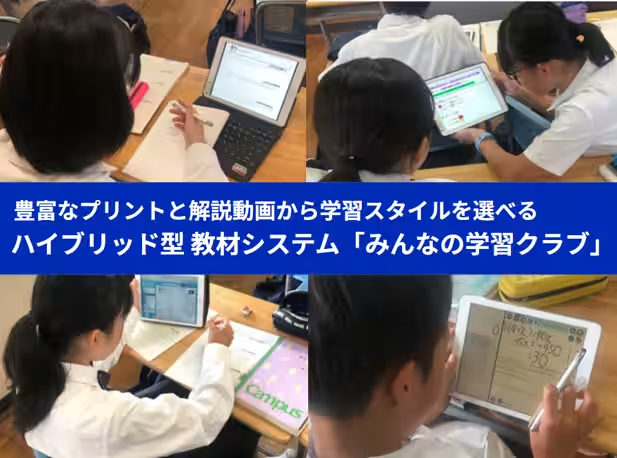
3. Incorporating Autonomous Learning in Classrooms: Practical tips for effectively integrating student choice learning in everyday lessons.
4. Utilizing External Knowledge: Showcasing effective case studies from the
Topics Other)







【About Using Articles】
You can freely use the title and article content by linking to the page where the article is posted.
※ Images cannot be used.
【About Links】
Links are free to use.