



The Dichotomy in AI Utilization Maturity Among Japanese Businesses Revealed
The Dichotomy in AI Utilization Maturity Among Japanese Businesses Revealed
The Japan Information Economy Society Promotion Association (JIPDEC), based in Minato-ku, Tokyo, has recently released findings from its comprehensive survey on AI utilization among Japanese companies, involving 1,107 entities. Conducted in January 2026, this study highlights critical insights regarding the degrees of AI maturity across various industries and ongoing challenges faced by businesses.
Key Findings from the Survey
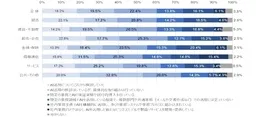
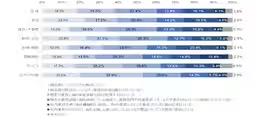
1. Varying Degrees of AI Utilization Maturity: The report reveals a stark contrast in the adoption of AI across industries. Sectors like information and communications and finance/insurance demonstrate a proactive approach to integrating AI technologies. Conversely, over 50% of respondents from public and miscellaneous sectors remain at the consideration stage, indicating that significant gaps exist in AI adoption between industries.
2. Significant Benefits Noted Post-AI Implementation: Companies using AI report substantial improvements in customer support, strategic planning, and product development, often achieving results that exceed their expectations. However, to enhance these effects, standardization and digital transformation (DX) within operations are seen as essential driving forces.
3. Persistent Challenges Surrounding Input and Output Data: Interestingly, challenges related to data handling and privacy concerns have not dissipated; many organizations continue to grapple with these issues even after implementing AI solutions. This highlights a critical need for ongoing efforts to address such challenges, suggesting that businesses should not treat data-related issues as one-time obstacles.
Readiness Levels Across Sectors
The survey revealed that approximately 60% of organizations remain in preliminary stages regarding AI utilization, with 18.2% only beginning to consider AI, 19.5% currently analyzing options without concrete actions, and 22.4% engaged in pilot projects. The contrast is notable when observing the information sector where 15.4% of companies are already at the new business creation stage. On the flip side, an alarming 52.9% within the public sector are still contemplating measures, reflecting a significant disparity in AI readiness.
As shown in the findings, there is a clear need for sectors lagging in AI maturity to accelerate their adoption strategies. The data makes it evident that firms engaged in robust digital transformation initiatives are witnessing superior benefits across their operations.
Effectiveness of AI Across Various Business Functions
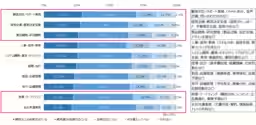
When evaluating the effectiveness of AI, more than 60% of respondents indicated they have seen positive results. Specifically, customer support roles reported a 29.1% return rate of 'better than expected results.' While most departments benefit from AI implementations, the notable differences in getting 'more than expected results' emerged prominently in customer service and executive decision-making support as opposed to common operational tasks and marketing.
In companies where DX practices are consistently applied, over 25% of all roles reported overall satisfaction and performance exceeding expectations. Therefore, it becomes critical for cross-departmental collaborations to leverage AI effectively, emphasizing the importance of standardization through digital transformation.
Ongoing Challenges with AI Implementation
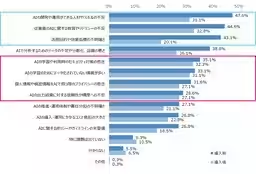
Throughout the evaluation of AI utilization, the survey examined both pre- and post-implementation challenges encountered. While many concerns—including clarity around utilization objectives and skills shortages—tend to improve post-deployment, issues regarding input data handling and output reliability persist. Companies reported ongoing worries about data quality and privacy even after implementing AI solutions, highlighting the necessity for continuous improvement strategies.
About the Survey
The 'Enterprise IT Utilization Trends Survey 2026' was conducted from January 16 to January 20, 2026, with assistance from IT Research Co., Ltd. (ITR). The survey delved into various aspects including current challenges and strategies around IT trends, privacy, information security, and digital trust. The target demographic consisted of about 17,000 respondents from domestic companies with over 50 employees, specifically those in positions responsible for IT strategy, security, or executive planning.
Conclusion
JIPDEC has been pivotal in developing Japan's information landscape since 1967, focusing on resolving technical and regulatory challenges to create a secure environment for data usage. With such comprehensive insights into AI adoption, there remains a pressing need for enterprises to enhance their capabilities and address lingering concerns regarding data management in order to fully leverage the potential of AI.
For further queries, please reach out to JIPDEC's Public Relations Office through their contact form.
Topics Business Technology)
【About Using Articles】
You can freely use the title and article content by linking to the page where the article is posted.
※ Images cannot be used.
【About Links】
Links are free to use.