



New Polymer Structure Analysis Service to Stabilize Recycled Plastic Quality
Introduction
The Toray Research Center (TRC), located in the Nihonbashi area of Chuo Ward, Tokyo, has recently rolled out a cutting-edge polymer structure analysis service. Utilizing a Multi-Detector Gel Permeation Chromatography device (MD-GPC), this service aims to bolster quality assessments for recycled plastics. The MD-GPC enables high-precision evaluations of molecular weights and structures, essential for maintaining the integrity of recycled plastic materials.
Service Overview
The newly launched service specifically analyzes the molecular characteristics of plastic materials, including their molecular lengths (molecular weights) and branching structures. By conducting these detailed analyses, TRC can effectively assess the unique attributes of recycled materials, such as strength, durability, processability, and the state of degradation at a molecular level. This service proves particularly beneficial for common materials like polyester and polyamide, widely used in fibers, films, and molded products. Through this service, companies can achieve a balance between stable processability and product quality, even when using recycled materials in their designs and developments.
Background on Recycling Challenges
As the demand for sustainable practices escalates, the importance of recycling technologies for used plastics has gained significant attention. However, the recycled plastics often suffer from performance variability due to degradation caused by heat, moisture, and ultraviolet light during their prior usage and subsequent processing. Consequently, attaining performance levels comparable to that of virgin materials consistently presents a challenge. One core issue lies in the alterations within molecular structures that are not visually detectable.
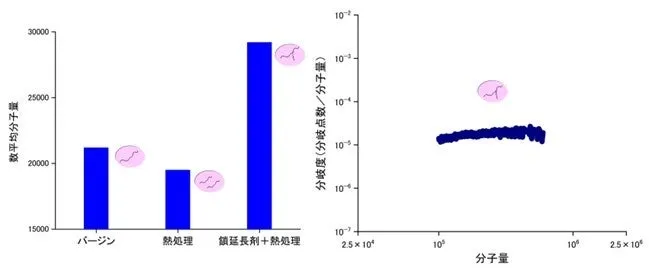
The properties of plastics are significantly influenced by their molecular structure, which includes the length of the molecular chains (molecular weight), the distribution of these weights, and the presence of branching structures. For instance, a drop in molecular weight during recycling can diminish melt viscosity, threatening dimensional stability during molding and reducing mechanical strength and durability. While it is feasible to restore or even augment molecular weight using chain-extending agents, conditions may inadvertently lead to new branching formations, impacting viscosity and product strength. Therefore, accurately evaluating both molecular weight and branching structure is critical for ensuring the quality stability of recycled materials.
Significance of the New Service
The innovative MD-GPC harnesses a combination of detectors that allow for the quantitative assessment of molecular weight distribution and branching degrees. This technology does not rely on standard samples for absolute molecular weight determination, thus enabling a nuanced understanding of how different recycling conditions and thermal histories affect material properties. Furthermore, it allows for a quantitative evaluation of optimal ranges for the addition of chain-extending agents and processing parameters.
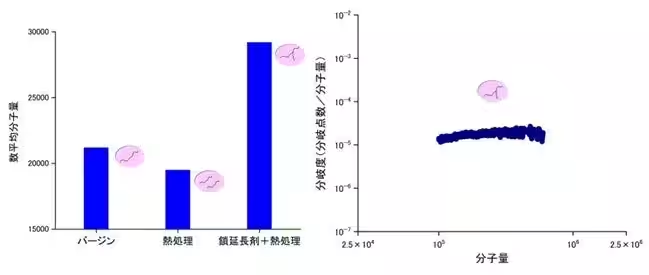
An examination of the effects of thermal treatment and chain-extending agent addition on polyester highlighted notable findings. Thermal treatment was observed to lower the average molecular weight, indicating degradation of the polyester. Conversely, the addition of chain-extending agents confirmed that molecular weights could exceed those of virgin materials. Detailed analysis further revealed a consistent relationship between molecular weight and branching degree, regardless of the molecular weight variations.
Future Prospects
Ultimately, TRC's new service is positioned to contribute to the design of recycled materials, process optimization, and quality stabilization during large-scale production. Potential applications include:
- - Packaging materials and films using recycled raw materials
- - Development of sustainable materials such as fibers and nonwovens
- - Molding materials for automotive and home appliance applications
- - High-value-added materials utilizing biomass and recycled materials
TRC remains committed to its foundational philosophy of contributing to society through advanced technologies. The center will continue to pursue the enhancement of analytical and evaluation techniques, fostering innovation to assist clients in material development and problem-solving while promoting the realization of a sustainable society.
Topics Consumer Products & Retail)







【About Using Articles】
You can freely use the title and article content by linking to the page where the article is posted.
※ Images cannot be used.
【About Links】
Links are free to use.