



Japanese Vocational Students Tackle Challenges in Africa: Highlights from the TICAD9 Open Innovation Challenge
Tackling Africa's Challenges: Insights from the TICAD9 Open Innovation Challenge
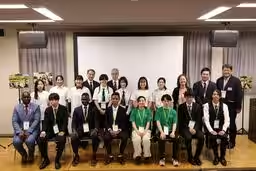
The hybrid event of the 9th Tokyo International Conference on African Development (TICAD9) was held on August 20, 2025, at the JICA Yokohama Center. Co-hosted with Nagaoka University of Technology, the event primarily focused on the "Kosen Open Innovation Challenge" aimed at solving problems in Africa through collaborative efforts between Japanese vocational students and local stakeholders from African nations.
This unique initiative encouraged students to engage in a hackathon where they could provide innovative solutions to specific challenges posed by partners in Africa. The opening remarks were delivered by Mr. Nakamura, a special advisor to the president of JICA, followed by keynote speeches from Japanese political representatives and educational leaders from Madagascar.
One standout feature of the Kosen Open Innovation initiative is that award-winning teams are given opportunities to conduct practical experiments in the field, allowing them to apply their ideas and technologies effectively. Emphasizing the concept of "reverse innovation," the project is designed to ensure that the valuable learnings gained from Africa can be brought back to Japan, enriching both cultures and fostering a constructive dialogue.
The first part of the event featured presentations by students and local partners. Notably, Nagaoka Kosen's team, which was dispatched to Kenya, presented their work on a business model that seeks to alleviate food shortages in Africa through mushroom cultivation, reporting successful experiments using eco-solar cookers. This initiative aims to provide a sustainable food source for local communities.
Meanwhile, Ube Kosen shared insights from their project in Madagascar aimed at reducing malnutrition. They combined rice cultivation and a local sprinkle condiment, which received positive feedback from locals during their testing phase. One local partner, Ms. Tino from Antananarivo Higher Technical Institute, expressed her satisfaction with the reception of the product, noting its potential for future business opportunities.
Kisarazu Kosen presented their approach to tackling environmental pollution caused by locusts, emphasizing the feasibility of using locally available materials for pest control. Their method focuses on reducing costs while achieving sustainable agricultural practices.
Additionally, Hakodate Kosen presented their concept for a "safi box," designed to help Senegalese fishermen maintain fish freshness amid dwindling marine resources. Nagaoka Kosen also discussed their innovative approach to addressing threats posed by climate change to cocoa production, proposing a solution involving biochar made from cacao pods.
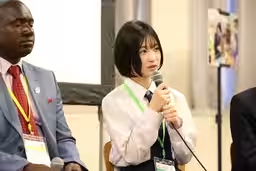
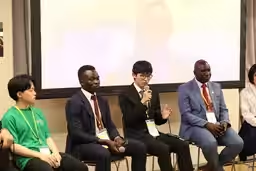
The second session comprised a panel discussion moderated by Deloitte Tohmatsu's Senior Manager, Mr. Sakata. A diverse panel of nine experts shared their experiences regarding the significance of the Kosen Open Innovation platform. Many students spoke about their initial anxieties before embarking on their journeys but were pleasantly surprised by the warm and welcoming nature of the local communities they encountered.
A strong sentiment emerged from the discussion regarding the importance of overcoming unexpected obstacles during field experiments. Local partners acknowledged the dedication of the students, noting that their innovative spirit and eagerness to address local needs and business requirements would lead to fruitful collaborations.
Madagascar's Minister of Technical and Vocational Education, Marie Marceline Rasolofoson, reinforced the importance of fostering opportunities for collaboration between young people from Japan and Madagascar, expressing heartfelt gratitude for the students' efforts.
The event culminated with an emphasis on the potential of this initiative to contribute to global advancements by tackling Africa's challenges. The partnership between the innovative Japanese youth and African counterparts showcases a model for education that prepares the next generation of leaders equipped to engage in problem-solving across borders.
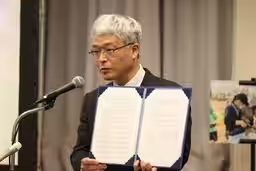
Following the panel discussion, it was announced that a collaborative academic agreement had been established between Nagaoka University of Technology and Kwame Nkrumah University of Science and Technology in Ghana, further solidifying the commitment to international educational exchanges.
Lastly, the Vice President of Nagaoka University of Technology concluded the event by expressing hope that this initiative inspires numerous young individuals to recognize social issues as personal responsibilities, driving them towards creating a better society.
The TICAD9 Open Innovation initiative highlights the invaluable learning experiences it offers to youth, emphasizing collaborative efforts that transcend borders and cultivate innovative solutions for pressing global challenges.

Topics Other)

【About Using Articles】
You can freely use the title and article content by linking to the page where the article is posted.
※ Images cannot be used.
【About Links】
Links are free to use.