




Okayama University Discovers Key to Evolution from Algae to Higher Plants
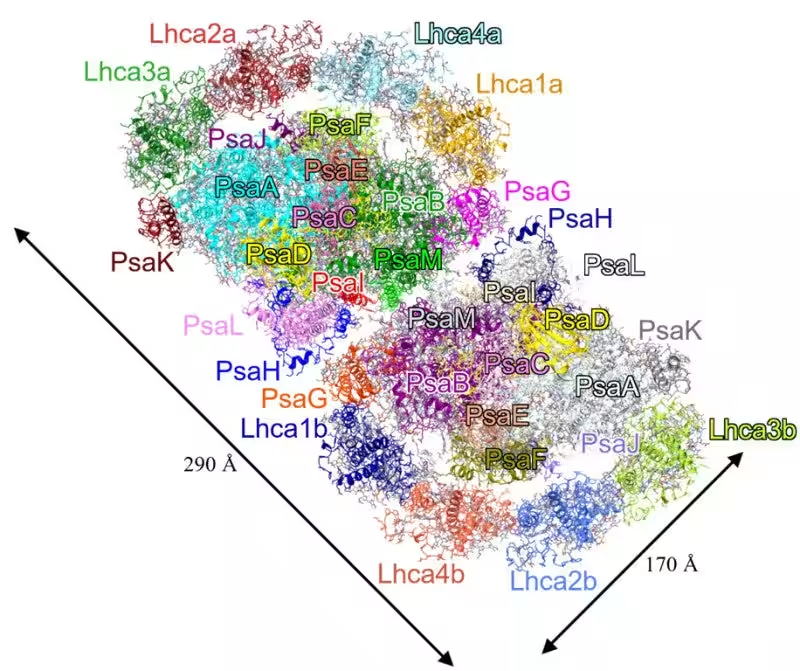
In a groundbreaking study, researchers from Okayama University have made significant strides in understanding the evolutionary leap from algae to higher plants. They isolated both the monomeric and dimeric forms of the photosystem I (PSI) - light-harvesting complex I (LHCI) supercomplex from the model organism Marchantia polymorpha, a type of bryophyte. Utilizing a state-of-the-art 300 kV cryo-electron microscope, they achieved remarkable resolutions of 1.94Å and 2.52Å for the PSI-LHCI monomer and dimer, respectively.
One of the notable findings of this research is that the PSI-LHCI monomer was analyzed with exceedingly high resolution, revealing detailed configurations of internal water molecules and excitation energy transfer pathways within the complex. This level of detail allows researchers to ascertain how energy is handled during photosynthesis, a crucial process for life on Earth. Furthermore, the dimeric structure of the PSI-LHCI complex was determined for the first time in the world, showing a novel mode of assembly not found in previously reported green algae-derived complexes, indicating a direct binding between PSI cores rather than through antenna complexes.
The PSI is a vital component in photosynthesis, responsible for converting light energy into chemical energy in the form of NADPH. Marchantia polymorpha has been recognized as an essential model organism due to its primitive characteristics that provide insights into plant evolution and photosynthetic mechanisms. Until now, the structure of the PSI from land plants was largely understood only in its monomeric form, with other forms remaining obscure.
The research team, including Assistant Professor Pi-Cheng Tsai, Romain La Rocca, Professor Jian-Ren Shen, and others, has highlighted the significance of the identified subunits PsaB, PsaG, PsaH, and PsaM in the formation of the dimer. These findings indicate that the dimeric form of PSI can contribute to higher density and efficiency in the photosynthetic apparatus.
Moreover, despite the differences in structure between the monomer and dimer, the core processes of energy transfer appear consistent, suggesting an evolutionary advantage of the dimeric form’s compactness.
This key discovery was published in an online version of the journal "Communications Biology" on February 5, 2026. The research received funding from various sources including the Japan Society for the Promotion of Science, supporting initiatives aimed at understanding plant photosynthesis and its evolutionary significance.
Assistant Professor Tsai expressed his excitement about the impact of this work, emphasizing his previous research in cancer and microbial studies while underlining the importance of this contribution to photosynthetic enzyme research.
In sum, the revelations about the PSI-LHCI complex not only illuminate the structure of this integral component of photosynthesis in Marchantia polymorpha but also unlock potential insights into the evolutionary transitions of photosystems as terrestrial plants emerged from ancestral algal lineages. This research acts as a stepping stone to further explorations of how these complexes have adapted across different plant groups, significantly contributing to our understanding of botanical evolution and the intricate mechanisms of photosynthesis.





One of the notable findings of this research is that the PSI-LHCI monomer was analyzed with exceedingly high resolution, revealing detailed configurations of internal water molecules and excitation energy transfer pathways within the complex. This level of detail allows researchers to ascertain how energy is handled during photosynthesis, a crucial process for life on Earth. Furthermore, the dimeric structure of the PSI-LHCI complex was determined for the first time in the world, showing a novel mode of assembly not found in previously reported green algae-derived complexes, indicating a direct binding between PSI cores rather than through antenna complexes.
The PSI is a vital component in photosynthesis, responsible for converting light energy into chemical energy in the form of NADPH. Marchantia polymorpha has been recognized as an essential model organism due to its primitive characteristics that provide insights into plant evolution and photosynthetic mechanisms. Until now, the structure of the PSI from land plants was largely understood only in its monomeric form, with other forms remaining obscure.
The research team, including Assistant Professor Pi-Cheng Tsai, Romain La Rocca, Professor Jian-Ren Shen, and others, has highlighted the significance of the identified subunits PsaB, PsaG, PsaH, and PsaM in the formation of the dimer. These findings indicate that the dimeric form of PSI can contribute to higher density and efficiency in the photosynthetic apparatus.
Moreover, despite the differences in structure between the monomer and dimer, the core processes of energy transfer appear consistent, suggesting an evolutionary advantage of the dimeric form’s compactness.
This key discovery was published in an online version of the journal "Communications Biology" on February 5, 2026. The research received funding from various sources including the Japan Society for the Promotion of Science, supporting initiatives aimed at understanding plant photosynthesis and its evolutionary significance.
Assistant Professor Tsai expressed his excitement about the impact of this work, emphasizing his previous research in cancer and microbial studies while underlining the importance of this contribution to photosynthetic enzyme research.
In sum, the revelations about the PSI-LHCI complex not only illuminate the structure of this integral component of photosynthesis in Marchantia polymorpha but also unlock potential insights into the evolutionary transitions of photosystems as terrestrial plants emerged from ancestral algal lineages. This research acts as a stepping stone to further explorations of how these complexes have adapted across different plant groups, significantly contributing to our understanding of botanical evolution and the intricate mechanisms of photosynthesis.
Topics Other)
【About Using Articles】
You can freely use the title and article content by linking to the page where the article is posted.
※ Images cannot be used.
【About Links】
Links are free to use.