



Innovative Changes in the IGAM2 Duck Robot to Streamline Organic Rice Cultivation
Changes in Smart Agriculture with IGAM2 Duck Robot
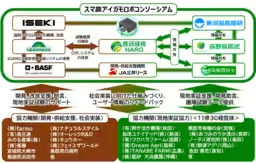
The Smart Agriculture Duck Robot Consortium, led by the National Agriculture and Food Research Organization (NARO), is embarking on a groundbreaking initiative aimed at enhancing and promoting the functionalities of the IGAM2, an automated weed control robot designed for rice paddies. This effort aspires to significantly reduce the time spent on weeding tasks by an impressive 80% and to foster the expansion of organic rice cultivation across Japan.
In a bid to align with the goals established in the 2021 Green Food System Strategy, which aims to increase the area devoted to organic farming to 1 million hectares by 2050, this initiative is paramount. The challenges associated with weeding in organic rice farming have historically posed substantial barriers to this target. Weeding and pest control are labor-intensive processes that often discourage farmers from engaging in organic practices, thereby hindering the growth of organic farming.
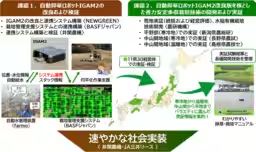
To address these challenges, a more advanced version of the IGAM2 was launched in March 2025, featuring improvements in performance and ease of use. This new iteration is lighter and more cost-effective, making it suitable for small and irregularly shaped rice fields, which are prevalent in hilly regions. However, widespread adoption necessitates further enhancements tailored to various soil types and farming conditions across Japan. Additionally, a comprehensive agricultural technique must be developed to support the implementation of this technology.
The consortium will promote collaborative efforts with 11 prefectures and 30 agricultural businesses to rigorously test the updated IGAM2. The goal is not merely to improve the robot’s functionality but also to integrate it with automated water management systems and cultivation management support systems. By achieving an 80% reduction in weeding time, farmers will find it much easier to engage in organic rice cultivation, thereby promoting the expansion of hectares devoted to this practice.
Furthermore, aligning with the automated water management system is expected to streamline management processes, making organic rice farming more accessible and less labor-intensive.
Objectives and Structure of the Consortium
The

Topics Other)
【About Using Articles】
You can freely use the title and article content by linking to the page where the article is posted.
※ Images cannot be used.
【About Links】
Links are free to use.