



Leisure White Paper 2026 Reports Declining Leisure Engagement Trends
Leisure White Paper 2026 Overview
On July 16, the Japan Productivity Center (JPC) released a preliminary report for the Leisure White Paper 2026, which outlines key trends and statistics regarding leisure activities in 2025. This research is based on a survey conducted online in February, collecting responses from 3,279 individuals aged between 15 and 79 across the nation.
Declining Leisure Time and Expenditure
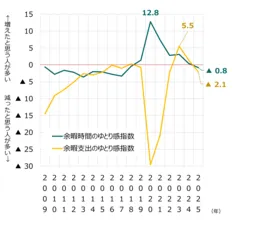
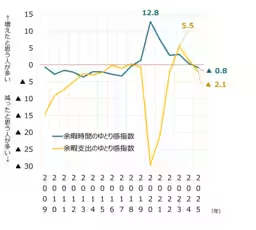
The survey results indicate a concerning trend where both leisure time and leisure spending have decreased compared to 2024. Specifically, the Leisure Comfort Index—a measure of the difference between those who reported increased leisure time and those who reported decreases—showed a negative figure of -0.8 for leisure time and -2.1 for leisure expenditure. More alarmingly, this marks the first decline in leisure time since 2018 and in leisure spending since 2022.
Importance of Leisure vs. Work
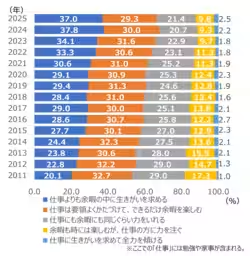
When respondents were asked whether they prioritize work or leisure, those defining themselves as part of the ‘leisure-focused group’ amounted to 66.3%. While this figure is moderately lower than the peak of 67.8% recorded in 2024, it still highlights a significant number of individuals seeking purpose and fulfillment in leisure activities over professional obligations.
Domestic Tourism Dominates Leisure Activities
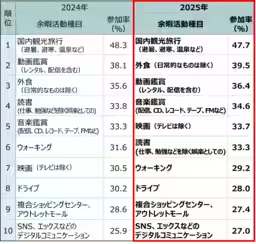
For the fourth consecutive year, domestic tourism emerged as the most popular leisure activity, with a participation rate of 47.7%. Although this reflects a slight decrease from 48.3% in 2024, it further illustrates the ongoing preference for domestic travel among the Japanese populace. Other leisure activities that made the top rankings include dining out, which saw a notable increase, and video viewing, which slipped down the rankings.
Trends in Potential Demand
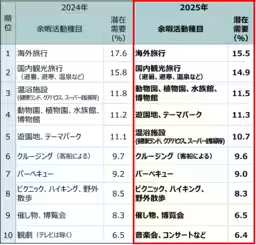
The survey also explored potential demand for various leisure activities, uncovering that both overseas travel and domestic tourism remain at the top of consumer wishes, echoing findings from 2024. However, both categories experienced a decrease in interest compared to the previous year, indicating a potential shift in consumer sentiment.
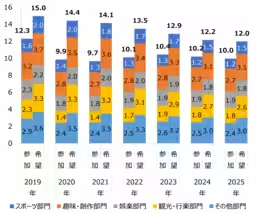
Furthermore, the average number of leisure activities participants engaged in decreased to 10.0, down by 0.2 from 2024. While this figure remains higher than during the pandemic years of 2020 and 2021, it has not returned to the levels seen in 2019, when the average was 12.3 activities.
Conclusion
The Leisure White Paper 2026 aims to reflect important societal trends and challenges affecting leisure activities. As the final report is set for release this October, these preliminary findings urge us to consider the shifting landscape of leisure engagements, emphasizing a need for adaptation amidst declining figures. For detailed insights, individuals are encouraged to refer to the official report and supplementary documents available on the JPC's website.
Topics Consumer Products & Retail)
【About Using Articles】
You can freely use the title and article content by linking to the page where the article is posted.
※ Images cannot be used.
【About Links】
Links are free to use.