



The Future of Physical AI: Challenges and Opportunities for Japan's Manufacturing and Logistics Sectors
The Future of Physical AI: Challenges and Opportunities for Japan's Manufacturing and Logistics Sectors
Physical AI technology is gaining momentum as a pivotal component in how industries perceive, assess, and interact with the physical world. A recent study conducted by Roland Berger, a prominent consulting firm based in Munich, unveils startling findings regarding Japan's progression in the realm of physical AI, particularly in the manufacturing and logistics sectors.
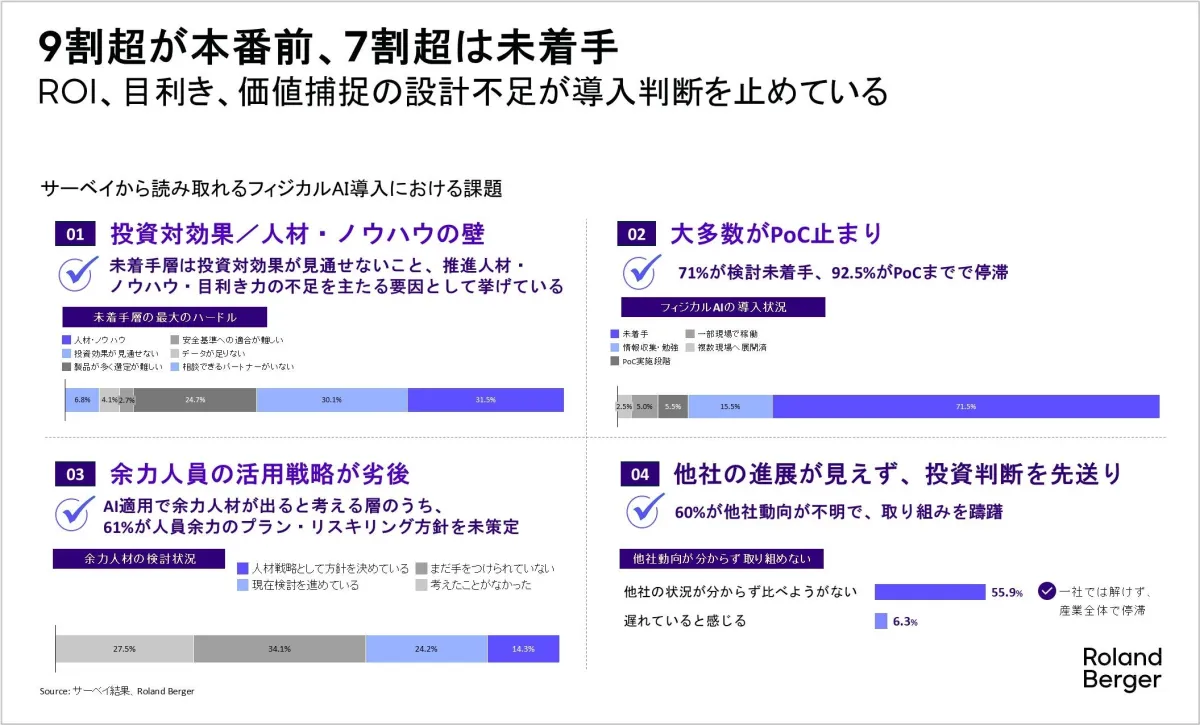
Roland Berger has released a report titled "4 Conditions for Japanese Companies to Avoid Ending Physical AI at PoC," following a survey of 200 CxO executives from the manufacturing, logistics, and infrastructure service sectors. The report points out a glaring statistic: only 7.5% of companies are successfully operating physical AI technologies, indicating that there is significant room for growth.
The global shift towards integrating physical AI into industries is underscored by its potential implications for the economy. Relevant research, including Roland Berger's "Humanoid Robots 2026" report, projects that the market for humanoid robots—a subdomain of physical AI—could reach as much as $4 trillion by 2050. This would place it on par with the automotive industry in terms of market scale. In fact, China is leading this frontier with over 15,000 humanoid robots expected to be produced by 2025, dwarfing other regions like North America and EMEA, thus sparking an international competition for implementation.
As Japan gears up for significant investments in physical AI—anticipated to exceed ¥10.5 trillion by 2040—there is a pressing need to improve the operational effectiveness of this technology. The Roland Berger study highlights that a staggering 71.5% of companies have not even started assessing the integration of physical AI into their work processes. The challenges stand out as a lack of clear ROI, insufficient human resources and expertise, and difficulty in determining the first steps towards implementation. Despite recognizing the importance of physical AI, many companies are struggling to find actionable paths toward its incorporation into their business models.
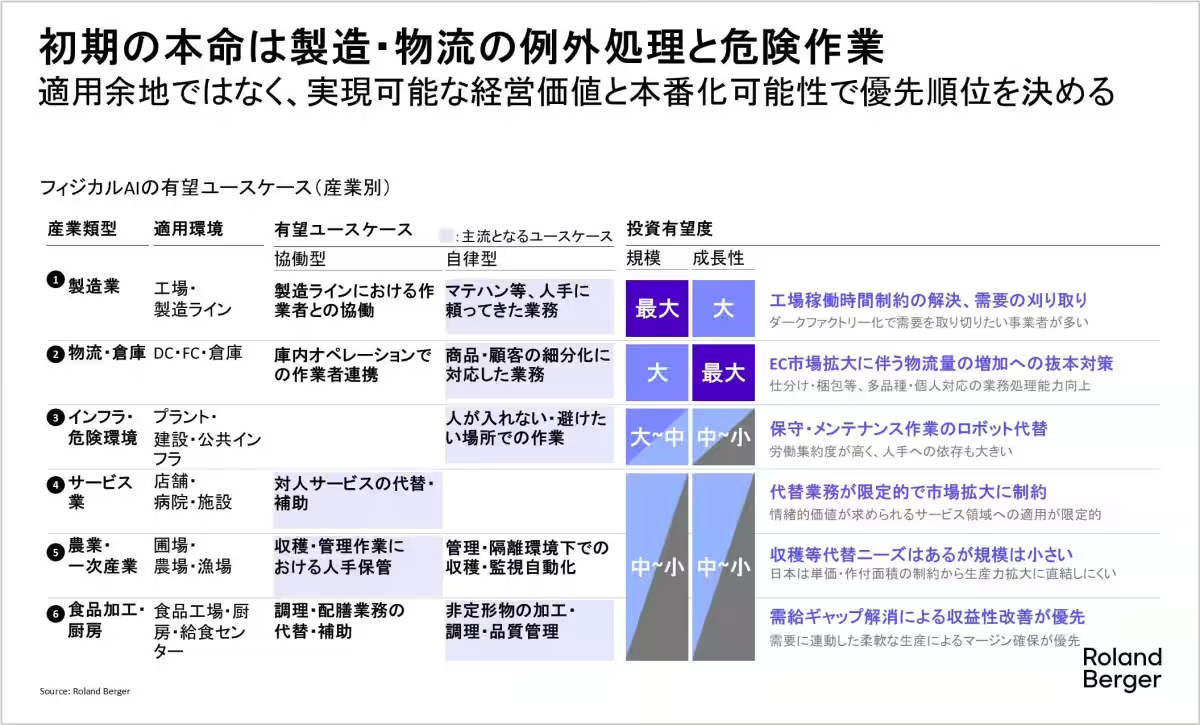
What does this signify for the future? Roland Berger approaches physical AI not merely as a tool for reducing labor costs but as a means to enhance productivity and foster growth. Industries with inherent human dependencies, such as logistics and manufacturing, can particularly benefit from investments in this technology. The report suggests that rather than embarking on grand-scale projects, enterprises should focus on smaller pilot implementations to gather insights and data. This approach can foster collaboration with suitable partners to eventually scale up applications in an efficient manner.
Roland Berger is committed to driving innovation and cutting-edge insights in the AI realm, ensuring that client companies experience tangible outcomes from their investments. The firm has made strategic collaborations, such as investing in new business ventures focused on collaborative AI, to propel these innovations forward.
In early 2026, they partnered with Jonas Andruolis, founder of Aleph Alpha, to co-develop collaborative AI technologies. They also cultivate a vibrant community named Spielfeld, which includes individuals from startups, corporate NGOs, digital innovation facilities, and academic institutions. Over 100,000 participants have engaged in initiatives through this community.
Through collaborative efforts and pioneering research conducted at RB AI Labo, Roland Berger is focused on advancing the technical foundations and architectures of generative AI, equipping industries with necessary knowledge and solutions.
For a more in-depth understanding, readers can explore the complete report, "4 Conditions for Japanese Companies to Avoid Ending Physical AI at PoC," available on Roland Berger's official website.
Survey Overview
- - Survey Duration: July 8-9, 2026
- - Conducting Agency: Rakuten Insight
- - Respondents: 200 CxO executives in the manufacturing/logistics/infrastructure services sectors across Japan
- - Methodology: Online survey with 12 structured questions
About Roland Berger
As the only global consulting firm originating from Europe, Roland Berger has been at the forefront of transformation in partnership with leading companies worldwide. Amid an era of rapid change in the business landscape, we leverage deep industry knowledge and practical capability to spearhead corporate transformation, bolster competitiveness, and enable sustainable growth. Since our founding in 1967, headquartered in Munich, we continue to converge expertise and insights from around the globe, focusing on data, AI, and sustainability to strike new opportunities for growth and value creation. Visit our website | Follow us on LinkedIn | Read our brand story
Their resolve to forge ahead and innovate is evident.
Topics Business Technology)
【About Using Articles】
You can freely use the title and article content by linking to the page where the article is posted.
※ Images cannot be used.
【About Links】
Links are free to use.