


AI-Driven Drug Discovery: New Inhibitors for Cancer-Related Enzyme AKR1B10
Revolutionizing Drug Discovery with AI
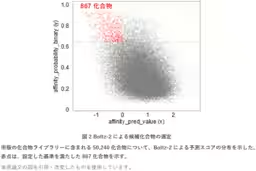
In recent years, the integration of artificial intelligence (AI) into the pharmaceutical industry has opened new avenues for accelerating drug discovery. A collaborative research group has successfully demonstrated a novel process that combines AI predictions with manual screening methods. This approach focuses on identifying efficient inhibitors of the cancer-related enzyme AKR1B10. The AI model, named Boltz-2, proved instrumental in extracting promising candidate compounds from a vast library of over 50,000 compounds.
The Importance of AKR1B10
AKR1B10, or Aldo-Keto Reductase 1B10, plays a significant role in detoxifying reactive carbonyl compounds and is closely linked to various types of cancer. Its abnormal expression is associated with cancer progression and drug resistance, making it a compelling target for developing new cancer therapies. The challenge lies in identifying compounds that not only inhibit AKR1B10 effectively but also exhibit high selectivity—meaning they do not adversely affect similar enzymes, such as AKR1B1.
The Research Process
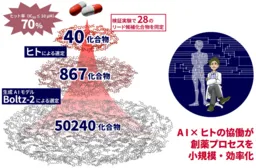
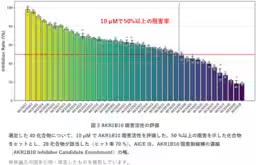
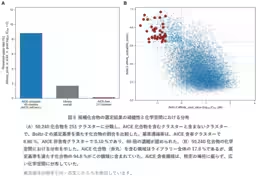
The team, including researchers from the National Institute of Advanced Industrial Science and Technology (AIST) and Gifu University, aimed to mine the 50,240 compounds in their library to discover viable inhibitors of AKR1B10. The combination of AI predictions and human expertise narrows down an initial pool of 867 candidates to 40 promising compounds. Remarkably, out of these, 28 demonstrated significant inhibitory activity, with seven achieving sub-micromolar potency in later validation. This rigorous selection showcases a hit rate of 70%, significantly higher than the standard 1% to 10% rate typically associated with virtual screening based solely on structural similarities.
AI’s Role in Bridging the Gap
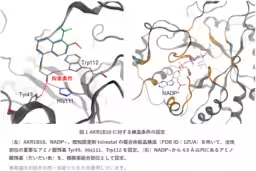
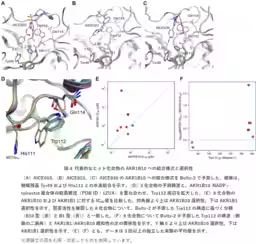
One of the challenges in drug discovery is the "dry-wet gap," which refers to the disconnect between computational predictions (dry) and experimental results (wet). By leveraging Boltz-2's co-folding model, the researchers overcame some limitations typically encountered in traditional screening methods. They introduced constraints based on the enzyme’s functionality, improving prediction accuracy and ensuring that the selected compounds would effectively engage with AKR1B10 without binding to similar structures like AKR1B1. This strategic innovation reduces the need for extensive automated laboratory setups, allowing for a more efficient exploration of potential new inhibitors.
Key Findings and Selectivity
Among the seven highly effective inhibitors, the compounds exhibited remarkable selectivity for AKR1B10 while showing minimal activity against AKR1B1, highlighting the importance of precise molecular interactions in drug design. For instance, the compound AICE017 displayed an impressive ability to inhibit AKR1B10 up to 6.47 times more effectively than AKR1B1, demonstrating the success of the predictive modeling.
Future Directions
The implications of this research are significant. Moving forward, the research team plans to further refine the chemical properties of the identified inhibitors to enhance their efficacy and drug-like characteristics, such as solubility and permeability. They aim to test these candidates in cancer cell lines and animal models, assessing their potential to overcome drug resistance and complement existing treatments. Furthermore, the methodology applied here, combining AI insights with structural constraints, could be utilized in exploring other coenzyme-dependent enzymes, expanding the horizons for drug discovery.
Conclusion
This collaborative effort not only demonstrates the practicality of using AI in drug discovery but also emphasizes the importance of integrating computational predictions with experimental validation. The findings underscore how innovative approaches can lead to the discovery of novel compounds, potentially providing new avenues for cancer treatment. As the field evolves, continued research in this direction may yield powerful tools to combat cancer more effectively and make strides in overcoming the challenges of drug resistance.
References
This study has been documented in the "Journal of Chemical Information and Modeling," published on September 12, 2026, and can be accessed via DOI: https://doi.org/10.1021/acs.jcim.6c00874.
Topics Health)

【About Using Articles】
You can freely use the title and article content by linking to the page where the article is posted.
※ Images cannot be used.
【About Links】
Links are free to use.