


Revolutionary Design Strategy for Tough and Flexible Glassy Polymers Through Ion Crosslinking
A New Design Strategy for Enhancing Glassy Polymers
High-performance polymers, particularly glassy polymers, have long struggled with a critical challenge: balancing hardness and toughness. Traditional methods utilizing ionic bonding often lead to the formation of ionic clusters, which can inadvertently make these materials brittle despite improving their elastic modulus. This article delves into a groundbreaking study performed by the Advanced Chemical Department at Tokyo University of Science, uncovering a novel approach to achieve both strength and resilience in glassy polymers.
Research Overview
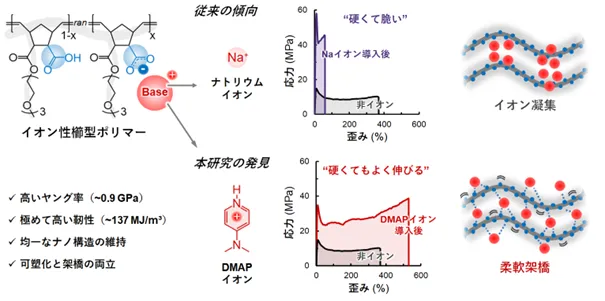
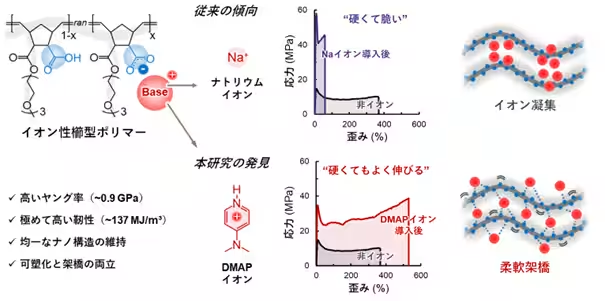
In pioneering work led by Lecturer Daisuke Aoki, graduate students Kotaro Uchiyama and Ryotaro Miyazawa, alongside Professor Koji Arimitsu, the team synthesized an innovative ionic comb-shaped polymer. By neutralizing carboxylic acid groups within the polymer using the bulky organic base 4-Dimethylaminopyridine (DMAP) alongside sodium ions, they managed to significantly suppress nanoscale phase separation. This development resulted in remarkable improvements in toughness—up to approximately 137 MJ/m³—and Young's modulus of around 0.9 GPa. These improvements are striking, with toughness escalating to approximately four times that of the pre-neutralized substances, while both elastic modulus and yield stress doubled.
The implications of this research extend into various applications, particularly within structural materials for transportation and electronics, wherein both hardness and durability are crucial.
Challenges with Traditional Methods
Historically, the journey to enhance the toughness of glassy polymers has been fraught with difficulty. The established idea of achieving toughness through ionic physical crosslinking has found limitations in numerous systems due to the propensity for ionic units to aggregate into nanoscale clusters. This aggregation restricts the mobility of polymer chains, leading to a trade-off between enhanced elasticity and increased brittleness. Furthermore, while some reports have indicated the potential for ionic liquids to strengthen polymers without inducing phase separation, these methods are typically restricted to specific combinations of materials.
The innovative research group at Tokyo University of Science has taken the next step by utilizing a tightly integrated structure of oligoethylene glycol side chains and carboxylic acids within a poly-norbornene framework. Their findings showed that using DMAP in conjunction with sodium ions produced notable improvements in mechanical properties without triggering phase separation, maintaining a homogeneous nanoscale structure throughout.
Detailed Findings of the Research
In their systematic comparison, the study focused on contrasting the mechanical properties and nanoscale structures resulting from using DMAP versus sodium ion neutralization. The tensile test results demonstrated a significant improvement across nearly all ratios of DMAP neutralization, indicating that toughness and elastic modulus could enhance simultaneously—even reaching remarkable values for yields stress and fracture toughness.
The Fourier Transform Infrared (FT-IR) spectroscopy results revealed a complete proton transfer between the carboxylic acid groups and the pyridinium ions, indicating stable ion pairs were maintained even in solid membranes. Contrarily, the scattering experiments disclosed that only the DMAP neutralized samples exhibited a consistent structure without evidence of phase separation, whereas sodium-ion neutralized samples showed distinct scattering peaks indicative of particle aggregation.
Dynamic mechanical analysis further supported these findings, with DMAP causing a notable drop in the glass transition temperature, functioning as a plasticizer, whereas sodium led to higher temperatures that suggested increased rigidity.
Thus, the study introduces a new approach termed 'flexible crosslinking', where a homogeneous distribution of ionic interactions effectively acts as crosslinking points while allowing the molecular chains to retain their mobility, resulting in enhanced toughness and functionality.
Future Directions
This breakthrough suggests that, even without ionic liquids, it is possible to fortify glassy polymers through a combination of bulky side chains and organic bases. The straightforward manipulation of counterion types and side chain designs allows for potential widespread applications in existing polymer compositions containing carboxylic acids or polyelectrolytes.
The research group is now set to quantitatively examine this exquisite ionic crosslinking from the perspective of viscoelastic relaxation and explore a broader range of counterions and backbone structures, which could lead to significant advancements in the development of structural materials and electronics that require both hardness and durability.
Conclusion
This innovative exploration marks a significant step forward in polymer science, opening new pathways for the creation of robust materials relevant to various industries. As researchers continue to refine these methodologies, the potential applications in critical technologies hint at a promising future for strong, yet flexible, materials.
Topics Consumer Products & Retail)







【About Using Articles】
You can freely use the title and article content by linking to the page where the article is posted.
※ Images cannot be used.
【About Links】
Links are free to use.