



Redefining Interfaces for Next-Generation Secondary Batteries: Breakthrough Insights
Redefining Interfaces for Next-Generation Secondary Batteries
A pivotal review paper has been released by researchers at Tokyo University of Science, highlighting the intricate dynamics of interface layers in lithium, sodium, and potassium ion batteries. The study systematically compares these batteries, revealing distinct characteristics tied to each ion type which influence formation and degradation mechanisms.
Key Findings
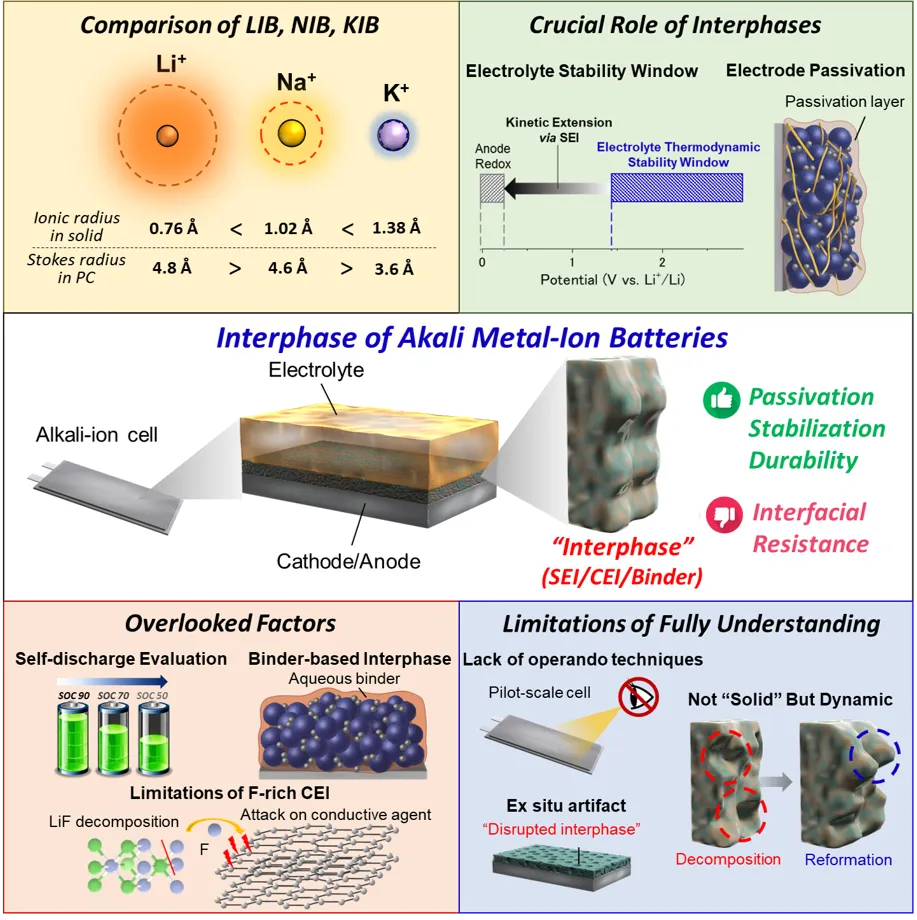
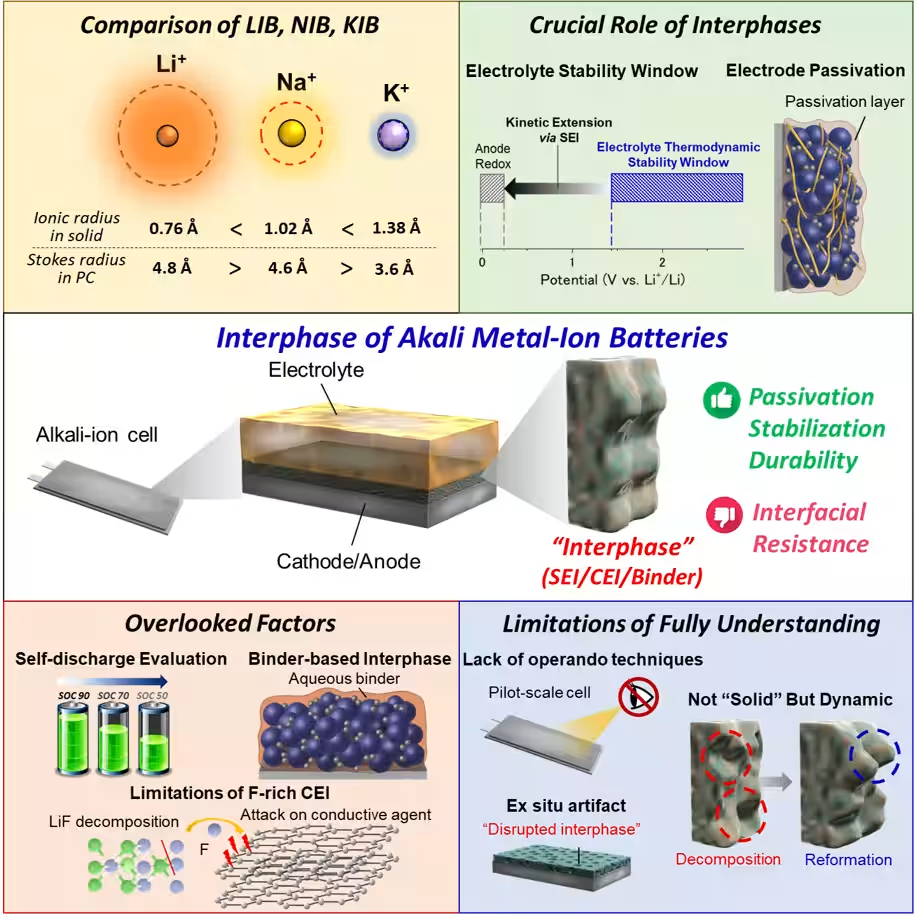
The researchers argue against simply applying established lithium-ion knowledge to sodium and potassium ion batteries, as their unique properties necessitate a more tailored approach. Traditionally regarded as static solid films, the solid electrolyte interphase (SEI) and the cathode electrolyte interphase (CEI) are redefined here as dynamic layers that evolve continuously during battery operation.
The research team, led by Assistant Professor Lee Changhee, has underlined the critical need to address the often-overlooked phenomena at the interfaces in sodium and potassium ion batteries. These batteries, touted as potential successors to lithium-ion batteries, come with unique challenges and opportunities for design improvements due to differences in the chemistries of sodium and potassium versus lithium.
Dynamic Nature of Interface Layers
The review outlines several core conceptual changes:
1. SEI and CEI should be viewed as dynamic and metastable structures rather than fixed solid membranes.
2. The limitations of fluorine-rich CEIs under high voltage conditions pose significant challenges to battery stability.
3. The role of binders in forming and stabilizing interface layers has been underestimated.
4. The understanding of CEI functions and formation mechanisms requires a multi-faceted analysis beyond simplistic solvent-based structures.
5. The relationship between self-discharge behavior and interface stability is crucial but remains largely unexplored.
Through this redefinition, the authors expect to accelerate the practical development and commercialization of next-generation sodium and potassium ion batteries. The emphasis is on creating a comprehensive understanding of interface chemistry conducive to rational design for enhanced stability and performance.
Broader Context and Research Implications
The increasing demand for sustainable energy storage solutions amidst rising lithium prices and resource limitations positions sodium and potassium ion batteries as viable alternatives. Both sodium and potassium are abundant and widely available, offering a more sustainable and cost-effective route to energy storage.
However, the existing gaps in understanding the interfaces in these systems remain a barrier to their industrial viability. By establishing a clearer framework for interface behavior, the research promises to pave the way for significant advancements in battery technology.
The research was supported by multiple funding bodies, including the Ministry of Education, Culture, Sports, Science and Technology, and the Japan Society for the Promotion of Science, among others.
The Future of Battery Research
Moving forward, it is imperative to investigate the degradation phenomena occurring under real charge-discharge conditions systematically. This includes developing techniques capable of assessing interface layers in practical battery formats. The integration of machine learning and data-driven methodologies for a unified exploration of alkali metals’ basic properties and electrochemical behaviors is expected to lead to innovative breakthroughs in battery technology.
Assistant Professor Lee remarked, "Sodium and potassium ion batteries hold promise, yet misconceptions about SEI and CEI layers have stunted their development. This paper provides new definitions that may spur significant advancements in the understanding of interface reactions, essential for breakthroughs in battery technology."
This comprehensive review is now available online in the prestigious journal Advanced Energy Materials as of January 30, 2026, and stands as a pivotal reference for future developments in the field.
Topics Consumer Technology)




【About Using Articles】
You can freely use the title and article content by linking to the page where the article is posted.
※ Images cannot be used.
【About Links】
Links are free to use.