



AI Pioneers the Future of Magnonic Crystals for Quantum Computing
Harnessing AI for Innovations in Magnonic Crystals
Recent advancements at Tokyo University of Science have unveiled a new chapter in the realm of quantum computing and magnetic device structures. A research collaboration led by Dr. Ryunosuke Nagaoka and Professor Masato Kotsugi has successfully employed AI-driven techniques to design magnonic crystal structures that exhibit remarkable properties. This novel approach not only highlights the potential of artificial intelligence in material science but also provides valuable insights into previously uncharted territories of nanomaterials.
Introduction to Magnonic Crystals
Magnonic crystals are engineered materials that allow for the manipulation and control of spin waves, which are essential for next-generation information processing technologies. Much like photonic crystals control light, these materials enable precise control over spin wave propagation. However, achieving desired characteristics in nanostructures has posed significant challenges, primarily due to the complexities associated with minor structural variations affecting spin wave propagation characteristics. Previous research has often relied on conventional methods that did not extensively explore high-order band properties, leaving many questions unresolved regarding optimal designs.
Revolutionary Approach with AI
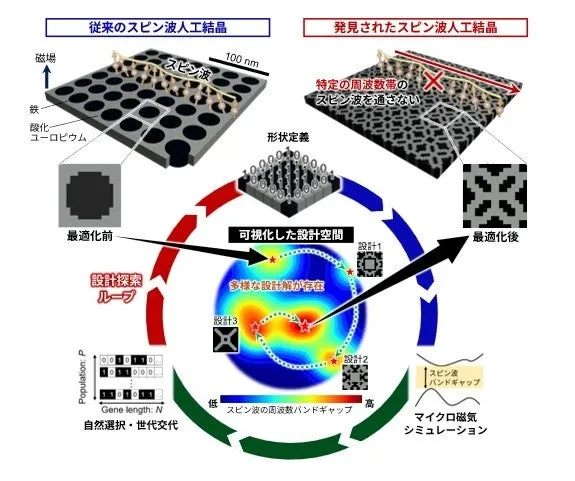
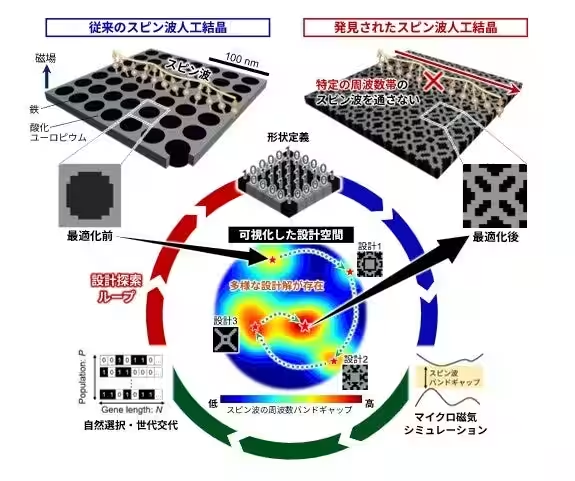
In a groundbreaking study, Dr. Nagaoka and his team utilized a genetic algorithm (GA) in conjunction with frequency-domain micromagnetic simulations to autonomously design structures with significant magnonic band gaps. This innovative combination of techniques enabled the researchers to discover multiple new magnonic crystal structures characterized by non-trivial topologies, specifically combining iron (Fe) and europium oxide (EuO).
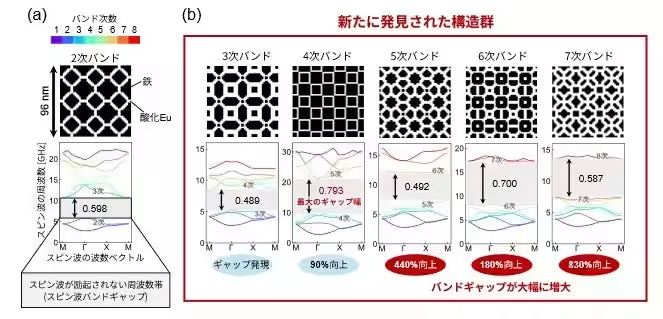
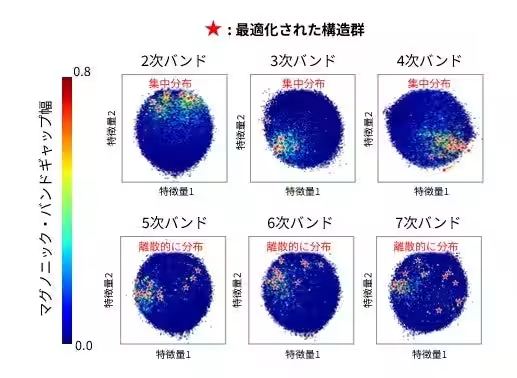
One notable outcome involved verifying a remarkably broad magnonic band gap of up to 8.7 GHz, confirming the potential of these materials. By employing advanced visualization techniques like Fast Fourier Transform (FFT) and Multidimensional Scaling (MDS), the team effectively analyzed and presented their findings, which illustrated how potential advantageous structures are distributed throughout the design space.
Key Findings in Design Space
The study led to the discovery of multiple optimal structures, particularly in higher-order bands (three or more), highlighting that promising structures are not limited to a singular solution in design space. This insight signifies a high degree of flexibility in the design process, suggesting that multiple configurations can achieve desired performance characteristics.
Moreover, the substantial improvements observed—highlighted by enhancements of 90%-830% in magnonic band gaps compared to existing designs—underscore the efficacy of using AI to facilitate complex material design.
Implications for Future Technologies
The implications of these research findings are substantial, positioning this technology as a potential cornerstone for energy-efficient next-generation devices, particularly in AI and quantum computing contexts. Professor Kotsugi noted the research's anticipated contributions to future information processing devices characterized by ultra-low power consumption, paving the way for advancements in smartphones and data centers.
International Recognition
This scholarly work gained international acclaim, being published in the Small Structures journal and honored with the Best Presentation Award at the 2026 Materials Research Society (MRS) Spring Meeting & Exhibit. Such recognition underscores the innovative nature and importance of the research findings, propelling the development of new classes of magnetic devices designed for efficient spin dynamics control.
Conclusion
In conclusion, the integration of AI into the design framework for magnonic crystals not only demonstrates innovative techniques for exploring nanostructures but also inspires future advancements in various technologies that rely on magnetic properties. As this research evolves, it remains a testament to the growing intersection of artificial intelligence and material science, promising significant contributions to quantum technology and energy-efficient electronic solutions.
For further inquiries and collaboration opportunities, please contact Professor Masato Kotsugi at the Tokyo University of Science, who plans to continue exploring the vast potential of this exciting frontier.
Topics Consumer Technology)
【About Using Articles】
You can freely use the title and article content by linking to the page where the article is posted.
※ Images cannot be used.
【About Links】
Links are free to use.