



Discovering 'Blanc de Chine': A Cultural Exchange in Porcelain Heritage
Unveiling the 'Blanc de Chine' Exhibition in Talavera de la Reina
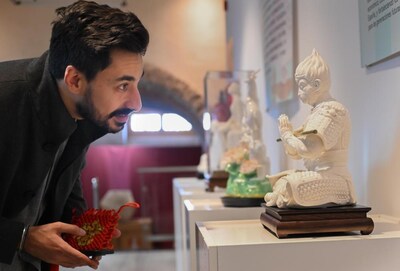
On November 11, 2025, the Spanish city of Talavera de la Reina, steeped in historical ceramic artistry, witnessed the opening of the exhibition entitled 'Blanc de Chine: Dehua Porcelain'. This event marks a significant intersection of East and West, showcasing China’s iconic white porcelain that has captivated art lovers around the globe.
Talavera de la Reina is renowned for its long-standing ceramic tradition, making it an apt venue for an exhibit that bridges burgeoning cultural exchanges between these two esteemed centers of ceramic craftsmanship. The exhibition provides visitors with a unique opportunity to immerse themselves in the artistic heritage and techniques that underscore the beauty of Dehua porcelain, often referred to as 'Blanc de Chine'.
Located in the central Fujian province, Dehua has long been recognized as one of the birthplaces of Chinese ceramic culture. Wu Zhipu, the head of the Dehua county delegation, expressed during the opening that the essence of Dehua porcelain lies in its deep-rooted continuity and the meticulous craft that has been passed down from master to apprentice through generations. He stated, “This long history of quality craftsmanship has solidified Dehua’s position in the global porcelain landscape.”
At the core of this heritage are over 6,000 professional ceramic artists currently defining the landscape of Dehua’s production. One prominent artist, Lian Deli, pushed the boundaries of thin-walled porcelain with his creation titled 'Myth', an exquisite piece measuring only 0.2 millimeters thick. Deli highlighted how technological advancements have opened avenues for traditional craftsmanship, making it possible to create forms that are thinner, lighter, and more translucent than ever before. “Digital tools and precise firing control serve as allies rather than threats,” he noted, emphasizing that the final touch still relies on decades of artisan skill and experience.
Today, Dehua porcelain is celebrated internationally, exported to over 190 countries and regions. With the presence of around 4,500 ceramic businesses operating within the locality, the industry achieved a remarkable output value of 60.2 billion yuan from January to October this year alone. As Dehua expands its international footprint, it has also established the trademark 'Blanc de Chine' in Spain, seeking to leverage this market as a gateway to Europe, Africa, and Latin America.
During the exhibition, discussions between Dehua and Talavera de la Reina laid the groundwork for a twinning partnership aimed at fostering deeper collaboration in cultural exchanges, trade, and ceramic crafts. Wu elaborated on plans for Dehua to establish international promotion centers for Blanc de Chine, inviting Spanish partners to visit China to explore the artistry firsthand. “We aspire for more people across the globe to experience the charm of Dehua porcelain,” he remarked.
Looking forward, Dehua aims to integrate its ceramic legacy with cultural tourism initiatives that offer immersive experiences while inviting global visitors to engage directly with the heritage of what is often celebrated as ‘Chinese white’. Thus, 'Blanc de Chine' serves as not just an exhibition, but a bridge between cultures, a testament to the power of art in connecting diverse histories and people.
As the exhibition continues to run, it stands as a powerful reminder of how the arts can transcend borders, allowing spectators to appreciate the rich tapestry of human creativity bonded through a shared focus on craftsmanship and innovation.
Topics Entertainment & Media)
【About Using Articles】
You can freely use the title and article content by linking to the page where the article is posted.
※ Images cannot be used.
【About Links】
Links are free to use.