



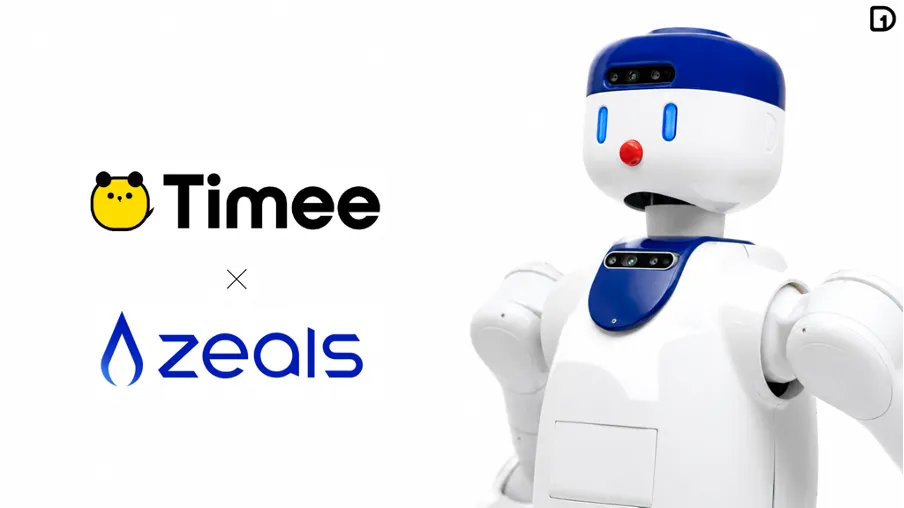
Creating New Job Opportunities in the Age of Physical AI: ZEALS Partners with Timee
Partnership for Innovation in Physical AI
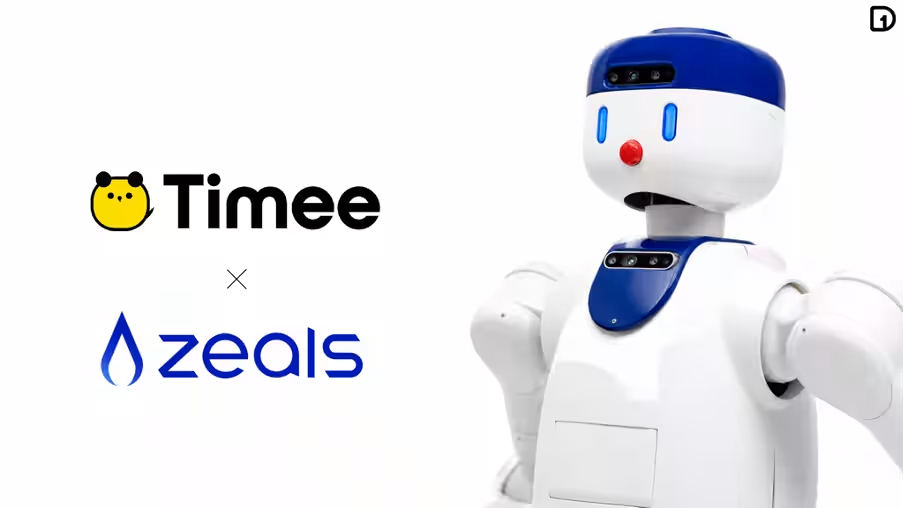
ZEALS, a company based in Meguro, Tokyo, known for developing the compact humanoid robot 'D1', has announced a new partnership with Timee, a short-term job service provider, based in Minato, Tokyo. This collaboration aims to create a new category of jobs called 'Data Collection Spot Work', which is essential for the advancement of Physical AI.
What is Data Collection Spot Work?
Data Collection Spot Work involves gathering and organizing real-world data beneficial for the learning and improvement of Physical AI systems. In this context, it is important to clearly define the scope of information to be gathered and its purpose, while ensuring safety, quality control, and privacy considerations.
By leveraging ZEALS's expertise in humanoid development and Timee's extensive knowledge in connecting diverse workplaces with workers, this partnership endeavors to explore new avenues for work that support the evolution of Physical AI.
Background of the Partnership
In recent years, the rapid evolution of generative AI has transformed how we utilize AI in digital domains such as text, images, and voice. However, for Physical AI—robots and humanoids interacting with people, objects, and their environments—data collection must include corporeal information derived from the real world.
Understanding how individuals interact with objects, the order of tasks they perform, and how they make decisions in various situations are insights that cannot be found spontaneously online; they must be collected and organized in real-life settings.
Globally, countries like the United States and China are already establishing businesses dedicated to collecting real-world data to develop Physical AI and robotics. As Japan gears up for the social implementation of Physical AI, there is an increasing need for mechanisms to continuously collect and utilize real-world data.
ZEALS publicly launched its D1 humanoid on August 5, 2026, designed for tasks in indoor environments in Japan. The goal is to produce 100 units in the 2026 fiscal year and achieve a cumulative operational time of 10,000 hours, starting with fields like healthcare and caregiving, before expanding into manufacturing, logistics, and hospitality.
Designing New Opportunities
To ensure the continuous operation of humanoids like D1 in real-world settings, capturing data related to workflow, human movements, judgments, and handling exceptional situations will be crucial. By designing these efforts as a new 'job' that utilizes human flexibility and experience, both companies believe they can balance the development of Physical AI with the creation of new employment opportunities.
Roles of Each Company in the Partnership
ZEALS will leverage its experience in humanoid development and operation to define the data necessary for Physical AI to learn from workplace settings. They will also design requirements for data collection tasks and organize surrounding activities that arise during robot deployment.
On the other hand, Timee will apply its expertise in shaping diverse workplace tasks to create job opportunities, focusing on workforce recruitment, matching, and operational methods specific to the needs of each location.
Key Initiatives Under Consideration
1. Design of Data Collection Spot Work for Physical AI
This involves designing tasks for gathering and organizing data related to procedure, actions, environment, human assistance, and responses to exceptions.
2. Establishing a Safe and Quality-Controlled System
The partnership will clarify the roles of both companies to create a safe environment for spot workers, discussing operational frameworks related to training, safety, and data privacy.
3. Utilizing Spot Workers in Robot Introduction and Operation
Beyond data collection, the partnership will examine how to leverage spot workers in tasks such as setting up, initial operation support, user guidance, and ongoing robot performance assessments.
Future Outlook
ZEALS believes that AI and robots can be more than mere replacements for human tasks; they have the potential to foster new jobs and work styles. As Physical AI expands into active environments, new tasks related to setup, support, quality checks, and feedback could emerge.
By integrating human judgment with the development of Physical AI, ZEALS, through this partnership with Timee, aims to create new job categories that support the essence of collaboration between humans and technology in the Physical AI era.
In the future, the collaboration will explore various operational tasks beyond data collection, including robot support and integration into various sectors.
About the D1 Humanoid
The D1 is a compact humanoid robot developed by ZEALS for indoor usage, aimed at carrying out specific tasks within Japan's unique environments. Utilizing top-notch global technology and components, it offers adaptable conversation, guidance, mobility, multilingual support, and assistance with tasks thanks to its dual-arm functionality.
Officially announced on August 5, 2026, it will be available from 5 million yen per unit. ZEALS aims to produce 100 units within the 2026 fiscal year to support sectors facing labor shortages, such as healthcare, manufacturing, logistics, and hospitality.
For more information on D1, visit D1 Website.
Company Profiles
Timee, Inc.
Founded: August 2017
Location: 35th Floor, Shiodome City Center, 1-5-2 Higashi-Shinbashi, Minato, Tokyo
CEO: Rei Ogawa
Website: Timee Company
ZEALS
Founded: April 1, 2014
Location: 6F Ark Tower, 1-8-1 Shimomeguro, Meguro, Tokyo
CEO: Masahiro Shimizu
Website: ZEALS
Topics Consumer Technology)
【About Using Articles】
You can freely use the title and article content by linking to the page where the article is posted.
※ Images cannot be used.
【About Links】
Links are free to use.