




EY Strategy and Consulting Supports Japan's Maritime Shipping Standardization Initiative
EY Strategy and Consulting's Role in Standardizing Maritime Shipping Pricing in Japan
In March 2026, the Ministry of Land, Infrastructure, Transport and Tourism (MLIT) of Japan published a document outlining standardized principles for the calculation of freight and charter fees in domestic maritime shipping. EY Strategy and Consulting Co., Ltd. (EYSC), based in Chiyoda, Tokyo, provided crucial support in this initiative aiming to improve transparency and fairness in pricing negotiations between shipping companies and shippers.
Background and Challenges in the Industry
Domestic maritime shipping is pivotal, accounting for approximately 40% of Japan’s freight transportation. Its role extends to conveying essential raw materials, such as steel and petroleum products, which are vital for industrial activities. However, many players in this sector are small to medium-sized enterprises, which have struggled with structural challenges. One significant issue is the difficulty in justifying freight and charter fee calculations during negotiations with shippers, leading to an opaque pricing process.
Often, the complexities tied to the provision of shipping services and their associated costs are not clarified, resulting in indistinct price negotiations. This can foster misunderstandings between contractors and clients regarding the nature of the work and the associated costs, perpetuating a cycle of ambiguity in the transaction process.
With additional layers, such as ancillary services of shipping that are not clearly delineated from freight charges, there's a risk that both parties have divergent interpretations of what is included under the pricing umbrella.
Recognizing these multifaceted challenges, the Ministry of Land, Infrastructure, Transport and Tourism is committed to creating an environment where fair shipping fees can be established, which culminated in the development of these standardized pricing principles.
Support Provided by EYSC
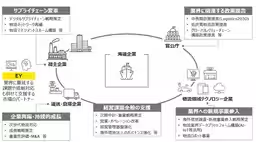
In formulating these principles, EYSC adopted a methodical approach tailored for practical implementation. This involved organizing cost-based pricing frameworks, understanding the realities on the ground, and facilitating consensus-building among stakeholders.
Initially, EYSC referred to standardized contracts from the Japan Shipping Association and prominent companies' transportation terms to clarify the details of the services provided under shipping and charter contracts. They identified cost elements tied to each service and formulated computation methods for freight and charter fees based on these factors.
Subsequent efforts included conducting surveys and interviews with domestic shipping operators to gain insights into actual service provisions and pricing practices. These findings contributed to the preliminary draft of the standardized pricing principles. Discussions amongst a panel of industry experts that included shipping companies and academic scholars, as well as consultations with shippers and discussions at national stabilization and efficiency transport councils, ensured comprehensive input was captured.
The culmination of these processes enabled EYSC to support the finalization of the standard principles effectively.
Looking Ahead
Going forward, the standardized principles are set to be disseminated and utilized, particularly within governmental and industry associations. Successful embedding of these standards relies on the shared understanding and consistent application by both domestic shipping operators and shippers.
Mitsuhiro Shida, Partner of Supply Chain & Operations at EYSC, remarked on the significance of this initiative, emphasizing it reframes domestic maritime shipping as an essential social foundation supporting national industries and livelihoods. By enhancing fairness in transactions, improving crew work conditions, and boosting productivity, it paves the way for a more resilient and inclusive societal and industrial framework.
Shida stated, "Through our contribution, we're dedicated to fostering a better society by supporting ongoing dialogue and collaboration in the domain of maritime and logistics infrastructure."
For more information on the standardized principles for freight and charter fee calculations in domestic maritime shipping, you can visit the Ministry of Land, Infrastructure, Transport and Tourism's website.
About EY
EY is committed to creating new value for its clients, its teams, society, and the planet while establishing trust in the capital markets to build a better working world. Utilizing data, AI, and advanced technology, EY assists clients in confidently shaping their futures, addressing pressing current and future challenges. Serving in assurance, consulting, tax, strategy, and transaction realms, the company's expertise is bolstered by a robust global network, providing services across over 150 countries.
As EY aims to shape the future with confidence, its consulting services strive to transform businesses through the powers of people, technology, and innovation, ultimately creating long-term value for individuals, clients, and society alike.
For further details about EY's consulting services, please visit ey.com.

Topics Other)






【About Using Articles】
You can freely use the title and article content by linking to the page where the article is posted.
※ Images cannot be used.
【About Links】
Links are free to use.