



Exploring Clinical Organizational Science and Its Frameworks for Effective Feedback
Understanding Clinical Organizational Science and Its Practical Implications
In recent discussions surrounding organizational dynamics, the concept of Clinical Organizational Science (COS) has gained notable attention. COS is not merely a collection of theoretical ideas; rather, it serves as a comprehensive framework that integrates complex systems science, neuroscience, organizational psychology, and behavioral science to foster an environment where organizations can actively reproduce stable interaction structures.
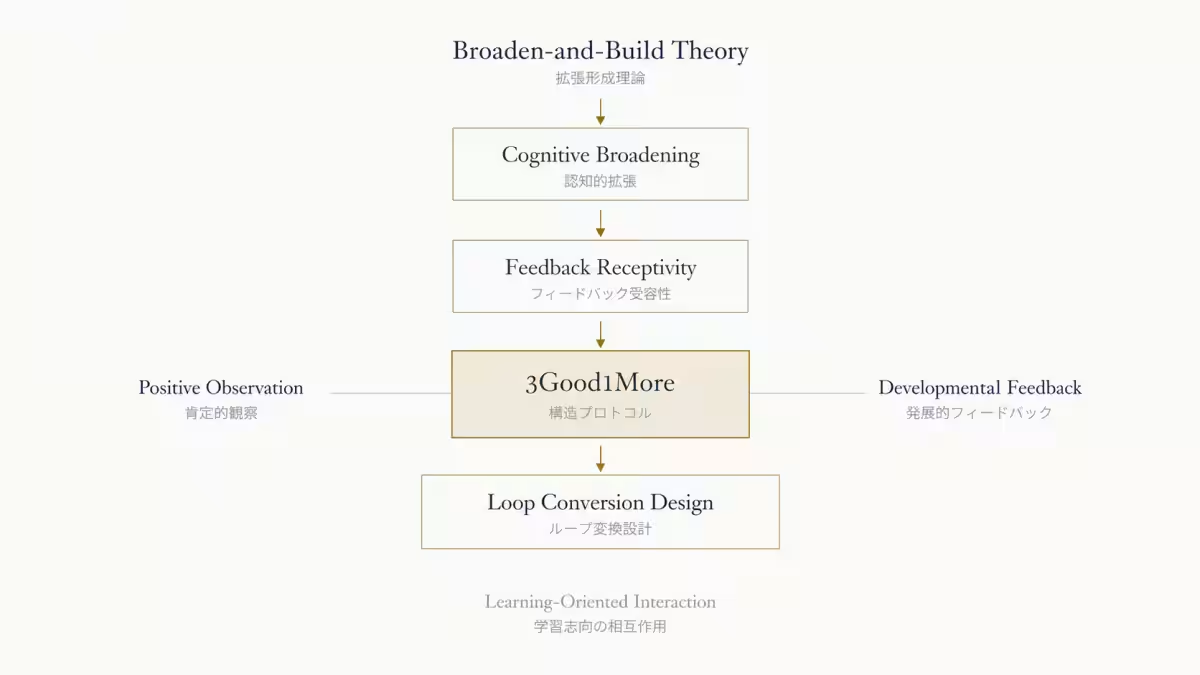
At the forefront of this discourse is the framework known as 3Good1More, a method proposed by DroR, a research firm based in Shibuya, Tokyo, led by CEO Makoto Yamanaka. This framework has been positioned not as a technique for mere praise but as a structured protocol that supports cognitive expansion and feedback responsiveness. By systematically placing three positive observations (Good) before one constructive observation (More), the intention is to create conditions that encourage an open mindset, rather than simply expressing commendation.
Fredrickson's Broaden-and-Build Theory
The foundation of the 3Good1More framework draws on Barbara Fredrickson's Broaden-and-Build theory. This theory posits that positive emotions can elevate individuals' cognitive and behavioral repertoires, leading to the development of long-term psychological and social resources. COS leverages this theory to enhance the feedback mechanism within organizations, suggesting that when positive observations precede developmental feedback, such feedback is processed as learning information rather than threats.
DroR's latest research highlights how this relationship, which supports the 3Good1More approach, addresses the patterns of organizational communication and the often-critical predispositions present in feedback exchanges. By establishing a structured sequence where positive observations lead, individuals are more likely to engage in constructive discussions.
The Mechanism of 3Good1More and Its Importance
Within the 3Good1More framework, the formulation is delicate and purposeful. The aim is not to rely on a mere positivity ratio; rather, the framework considers 3 as a practical initial value that facilitates expansive cognitive engagement without overwhelming individuals. Research shows that having too few or too many positive observations can skew the effectiveness of feedback; thus, three emerges as an optimal default for creating a conducive environment for development.
Moreover, the emergence bridge concept proposed by COS connects individual behavioral change to organizational evolution, underscoring how micro-level actions can influence broader structural shifts within organizations. By embedding this practice into organizational rhythms such as weekly reviews, retrospectives, and team feedback sessions, COS aims to minimize individual biases in communication and instead focus on collective interaction structures.
Organizational Rhythm and Embedded Practices
It's crucial to note that 3Good1More is not merely an esoteric conversational tool; it’s positioned as an integral part of an organization's operational rhythm. Whether during project reflections or one-on-one meetings, this structured approach allows organizations to implement feedback mechanisms that do not overly depend on individual moods or abilities. The idea is to shift the focus towards a resilient organizational structure where feedback is treated as a continuous learning opportunity.
CEO Makoto Yamanaka emphasizes that while addressing problems and providing constructive criticism is necessary, structuring positive observations beforehand cultivates an environment where such feedback is productive and development-oriented. The 3Good1More approach is about nurturing a culture of learning while still maintaining openness to necessary critique.
The Way Forward: A Call for Future Research
This framework is presented as a conceptual analysis rather than a conclusive statement on proven effectiveness. The aim is to challenge existing disconnected scientific knowledge by integrating it into a structured intervention framework for organizational transformation. COS is not about replacing existing theories but repositioning them with a focus on psychological safety and adaptive complexity.
As we advance in this exploration of Clinical Organizational Science, more insights will emerge. On June 4th, DroR will release further analysis connecting COS with Nonaka's SECI model, exploring how tacit knowledge integrates into organizational transformation.
In summary, COS and the 3Good1More framework are poised to reshape how organizations perceive and implement feedback mechanisms. As new research is conducted and the frameworks are tested, they hold the potential to redefine organizational learning pathways significantly.
Topics Business Technology)
【About Using Articles】
You can freely use the title and article content by linking to the page where the article is posted.
※ Images cannot be used.
【About Links】
Links are free to use.