



Discovering a New Butyrate-Producing Bacterium in the Gut of Rainbow Trout: A Breakthrough for Aquaculture
A New Era for Fish Intestinal Health
In a remarkable scientific achievement, a team led by Mio Takeuchi, a senior researcher at the National Institute of Advanced Industrial Science and Technology (AIST), has identified a novel butyrate-producing bacterium from the gut of the rainbow trout. This discovery opens new avenues for enhancing aquaculture practices and fish health.
The Context of the Discovery
The global aquaculture industry has been witnessing rapid growth, with a notable increase in land-based fish farming in Japan. Rainbow trout, in particular, has seen a surge in demand, especially for sushi-grade products. However, this industry faces several challenges, including the depletion of fish meal, a primary feed component, and disease outbreaks among fish populations. As a solution, research into “gut health” technologies is on the rise, focusing on enhancing fish health and growth through beneficial gut bacteria.
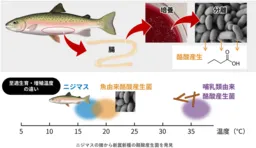
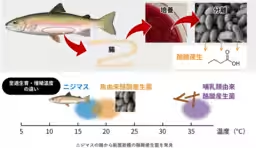
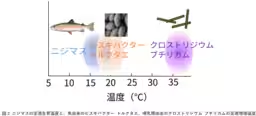
While butyrate-producing bacteria have been recognized for their health benefits in humans, using mammalian-derived strains in aquaculture has proven challenging due to temperature incompatibilities. The newly discovered bacterium from the intestines of rainbow trout is expected to provide a sustainable alternative.
Research Background
The research conducted by AIST's Molecular Biosystems Research Center previously investigated microbial-derived biomarkers for disease detection in fish. With a particular focus on the microbiome of the rainbow trout, the research team compiled literature data and utilized advanced sequencing technologies to identify key microbial genera present in the fish's gut.
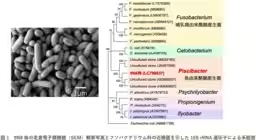
Through gene sequencing, researchers found a strain of bacteria closely related to Fusobacterium that had not been classified previously. This led to extensive efforts to cultivate and analyze gut bacteria from the rainbow trout.
Discovering the New Bacterium
The researchers obtained rainbow trout from the Seki Lake Trout Farm in Shiga Prefecture and isolated the gut mucosa to culture the bacteria. By applying various growth conditions, they successfully recovered numerous gut bacteria. The analysis of these isolates revealed a previously unidentified bacterium, referred to as
Piscibacter tructae. This anaerobic bacterium was capable of producing short-chain fatty acids such as butyrate and acetate, which are vital for a healthy gut microbiome.
Genomic analysis confirmed that Piscibacter tructae possesses unique butyrate-producing genes, particularly those involved in the lysine pathway. The optimal growth temperature for this strain was found to be around 20 degrees Celsius, aligning closely with the rainbow trout’s preferred growing conditions.
Implications for Aquaculture
This breakthrough promises to revolutionize aquaculture practices. By using fish-derived butyrate-producing bacteria, aquaculturists can enhance gut health, potentially improving growth rates and disease resistance in fish. Given that traditional mammalian-derived probiotics often fail to colonize effectively in cold-water fish, the identification of a fish-specific bacterium is a significant advancement in sustainable aquaculture.
The outcomes of this research are expected to not only boost the production of rainbow trout but also impact the farming of other fish species, including farmed salmon.
Future Research Directions
Although anaerobic bacteria in fish guts had not received significant attention previously, this study highlights their potential importance in fish health and growth. Future research will focus on relationship-building experiments to explore how butyrate-producing bacteria influence the overall health of fish. Additionally, incorporating Piscibacter tructae as a new probiotic in aquaculture could enhance fish health and reduce reliance on antibiotics.
Publication Information
The study titled, "Piscibacter tructae gen. nov., sp. nov., an anaerobic butyrate producing Fusobacteriaceae bacterium isolated from gut of rainbow trout," will be published in the International Journal of Systematic and Evolutionary Microbiology on August 6, 2025.
This advancement is funded by the Urakami Foods and Food Culture Promotion Foundation, emphasizing the importance of collaborative efforts in scientific research.
In conclusion, the identification of this novel bacterium signifies a critical step towards improving gut health in fish, offering solutions to pressing challenges faced by the aquaculture sector today.
- ---
Topics Other)
【About Using Articles】
You can freely use the title and article content by linking to the page where the article is posted.
※ Images cannot be used.
【About Links】
Links are free to use.