




Novel Light Control through Twisted Orientation of Thin Crystal Structures Redefines Optical Technology
Innovative Light Manipulation with Nanometer-Thin Crystals
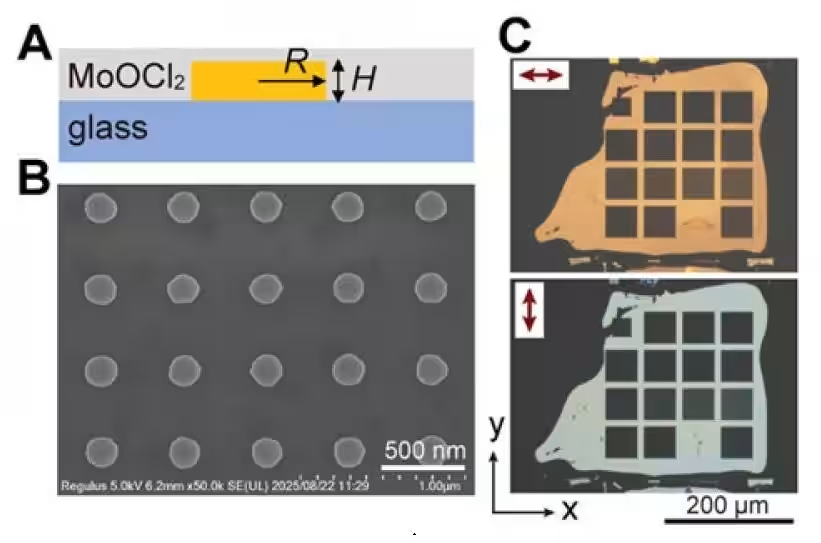
Recent research conducted by a collaborative team from Okayama University and Hokkaido University has revealed a significant advancement in the manipulation of light through incredibly thin crystal structures, specifically focusing on a nanometer-thick 2D crystal known as MoOCl2 (dichlorooxomolybdenum (IV)). This innovative research showcases how the orientation and twisting of such crystals can be instrumental in controlling light behaviors, leading to promising applications in optical technology.
Key Findings
The team demonstrated that with circular nanostructures, it is possible to drastically control both the wavelength and intensity of resonant light by altering the vibration direction of the light itself. This discovery is particularly noteworthy as it uncovers the potential for harnessing the unique properties of thin MoOCl2 crystals, rather than relying on traditional metallic structures like gold and silver, which have historically been the primary materials used for nanostructures.
By configuring the MoOCl2 crystalline layers at different angles, or twisting them, researchers confirmed the emergence of extraordinary circular dichroism (CD) within circular nanostructures. This characteristic is defined as the differential response of materials to right and left-handed circularly polarized light, a quality that can open new doors for high-sensitivity sensors capable of distinguishing overlapping molecular shapes when viewed through mirrors.
The Research Team
The notable work was led by Professor Hiroaki Misawa, a special appointment at Okayama University, alongside Dr. Yaolong Li and Professor Yasutaka Matsuo of Hokkaido University's Electronic Science Research Institute, as well as Professor Qihuang Gong from Peking University's Department of Physics. Their collaborative efforts exemplify the synergy between advanced nanofabrication technologies and international research capabilities.
Applications and Future Directions
The implications of this research are far-reaching. The advancements in optical technology, facilitated by manipulation of light through these new crystal arrangements, could revolutionize sectors relying on high-precision optical components. From cutting-edge sensor technologies capable of distinguishing molecular forms, to potentially groundbreaking applications in telecommunications and beyond, the future of light manipulation appears incredibly promising.
Furthermore, the foundational research aligns with global efforts toward sustainable innovation, as it contributes to the development of environmentally friendly and efficient materials in optics. As light control technology evolves, the potential to incorporate such innovations in various practical applications continues to expand.
Publication Details
This significant research was published on February 24, 2026, in the reputable scientific journal 'Nature Communications' and is available online as an Article in Press (a preliminary version that has been peer-reviewed and accepted).
For those seeking to explore the comprehensive research findings, more information can be found at Okayama University's official press release.
Conclusion
The newly discovered techniques for manipulating light using nanometer-thin crystals not only promise to advance existing optical technologies but also highlight the value of interdisciplinary collaboration in scientific research. As we delve further into the capabilities of materials like MoOCl2, the scientific community and industries alike stand to benefit tremendously, potentially leading to groundbreaking innovations in multiple fields.






Topics Consumer Technology)
【About Using Articles】
You can freely use the title and article content by linking to the page where the article is posted.
※ Images cannot be used.
【About Links】
Links are free to use.