




New Quantum Gate Proposal Links Light and Atoms to Reduce Errors in Quantum Computing
A Breakthrough in Quantum Computing
The realm of quantum computing is on the verge of a significant breakthrough thanks to a theoretical proposal by a collaborative research team from Waseda University and leading institutions in Singapore. This groundbreaking innovation introduces a novel quantum gate that effectively links light and atoms, streamlining quantum calculations while simultaneously reducing error rates.
The Significance of Quantum Gates
Quantum gates are pivotal in the area of quantum information processing. One of the most critical among them is the controlled displacement gate, which has struggled with the challenge of efficiently uniting the unique properties of light and atoms. Traditionally, the implementation of this gate required multiple reflections of light within a resonator, leading to undesirable losses and cumulative errors in calculations.
Key researchers including Shingo Kikura, a graduate student at Waseda University, and Professor Takao Aoki, alongside Hayato Goto from RIKEN's Quantum Computing Research Center and Dr. Fumiya Hanamura from the National University of Singapore, have proposed a new approach that only requires a single reflection of light in a resonator. This innovative methodology not only speeds up the quantum calculation process but also minimizes the inaccuracies typically associated with conventional methods.
The Mechanism of the New Gate
This novel approach proposes a 'single-shot' method for implementing the controlled displacement gate. By precisely controlling an atom within the resonator through laser mechanisms, the state of the light pulse is altered in accordance with the quantum bit state of the atom. This means that a complex series of reflections is no longer necessary; a single reflection suffices to execute the controlled displacement gate.
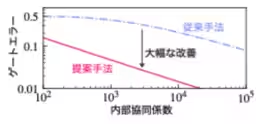
To further validate the method, the authors developed a detailed analytical model that incorporates real-world factors such as light loss and natural atomic decay. This model facilitates the evaluation and optimization of the proposed technique, demonstrating considerable improvements in gate fidelity compared to existing approaches. Detailed simulations indicated that the new method shows significant reductions in gate errors—critical in ensuring higher performance and reliability in quantum information systems.
Implications for Future Research
The implications of this research are profound. Light and atoms are both recognized as significant quantum systems, and the unification of these systems could yield groundbreaking advancements in quantum computing and communication. The introduction of a fast, low-error quantum gate is expected to stimulate experimental validations and applied research across various global research groups, further accelerating the development of hybrid quantum systems.
With this innovative research, not only has a new quantum gate method been proposed, but researchers have also reinforced the importance of high cooperative coefficients in achieving reliable quantum operations. This fosters further research into high-cooperative resonator systems and contributes to the societal implementation of quantum information technologies, including those employing atomic memories and light as communication media.
Expert Opinions
In the words of Shingo Kikura: "By harnessing the unique properties of disparate physical systems such as light and atoms, we're on the path to faster and more secure information processing capabilities. The 'single-shot controlled displacement gate' may very well act as a linchpin in realizing this vision. We aspire for our findings to make a meaningful impact in the advancement of quantum technologies in society."
Conclusion
In summary, the research team’s pioneering work in quantum gates represents a promising leap toward a more reliable and efficient future in quantum computing. The proposed methodologies set the groundwork for further exploration and experimentation, holding promise for industry-wide applications in quantum information processing, communication networks, and beyond.
Research Publication Details
This significant research was published on May 12, 2026, in the esteemed journal Physical Review Letters, affirming its relevance and potential impact on future scientific advancements. The full paper can be accessed here.

Topics Consumer Technology)
【About Using Articles】
You can freely use the title and article content by linking to the page where the article is posted.
※ Images cannot be used.
【About Links】
Links are free to use.