




The Discovery of Ornithopod Dinosaur Fossils in Kuji City: A Key to Evolutionary History
Discovering Ornithopod Dinosaur Fossils in Kuji City
In a groundbreaking development for paleontology, researchers have recently uncovered ornithopod dinosaur fossils from Kuji City, Iwate Prefecture, Japan. This discovery not only enriches the local fossil record but also plays a pivotal role in elucidating the evolutionary history of these ancient creatures.
The Kuji Amber Museum, known for its amber excavation experiences, has also become a crucial site for vertebrate fossils, including over 3,700 specimens from more than 30 species, dating back approximately 90 million years to the Late Cretaceous period. These findings have made the region an important focus for understanding the biodiversity of dinosaurs during this era in Japan.
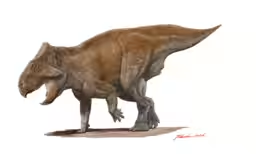
In recent studies, fossils belonging to both ceratopsians and iguanodontians—two major groups of ornithopod dinosaurs—were identified for the first time from this locality. The significance of these findings cannot be overstated as they provide fresh insights into the diverse range of ornithopods that roamed Japan during the Late Cretaceous.
Historically, Kuji City has yielded a rich array of diverse plant and animal fossils, recognizing it as a vital fossil site for understanding the Late Cretaceous fauna of East Asia. Numerous specimens, including sauropod and theropod dinosaur teeth, have helped illuminate the variety of dinosaur species that existed in the region and have contributed substantially to recent scientific efforts to uncover the complexity of the ecosystem.
Location of Fossil Discovery
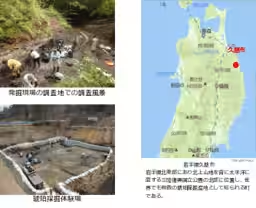
The fossils were discovered in small excavations managed by the Kuji Amber Museum, located in the Komokuzumachi area of Kuji City. This site lies just south of the bone bed where ongoing excavations in collaboration with Waseda University have been taking place. Since 2012, these studies have continued to uncover significant fossil specimens from the Kuji formation—dating back about 90 million years—and are heralded as one of the richest vertebrate fossil sites in East Asia.
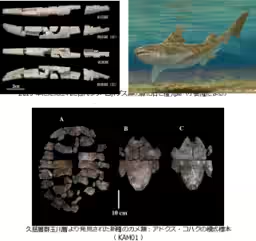
As of August 2025, paleontologists have recovered a staggering 3,500 vertebrate fossils across a wide range of species, including not only dinosaurs but turtles, crocodiles, and other aquatic reptiles. Notably, a near-complete turtle shell from a new species was reported in 2008, underscoring the area's diversity.
Contributions to the Evolutionary History of Ornithopods
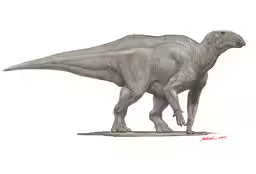
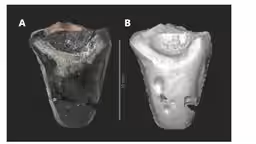
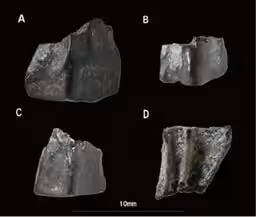
The ornithopod fossils in question consist of teeth categorized under the two groups—ceratopsians and iguanodontians. These fossils are crucial as they mark the first report of such species from Kuji. The evolutionary history of the ceratopsians has often been documented from regions like Hyogo, Fukuoka, and Kagoshima, but this is noted as the first record from Eastern Japan. In contrast, the iguanodontian fossils represent the 18th documented instance in Japan, marking a milestone for Iwate Prefecture.
The discovery of these ornithopod fossils sheds light on the previously understood fauna of Kuji in the Late Cretaceous, revealing a far greater diversity than previously recognized. The time period when the Kuji formation was deposited marked a significant era for the diversification of ornithopods, and this report significantly contributes to exploring the evolutionary pathways of each group.
Future Prospects
With only dental specimens available at the moment, paleontology in Kuji has exciting prospects for future excavations. As more bones such as jawbones and vertebrae from iguanodontians and ceratopsians are discovered, researchers will be able to trace finer taxonomic relationships and make comparative studies with ornithopods from the same era in Asia. This possibility opens new dialogues about ecosystem dynamics and migration between continents during the Cretaceous epoch.
The rich fossil record preserved in the Kuji formation awaits further exploration, which promises continued advancements in understanding the evolutionary history of dinosaurs in Japan and potentially worldwide.
In summary, the findings of ornithopod dinosaur teeth from the Late Cretaceous of Kuji City represent a significant addition to our knowledge of these ancient animals, showcasing the critical role of this region in paleontological research.



Topics Entertainment & Media)
【About Using Articles】
You can freely use the title and article content by linking to the page where the article is posted.
※ Images cannot be used.
【About Links】
Links are free to use.