



Tokyo-Based Startup Gel Coat Biomaterials Secures 200 Million Yen in Series A Funding
Gel Coat Biomaterials: Leading Innovation in Bio-Manufacturing
In a significant move for bio-manufacturing, Gel Coat Biomaterials (GCB), a startup emerging from the University of Tokyo, has successfully secured 200 million yen in its Series A funding round. This investment was made possible by Waseda University Ventures and Soken Chemical & Engineering Co., Ltd., both of which participated through a third-party allocation of shares. GCB, led by CEO Shin Yoshida, is also planning an extension round to raise an additional 100 million yen as they move forward.
The importance of biomolecules like enzymes and antibodies cannot be overstated, as they serve critical roles across various industries, including food, chemicals, and pharmaceuticals. However, the inherent instability of these biomolecules poses challenges in terms of temperature control and transport, often leading to increased costs and difficulties in practical applications. To combat these hurdles, GCB has developed a groundbreaking biotechnological platform called "Gel Coat™," based on a unique hydrogel discovered by Professor Madoka Takai from the University of Tokyo. This advanced hydrogel technology is designed to enhance the production efficiency and market expansion of the bioindustry.
GCB has already established stabilization techniques for biomolecules through the interaction analysis of the hydrogel and biomolecules, and it boasts numerous successful implementations. For example, by utilizing the Gel Coat™ technology, fragile enzymes that previously required storage at -30°C can now be stored stably at 4°C for four weeks. Moreover, the technology enables the creation of enzyme reaction environments that can utilize organic solvents, along with the added functionality of anti-fouling properties.
During the Series A phase, GCB aims to reduce the development time to one-tenth of previous efforts and expand its application range beyond enzymes to include antibodies and nucleic acids. Collaborative research with several major companies is already underway, garnering considerable interest from industries both domestically and internationally.
As a direct result of this funding, GCB will enhance the sophistication of its hydrogel technology and strengthen its mass production capabilities. They are also accelerating the practical application of customized Gel Coat™ solutions through collaborative research and development projects with major manufacturers. In addition, GCB is committed to advancing joint research efforts with universities to explore new functions of the hydrogel and to create new technologies associated with Gel Coat™.
Partnership with Soken Chemical
Soken Chemical & Engineering Co., Ltd. actively collaborates with academia and startups to foster innovation, particularly in healthcare, medicine, and energy sectors, aiming to create new business ventures by merging strengths from both sides.
About GCB’s Hydrogel and Gel Coat™ Technology
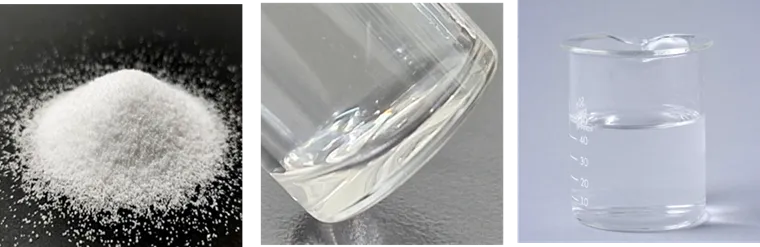
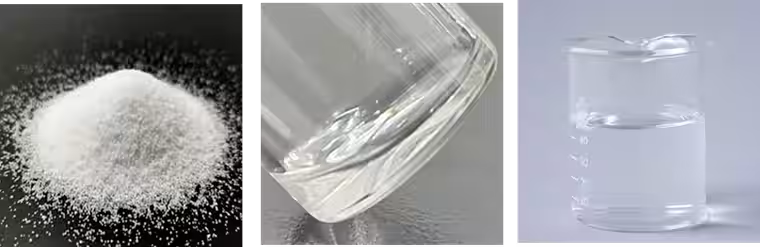
The ameba hydrogel, a groundbreaking material, consists of a single-component zwitterionic polymer that is gelled through physical cross-linking. Gel Coat™, which incorporates this gel, serves as a technology for the stabilization of enzymes and other biomolecules. Notably, this hydrogel transitions from gel particles when dried to a hydrogel in an aqueous solution, thus providing versatile applications.
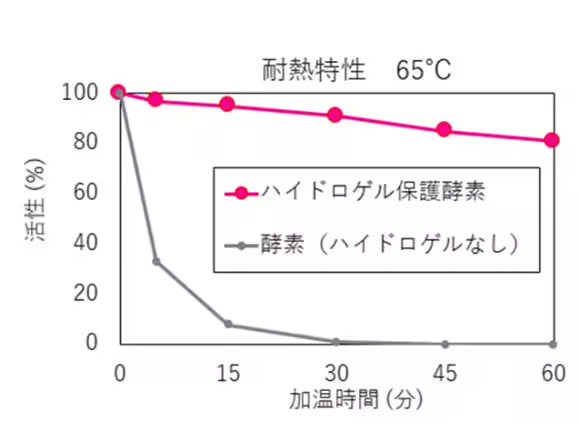
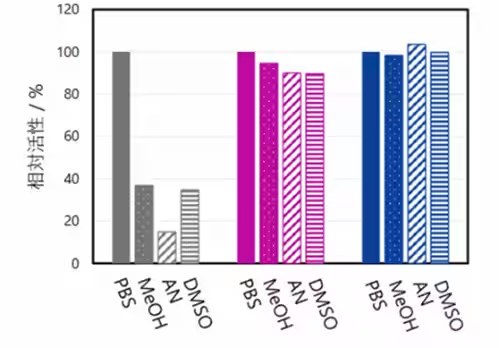
The technique of coating enzymes with the ameba hydrogel using Gel Coat™ ensures high residual activity, even under harsh conditions such as high temperatures (65°C) and organic solvents, as well as during repeated freeze-thaw cycles. The substantial patent portfolio surrounding Gel Coat™ establishes a strong competitive advantage in terms of intellectual property.
Visual Representation
Figures demonstrate the different forms of the ameba hydrogel:
- - Figure 1 displays the appearance of the ameba hydrogel: left shows dried gel particles, the middle shows the hydrated hydrogel, and the right illustrates diluted hydrogel in water.
- - Figure 2 shows the enzyme activity of β-galactosidase protected by the ameba hydrogel at 65°C, highlighting the enhanced activity maintenance compared to its unprotected counterpart.
- - Figure 3 illustrates the enzyme activity under organic solvent conditions, showing significant improvement when protected by the hydrogel compared to no hydrogel.
About Gel Coat Biomaterials
Gel Coat Biomaterials is a startup founded on research from Professor Madoka Takai's laboratory at the University of Tokyo's Graduate School of Engineering, specializing in bioengineering.
About Professor Madoka Takai
Professor Takai is a leading authority in electrochemistry, biointerfaces, and biomaterials. Her research focuses on high-functioning biosensing materials and medical microchips, with significant advances emerging from the development of the ameba hydrogel.
Company Overview
- - Founded: January 16, 2024
- - CEO & Co-founder: Shin Yoshida
- - CTO & Co-founder: Professor Madoka Takai
- - Email: [email protected]
- - Website: gelcoatbio.com
GCB's developments mark a vital step towards advancing the bio-manufacturing landscape, aiming to meet the challenges posed by the instability of biomolecules and driving efficiency in production processes, thus paving the way for broader industrial applications.
Topics Consumer Products & Retail)
【About Using Articles】
You can freely use the title and article content by linking to the page where the article is posted.
※ Images cannot be used.
【About Links】
Links are free to use.