



Breakthrough in NbAlN Semiconductors Enhances GaN Structures with Higher Carrier Densities
Successful Development of NbAlN Semiconductor
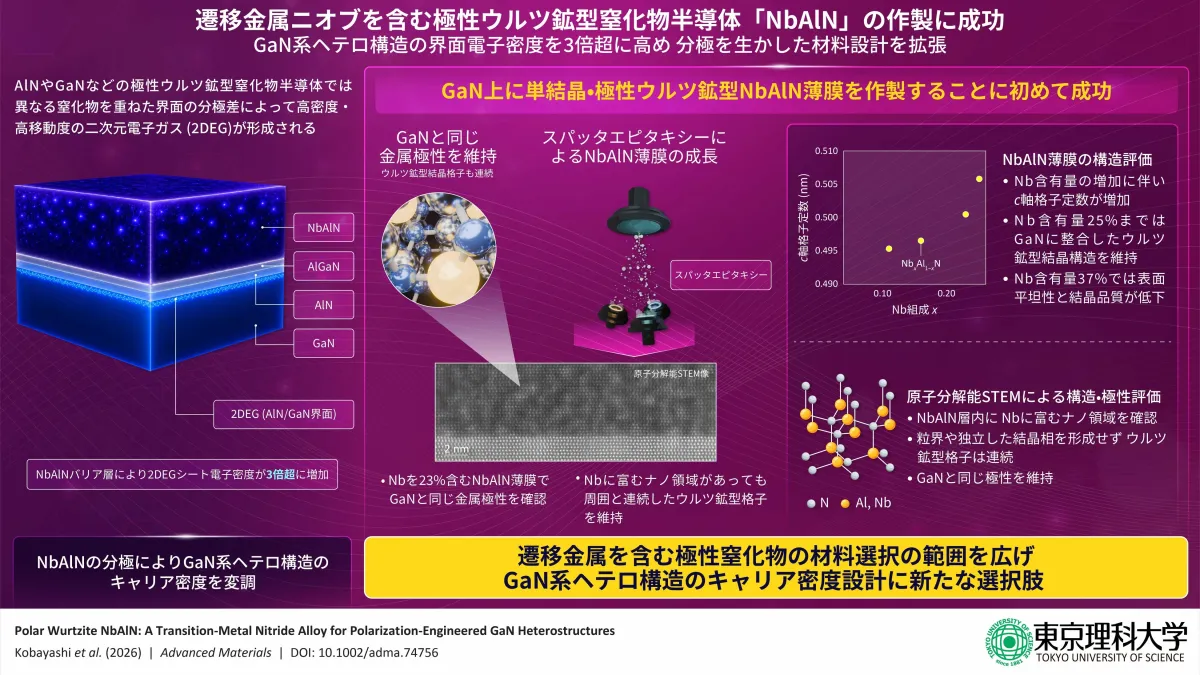
A groundbreaking advancement in semiconductor technology has been achieved by a research team from Tokyo University of Science and collaborating institutes, successfully creating a single-crystal epitaxial thin film of NbAlN, which incorporates the transition metal niobium (Nb), on a gallium nitride (GaN) substrate. This development marks a significant milestone in the field of polar nitride semiconductors.
Key Points of the Research
The researchers, led by Associate Professor Atsushi Kobayashi and Assistant Professor Kazuhisa Ikeda, have demonstrated, for the first time, that NbAlN can be produced with a consistent polar alignment that matches that of GaN, as confirmed through atomic-scale observations. The study highlights a novel design strategy that effectively increases the sheet electron density at AlN/GaN interfaces more than threefold, reaching up to approximately 1.7 × 10¹³ cm⁻². This achievement expands the design possibilities for materials that leverage the strong polarization effects inherent in nitride semiconductors.
Scientific Background
Aluminum nitride (AlN) and gallium nitride (GaN), representing polar wurtzite-type semiconductors, are renowned for their high breakdown voltage and strong polarization properties. These characteristics make them foundational materials for high-performance, high-frequency electronic devices. While experimenting with various additive elements, the team aimed to introduce niobium while maintaining a stable wurtzite structure and one-dimensional polarity — a significant challenge due to niobium's preference for metallic bonding in other compounds.
Methodology and Experimental Findings
Utilizing reactive sputter epitaxy, the team successfully grew NbAlN thin films with niobium concentrations ranging from 11% to 37% on GaN substrates. Analysis revealed that a Nb concentration of up to 25% allowed the retention of a smooth surface and a wurtzite crystal structure aligned with the GaN substrate. However, at 37%, the surface roughness and crystalline quality deteriorated, indicating a threshold for high-quality growth.
Through advanced techniques like ABF-STEM, the group confirmed the presence of niobium-rich nanoregions while ensuring crystal lattice continuity. This discovery is pivotal for semiconductor physics, demonstrating the successful incorporation of transition metals into polar nitride structures without compromising their integrity.
Moreover, when NbAlN was utilized as a barrier layer in NbAlN/AlGaN/AlN/GaN heterostructures, the team recorded a remarkable increase in the density of the two-dimensional electron gas (2DEG), achieving more than three times the reference structure's density while maintaining high mobility levels. Such enhancements are interpreted as a result of the polarization properties of NbAlN, which influences carrier density transformation effectively.
Future Directions
Looking ahead, the research team aims to measure polarization constants and band alignments, conduct in-depth analyses of the interface and impurities, and advance towards practical transistor fabrication to clarify the operating mechanisms and performance potential of devices utilizing NbAlN barriers. Associate Professor Kobayashi emphasized the complexity of effectively integrating niobium into the polar wurtzite structure of AlN, noting that maintaining the metal-like characteristics while adopting favorable crystal orientations presents a unique and challenging frontier in semiconductor materials science.
In conclusion, the findings published in the esteemed journal Advanced Materials not only highlight the innovative potential of transition metal nitride semiconductors but also pave the way for advanced electronic devices capable of improved functionality and efficiency across a range of applications.
Topics Consumer Technology)
【About Using Articles】
You can freely use the title and article content by linking to the page where the article is posted.
※ Images cannot be used.
【About Links】
Links are free to use.