



Groundbreaking Remote Distributed AI Infrastructure Proven Between Tokyo and Fukuoka Utilizing IOWN APN
Transforming AI Development with IOWN APN
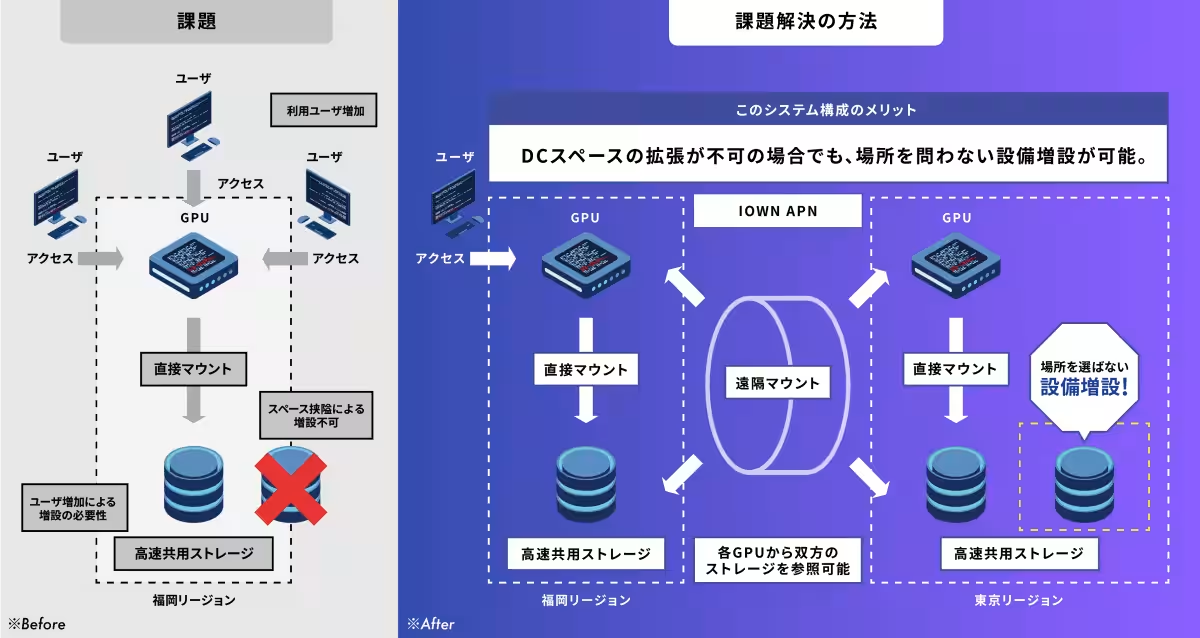
In a groundbreaking development, the GMO Internet Group, NTT East, NTT West, and QTnet have successfully completed a proof of concept demonstrating the effectiveness of a remote distributed AI infrastructure utilizing the Innovative Optical and Wireless Network (IOWN) and its All-Photonics Network (APN). This project connects storage systems in Tokyo with GPU resources in Fukuoka, aiming to provide critical infrastructure for advanced AI workloads.
Objectives of the Proof of Concept
The core objective of this proof of concept, which will be conducted from November 2025 to February 2026, is to evaluate the practical performance of AI workloads over a real IOWN APN line established between Tokyo and Fukuoka. The main focus is on measuring AI development performance through the connection of the GMO GPU Cloud with large-scale storage. The findings will offer insights into the feasibility of operating substantial language model training and other AI tasks remotely.
Importance of AI Development
As generative AI and large language models (LLMs) see exponential growth in demand, building an AI infrastructure capable of meeting these needs is crucial. Traditionally, physical proximity between GPUs and large-capacity storage was a necessity for efficient performance. However, the need for geographically distributed AI development, devoid of proximity constraints, has become increasingly pressing due to the challenge of limited data center space and the desire to manage data on-premises. This proof of concept is designed with these needs in mind.
Impact of Initial Testing (Phase 1)
Before moving into the main testing phase, the four involved companies executed a preliminary test in July 2025, simulating remote connection conditions between Tokyo and Fukuoka—approximately 1,000 kilometers apart. During this test, they validated performance metrics for two AI tasks: image recognition (using ResNet) and language training (LLama2 70B). The latency was adjusted to mimic real-world conditions, and findings revealed a benchmark score drop of only about 12%, confirming technical feasibility for commercial utility.
Primary Test Results (Phase 2)
For the actual proof of concept, the teams set up a real inter-site network using IOWN APN (100 GbE) connecting the GMO headquarters in Shibuya, Tokyo, to QTnet's data center in Fukuoka. They measured AI training performance utilizing GPU servers and high-speed storage resources. The outcomes were promising:
1. Large Language Model (LLama2 70B) Learning Task: The local setup took about 24.87 minutes, while the remote setup via IOWN APN only took 24.99 minutes, demonstrating that the latency incurred had minimal impact on performance (about 0.5% difference).
2. Image Classification Task (ResNet): The local environment recorded a time of 13.72 minutes compared to 14.38 minutes remotely. Proper data optimization enabled effective processing even in a distributed environment.
Overall, these results affirm that the IOWN APN can support comparable performance in remote distributed settings as found in local configurations.
Future Developments and Expectations
The success of this proof of concept signals a transformative change in how AI resources can function irrespective of physical distance. Historically, data transfer and replication to cloud operators' data centers were prevalent, but this new model, where computation can occur without relocating data, presents compelling benefits—particularly in sectors demanding high data sovereignty.
Key potential applications of this technology may include:
- - Training AI models using large or sensitive datasets without external data storage.
- - Integrating existing on-premises environments with remote cloud GPU resources.
- - Geographic distribution of resources to ensure continuity and resilience in the face of disturbances.
The four companies will continue leveraging the insights gained from this initiative to advance the practical implementation of remote distributed AI infrastructures tailored to client needs. Through partnership efforts with local data centers and enhanced services, they aim to evolve IOWN APN into a vital infrastructure component supporting AI and cloud frameworks in society.
Topics Consumer Technology)

【About Using Articles】
You can freely use the title and article content by linking to the page where the article is posted.
※ Images cannot be used.
【About Links】
Links are free to use.