




Exploring the Evolutionary Differences of Avian Color and Feeding Signals linked to ASIP and AGRP Proteins
Evolution of Avian Coloration and Feeding Control
Recent studies conducted by a team from Okayama University have shed light on how two related proteins, Agouti Signaling Protein (ASIP) and Agouti-Related Protein (AGRP), influence the color of bird feathers and their feeding habits. Despite originating from a common ancestor, these proteins have developed distinct characteristics, much like contrasting personalities.
The Proteins and Their Functions
ASIP and AGRP play critical roles in modulating the melanin-based coloration of feathers and regulating appetite and metabolism in both mammals and birds. These proteins interact with melanocortin receptors to determine pigmentation and feeding behaviors. Their common ancestry stems from a process known as gene duplication, which typically produces “brother molecules” or paralogs. However, the functional differences resulting from this duplication have remained less understood until now.
New Insights into Protein Secretion
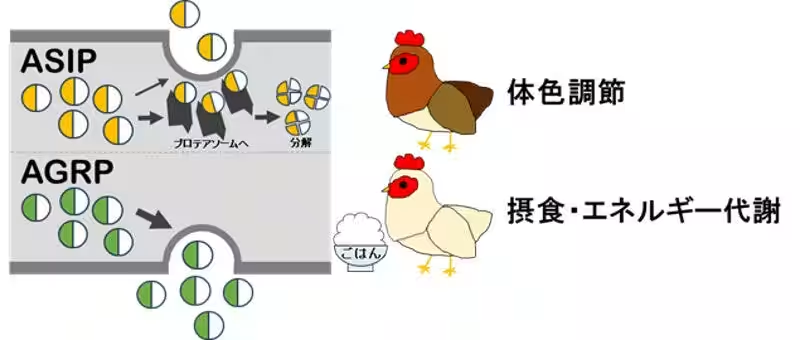
The research team, led by graduate student Hibiki Fukuchi, Professor Sakae Takeuchi, and Associate Professor Sayaka Aizawa, undertook an in-depth analysis comparing the secretion properties of ASIP and AGRP derived from chickens. Their findings revealed that ASIP has a notably lower secretion rate from cells compared to AGRP. This reduced secretion capability is attributed to structural differences in the N-terminal domain of ASIP.
Implications of Structural Differences
Moreover, the team identified that this unique domain structure in ASIP not only affects its secretion but also triggers protein degradation via the proteasome pathway, further limiting its availability in contrast to AGRP. These insights indicate that despite sharing evolutionary roots, ASIP and AGRP have diverged in their secretion characteristics due to variations that impact cellular transport.
Such differences may provide a biological basis for the elaborate mechanism through which birds have evolved to skillfully manage their pigmentation and appetite.
Broader Significance
The implications of this research extend into evolutionary biology by offering a biochemical understanding of how species adapt to diverse environments through physiological changes. By unraveling the molecular characteristics that differentiate ASIP and AGRP, scientists can begin to piece together the intricate evolutionary paths that led to the remarkable variety of colors seen in avian species today.
Professor Fukuchi expresses excitement over the potential applications of this research, stating, "The intricate patterns of bird plumage arise from a delicate balance of controls, which we sought to uncover through the role of ASIP. Understanding these molecular properties opens new avenues for studying how birds adapt to various environments."
The collaborative efforts have culminated in a publication in the journal Comparative Biochemistry and Physiology, Part B, marking a significant milestone in avian research. This innovative study not only contributes to scientific knowledge but also highlights the importance of young researchers like Fukuchi, supported by the JST Next-Generation Researcher Challenging Program and other funding initiatives.
In conclusion, the research from Okayama University emphasizes the evolutionary complexity behind avian signals, encouraging further investigation into the adaptive strategies birds employ through molecular biology.








Topics Other)
【About Using Articles】
You can freely use the title and article content by linking to the page where the article is posted.
※ Images cannot be used.
【About Links】
Links are free to use.