




Navigating the Shifting Landscape of APAC Logistics: Insights from Waypoint 2026
Understanding the APAC Logistics Market through Waypoint 2026
The logistics sector across the Asia-Pacific (APAC) region is undergoing significant changes, as highlighted in the latest report, "Waypoint 2026," by Cushman & Wakefield, a global real estate services firm headquartered in Chicago, Illinois. This report provides crucial insights for developing real estate strategies aimed at building robust and agile supply chains in an increasingly complex environment.
According to the Waypoint 2026 report, the APAC region continues to be the most tenant-friendly market globally, with 47% of the market favoring tenants—a notable increase from 33% in 2025. However, fluctuations in supply and demand are leading to diverse market conditions across the region.
In markets like Australia, Japan, and Singapore, where supply constraints are evident, competition for available space is intensifying, resulting in a predicted decrease in vacancy rates. Overall, it is expected that 43% of the APAC market will experience lower vacancy rates over the next three years, indicating a tightening market environment. Conversely, areas in India and mainland China are characterized by continued tenant-friendly conditions, fueled by ample new supply and sustained flexibility for tenants. Approximately one-third of the overall APAC market is anticipated to see rising vacancy rates amid ongoing development activities.
As regional divergences become increasingly prominent, tailored strategies for each market are gaining importance. For property owners, adapting real estate assets to meet the needs of high-growth sectors like e-commerce, manufacturing, and technology is becoming critical. Moreover, ensuring that properties meet energy demands and accommodate automation will be essential.
Dennis Yeo, Head of Investor Services and Logistics for Cushman & Wakefield's Asia-Pacific region, remarked, "Each market in the APAC region is at different stages of growth, supported by strong tenant demand driven by e-commerce and manufacturing. While markets like Japan and Australia suffer from supply constraints, China and India continue to offer new opportunities due to ongoing supply."
Furthermore, the overall demand across the APAC region remains buoyed by the diversification of the supply chain, strongly supported by e-commerce and manufacturing activities, especially as Southeast Asia rises as a key growth hub. Rising tenant activity in markets such as Vietnam, Indonesia, and Thailand aligns with the shift towards regionalization and the relocation of production bases. Simultaneously, the high-tech and automotive sectors continue to significantly influence demand across North Asia, enhancing the importance of modern, strategically located logistics facilities that can adapt to evolving operational and technological requirements.
Global Outlook: Tighter Markets and Rising Costs
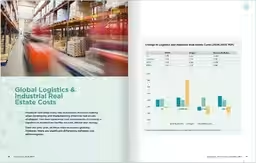
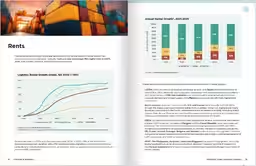
Globally, the Waypoint 2026 report indicates a downturn in tenant-friendly market environments, projecting a decrease from 52% in 2026 to 33% by 2029. Conversely, owner-favorable markets are expected to rise from 26% to 39%, indicating substantial shifts in market balance. As businesses seek to mitigate geopolitical, trade, and climate-related risks by restructuring their supply chains, demand for strategically located, high-quality assets remains strong. Currently, global logistics rents have surged by 36% compared to 2020, and rent increases are projected in 54% of markets over the next three years.
In the Americas, a notable shift towards "owner-favorable" conditions is anticipated, particularly in the U.S. as market balances adjust within major hubs, while nearshoring continues to support demand in Mexico.
In the EMEA region (Europe, Middle East, and Africa), declining vacancy rates and limited development pipelines are narrowing tenant options. Likewise, rising energy costs increasingly impact location decisions, driving demand for energy-efficient logistics properties.
Dominique Brown, Head of International Research at Cushman & Wakefield, stated, "The next phase of the logistics cycle will be determined by how well companies prepare. Those that incorporate resilience into their real estate strategies by smartly leveraging technology, automation, and stable energy supplies will be better positioned to navigate disruptions and achieve long-term growth."
For a more comprehensive look at the current state and future predictions of the logistics market, download the detailed report from the Waypoint 2026 website. Further insights into Cushman & Wakefield, a leading global provider of commercial real estate services, can be found at their official website.
- ---
For more details, you can view the complete report in PDF format. Visit the Waypoint 2026 website (available in English).

Topics Consumer Products & Retail)




【About Using Articles】
You can freely use the title and article content by linking to the page where the article is posted.
※ Images cannot be used.
【About Links】
Links are free to use.