



ManpowerGroup Unveils New Principles of Career Development Report
Unveiling the New Principles of Career Development
ManpowerGroup, a leading workforce solutions provider headquartered in Minato, Tokyo, has released a groundbreaking labor white paper titled "New Principles of Career Development". This report synthesizes insights from over 1,000 leaders and 2,400 employees across eight countries, including the UK, France, Brazil, Mexico, the US, Canada, Singapore, and Australia. The focus is on the engagement gap between leaders and employees.
Background of the Research: Addressing Diverse Employee Needs
In today's workforce, employees exhibit a heightened desire for growth and self-development. Many are striving to find meaning in their work through acquiring new skills and deepening their expertise. However, the lack of clear support and partnership for career development forces them to rely on personal initiatives and luck rather than structured plans. On the other hand, while leaders are earnest in supporting career growth, they are often overwhelmed by changing environmental factors, particularly technology. This imbalance leads to inadequate support for employees’ aspirations for continuous, forward-thinking assistance. The report highlights the essential data and insights organizations need to reconsider their strategies for human resource development and support.
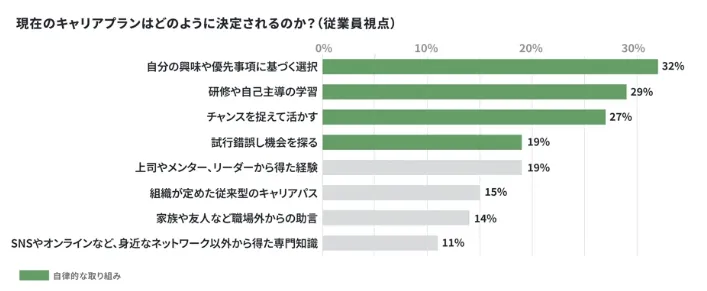
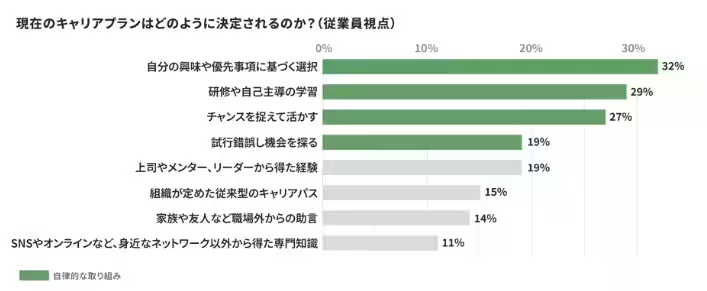
Employee Perspective: Crafting Careers Independently
Recent findings show that a significant portion of employees (32%) are taking charge of their career paths based on their interests and priorities. This implies a growing trend of self-directed career development. However, when leaders fail to engage actively with employees in their career planning, it ultimately leads to misalignment of goals, which can jeopardize workforce performance and widen skills gaps. It is crucial for companies to align talent development with strategic objectives.
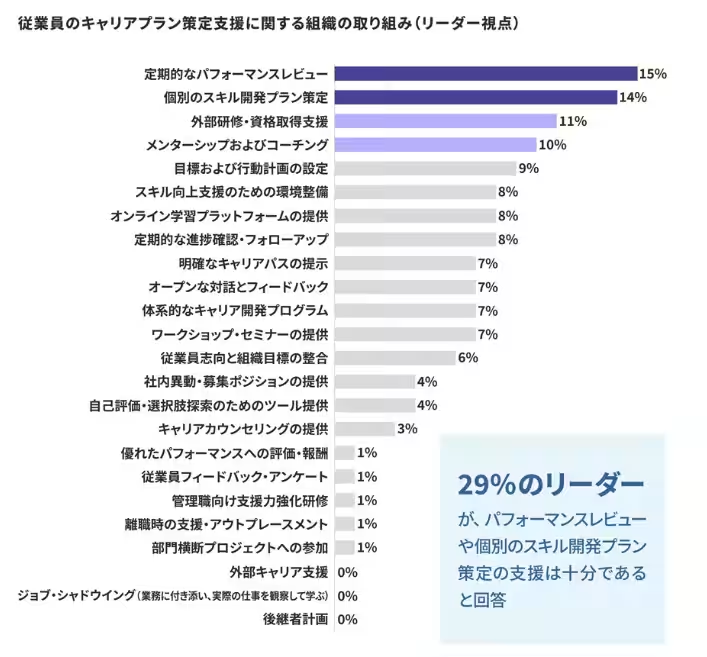
Leader Perspective: Current Support Efforts Are Lacking
Among the organizational strategies aimed at assisting in career planning, only 15% involve regular performance reviews, and 14% include creating individualized skill development plans. These measures often remain procedural and do not foster meaningful dialogue with employees. Due to increasing workloads and human resource shortages, leaders struggle to prioritize career development continuously.
Six Key Actions for Rebuilding the Career Support Model
To adapt to social changes and reconstruct talent strategies that empower employees to navigate their careers proactively, the report outlines six essential actions:
1. Develop Experience-Based Career Paths: Shift away from the traditional single ladder approach. By accumulating diverse experiences, employees can broaden their growth opportunities. Leaders must clearly communicate the organization’s flat structure and how employees can grow across teams and departments.
2. Encourage Decision-Making Based on Skills: View skills as currency that can be collected and exchanged within the organization. By leveraging digital skill portfolios, leaders can visualize and track employee growth, enabling more accurate decision-making.
3. Embrace AI and Prepare for Change: Support employees in understanding the implications of AI in their work. Foster a culture that views AI as a team member that enhances abilities, helping employees approach their tasks with confidence and creativity.
4. Transform Managers into Active Career Navigators: Empower managers to guide employees in their career growth. When evaluating leaders, companies should consider their ability to design individual career growth plans and facilitate smooth transitions within the organization.
5. Incorporate Experimental Approaches to Career Development: Move away from rigid career plans. Implement small-scale, intentional career experiments to allow employees to explore various roles and skills, ultimately finding paths that suit them best.
6. Facilitate Practical Learning within Workflows: To establish a continuous cycle of skill development, tie business strategies and projects directly to skill growth. Cultivate a culture that recognizes skills acquired through training and opportunities for learning.
Conclusion
The findings of ManpowerGroup’s labor white paper underscore the urgent need for organizations to address the widening gap between employee aspirations and leadership support. By revisiting their talent strategies with a focus on engagement and proactive development, businesses can better foster an environment where both leaders and employees thrive.
For more information on ManpowerGroup’s report, visit the following link: Detailed Report Here.
About ManpowerGroup Talent Solutions
As part of ManpowerGroup®, Talent Solutions® offers a range of services, including RPO and TAPFIN-MSP, addressing complex workforce needs. With insights drawn from deep industry knowledge, they provide data-driven solutions that support HR strategies from talent attraction to skill development.
About ManpowerGroup Inc.
ManpowerGroup® has been supporting organizational transformation in the evolving world of work for nearly 75 years, providing comprehensive workforce solutions in over 70 countries. Recognized for its commitment to diversity and inclusion, ManpowerGroup has been honored multiple times as one of the
Topics Other)
【About Using Articles】
You can freely use the title and article content by linking to the page where the article is posted.
※ Images cannot be used.
【About Links】
Links are free to use.