



New Insights into Tau Accumulation Mechanism Revealed by Cell Stress Response Abnormalities in Alzheimer's Disease
Understanding the Role of MARK4 in Tau Protein Accumulation
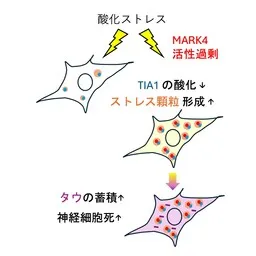
Recent findings from researchers at Tokyo Metropolitan University have unveiled a new mechanism by which the abnormal accumulation of tau protein, a key factor in neurodegenerative diseases like Alzheimer’s, is facilitated by cellular stress responses. Their study highlights the enzyme MARK4's crucial involvement in regulating stress granules, structures that form in response to cellular stress, particularly oxidative stress.
The Significance of Tau Proteins
Tau proteins are essential for maintaining neuronal structure, but their pathological accumulation leads to neurodegeneration. As individuals age, the risk of developing neurodegenerative disorders such as Alzheimer’s increases, correlating with rising oxidative stress levels that further complicate tau protein behavior. However, the intricate relationship between oxidative stress and tau accumulation has been insufficiently explored, leading to gaps in understanding the underlying mechanisms of these diseases.
Key Discoveries from the Research
This groundbreaking research has demonstrated that MARK4, known primarily as a tau kinase, plays a pivotal role beyond merely phosphorylating tau. The study found that under oxidative stress, MARK4 interacts with TIA1, a protein critical for stress granule formation, thereby promoting the formation of these structures. This collaboration ultimately exacerbates tau protein accumulation, leading to increased neurodegeneration.
Researchers utilized cultured cells subjected to oxidative stress to observe MARK4’s localization and interaction with TIA1. It was found that MARK4 not only accumulates within stress granules but also enhances their formation, while simultaneously preserving TIA1's function, which might otherwise be diminished under stress conditions.
Further experiments revealed that prior expression of either MARK4 or TIA1 alone did not significantly impact tau levels, but co-expression resulted in substantial increases in tau protein accumulation. This implies that MARK4's role is multifaceted, where it facilitates tau phosphorylation and supports stress granule stability, contributing to pathological changes associated with tauopathy.
Implications for Alzheimer's Disease Treatment
The findings are critical for understanding the molecular mechanisms driving tau pathology in Alzheimer's disease and related conditions. The enhanced relationship between MARK4 and TIA1 could serve as a promising therapeutic target; inhibiting MARK4 activity may not only reduce tau phosphorylation but also mitigate tau-driven neurotoxicity through its engagement with stress granule dynamics.
Notably, this research opens avenues for developing novel therapeutic strategies aimed at neurodegenerative diseases characterized by tau pathology, including progressive supranuclear palsy and cortical basal degeneration, in addition to Alzheimer's disease. Moreover, abnormalities in stress granule formation are also linked to various cancers, suggesting a broader relevance of this research beyond neurodegeneration.
The Future of Alzheimer’s Research
As the population ages, the rise in neurodegenerative diseases presents a pressing societal challenge. Current treatment options for halting the progression of conditions such as Alzheimer’s remain limited. Therefore, the elucidation of this new molecular mechanism connecting increasing oxidative stress with tau accumulation presents a critical advancement in our efforts to develop effective preventative and therapeutic measures for Alzheimer’s. Furthermore, ongoing research into MARK4's inhibition highlights the potential for leading to early-stage interventions, ideally before significant tau accumulation occurs.
Conclusion
In summary, this study has illuminated a significant molecular connection that may govern the pathogenesis of Alzheimer’s disease and similar neurodegenerative disorders. By linking oxidative stress with tau pathology through the actions of MARK4 and TIA1, it offers fresh perspectives that could inform future therapeutic strategies aimed at mitigating cognitive decline associated with these devastating conditions.
The findings hold promise not just in the realm of neurodegenerative diagnosis and treatment but also in enriching our understanding of cellular stress responses as a whole. This research is set for publication in the journal FEBS OpenBio, furthering academic discourse on this critical topic.
Topics Health)






【About Using Articles】
You can freely use the title and article content by linking to the page where the article is posted.
※ Images cannot be used.
【About Links】
Links are free to use.