



Collaborative Research on Multi-Location Living by Three Innovative Companies in Japan
Exploring the Impact of Multi-Location Living on Wellbeing
In an innovative collaboration, three companies - Nippon Steel Kowa Real Estate, SANU, and JDSC - are conducting research to investigate how multi-location living influences wellbeing. This study aims to scientifically elucidate the mechanisms of how urban and natural settings affect individuals' mental and physical health, laying the foundation for better urban and residential design.
Research Background
As work styles become more flexible and values diversify, urban residents are increasingly shifting from a single living location to multiple residences. According to a survey by the Japanese Ministry of Land, Infrastructure, Transport and Tourism, about 30% of urban residents express interest in dual-location living, showcasing a growing trend among the working generation toward choosing a lifestyle that includes multiple homes. However, comprehensive research that structurally captures the psychological and physiological effects of this lifestyle choice has not yet been fully developed in Japan or abroad.
This joint study seeks to understand lifestyle changes not just at the individual experience level but also as a social structure, aiming to generate insights that will contribute to the next generation of housing environments and urban design. Integrating expertise in housing, life fields, and AI/data analysis, this research is a rare initiative in Japan.
Initial Findings
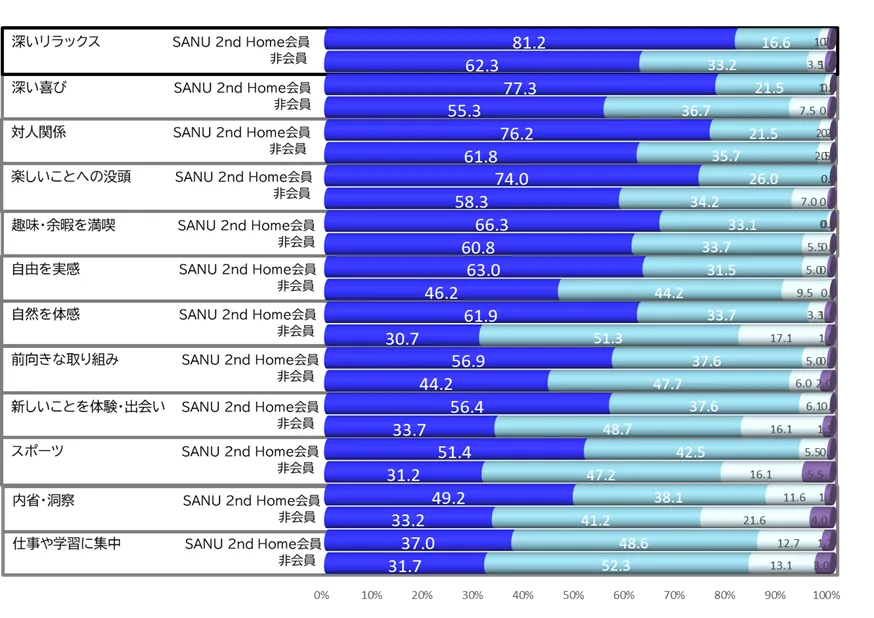
The initial analysis revealed important trends regarding the impacts of multi-location living on mental and physical well-being. The research surveyed 414 participants, comprising 196 SANU 2nd Home members and 218 non-members, focusing on their value perceptions regarding time and their physical and mental states in their homes and accommodations. Members of SANU tend to stay outside their primary residences more frequently compared to non-members, highlighting differences in lifestyle.
Key Insights
1. Higher Expectations for Wellbeing Among SANU Members
Both groups showed a common tendency to value time related to wellbeing, but it became evident that SANU members ranked their expectations significantly higher across many categories. This was particularly true for areas such as 'deep relaxation,' 'joy,' 'interpersonal relationships,' and 'immersion in enjoyable activities'. They demonstrated a greater appreciation for experiences that contribute to a sense of freedom and connection with nature.
2. Differing Wellbeing Perspectives at Home and Away
The analysis also revealed that SANU members reported a greater sense of satisfaction in achieving deep relaxation, experiencing nature, and feeling free while experiencing their accommodations, compared to non-members. In contrast, non-members tended to feel more fulfilled in terms of relaxation and personal insight while at home.
For SANU members, their primary residence was only a place where they could focus on work and learning effectively, indicating that their experiences away from home contribute significantly to their overall wellbeing.
Implications of the Findings
This research provides preliminary insights into understanding the structural impacts of multi-location living on mental and physical health. It highlights the importance of both 'place' and 'value perceptions' in defining the multi-location lifestyle. It suggests that for urban residents with high expectations for wellbeing, having spaces that facilitate both recovery (relaxation and connection with nature) and cognitive shifts (focus and introspection) could enhance their overall wellbeing.
Moving forward, the study encompasses multiple phases, intending to integrate biological indicators, behavioral data, and environmental factors to deepen the understanding of how multi-location living influences our mental and physical states. The aim is to derive data-driven answers to practical questions regarding which conditions, frequencies, and environments enhance wellbeing. An academic presentation is planned for May 2026.
Future Applications
The insights gained from this study are anticipated to be applied across various fields:
- - Housing and Urban Development (Nippon Steel Kowa Real Estate): Guiding the design of residential environments that contribute to wellbeing and promoting multi-location services.
- - Advancement of Multi-Location Living Services (SANU): Scientifically evidencing the significance of a lifestyle that embraces nature and personalizing stay experiences.
- - Development of Data-Driven Solutions (JDSC): Enhancing living experience platforms using behavioral logs and biological data, collaborating with companies and local governments in the real estate and living environments sector.
Roles of the Companies Involved
This research is driven by distinct roles of the partner companies:
- - Nippon Steel Kowa Real Estate Future Style Research Institute: Oversees research related to the future of housing and urban living.
- - SANU: Provides the practical field for multi-location living and collaborates with practitioners who navigate between urban and natural lifestyles.
- - JDSC: Builds evidence through AI and data analysis, offering independent design and interpretation of the findings.
Research Overview
- - Method: Online survey
- - Participants: 196 SANU 2nd Home members and 218 non-members
- - Conducted in: December 2025
- - Main Research Areas: Values associated with wellbeing, physical and mental states at home and accommodations, experiences related to multi-location lifestyle.
For more information on the Future Style Research Institute, visit Future Style総研.
Further, for more insights into the SANU 2nd Home service, check SANU and for updates on JDSC's technology contributions, visit JDSC.

Topics Consumer Products & Retail)
【About Using Articles】
You can freely use the title and article content by linking to the page where the article is posted.
※ Images cannot be used.
【About Links】
Links are free to use.