



Unlocking the 30-Year Mystery of Black Hole Gravitational Waves and Resonance Phenomena
Understanding the Resonance Phenomena of Black Holes
After three decades of speculation and inquiry, a significant breakthrough has emerged in the field of gravitational wave physics: the discovery of a resonance phenomenon related to black holes. The study, led by Associate Professor Hayato Motohashi from the Graduate School of Science at Tokyo Metropolitan University, has uncovered crucial insights into how black holes emit gravitational waves when they vibrate due to external influences, similar to a cosmic bell.
The Essence of Black Holes and Gravitational Waves
Gravitational waves are ripples in space-time, first predicted by Einstein’s General Theory of Relativity in 1916, and recently confirmed by the LIGO observatory through the detection of merging black holes. When black holes collide or consume matter, they vibrate, emitting gravitational waves characterized by a complex interplay of quasi-normal modes—these patterns are essential for understanding the nature of black holes.
A Mystery Unraveled
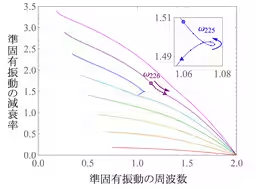
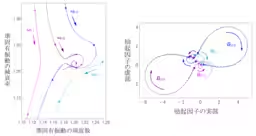
28 years ago, a peculiar anomaly was detected in the patterns of these quasi-normal vibrations. Tokyo Institute of Technology graduate student Hisashi Onozawa's calculations revealed that amidst regularly aligned vibrations, one exhibited an odd offset, resembling a dissonant note in music. This strange behavior led researchers to a long-standing mystery, as the origins of this anomaly remained unexplained for years.
In a remarkable leap forward, Professor Motohashi has identified the cause of this anomaly as a phenomenon called “pseudo-crossing,” occurring between two modes of vibration. This phenomenon not only explains the dissonant note but also leads to the amplification of gravitational waves—a unique resonance discovery that has significant implications for gravitational wave physics and beyond.
The Discovery Process
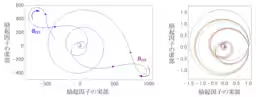
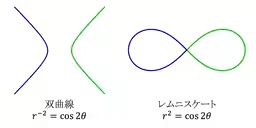
Utilizing advanced numerical calculation techniques based on Einstein’s theory, the research team conducted high-precision computations to determine the frequencies and decay rates of these vibrations. Their analysis unveiled a distinctive figure-eight pattern in the excitation factors of the modes, indicating a resonance effect that was not previously recognized.
Further computations revealed consistent instances of this behavior across various models, confirming that as two modes approach each other's frequencies, they exhibit a resonance amplification characteristic that is reminiscent of everyday resonance phenomena, such as pushing a swing in time with its natural frequency.
Theoretical Implications
Moreover, the findings suggested that this resonance effect can be addressed using a theoretical framework from non-Hermitian physics, a field that studies systems with energy dissipation and amplification. Professor Motohashi’s successful application of this framework to gravitational wave physics not only illuminates the behavior of black holes but also paves the way for new explorations in this emerging domain of study.
Through rigorous theoretical analysis, the team demonstrated that the extraordinary behavior observed in gravitational waves due to this resonance is, in fact, a common phenomenon that can be applied across various areas of physics, including electromagnetism and quantum systems.
Significance of the Findings
The implications of this research extend beyond mere theoretical exploration. The discovery of resonance phenomena serves as a novel indicator for analyzing black holes and their surroundings, allowing scientists to approach gravitational wave data with fresh perspectives and potentially shed light on the black hole's properties in unprecedented detail.
As gravitational wave astronomy continues to evolve, this breakthrough stands to influence the field significantly, providing deeper insights into the mechanisms at play in the universe’s most extreme environments. Historically, resonance phenomena have driven crucial advancements in various scientific disciplines, from nuclear magnetic resonance to particle physics, and this new understanding may catalyze further revelations in gravitational wave studies and cosmology.
Conclusion
The recent findings have not only resolved a long-standing enigma but also mark a substantial advancement in black hole research. The interdisciplinary approach combining techniques from physics and mathematics has opened doors to a new academic realm, where further discoveries in non-Hermitian gravitational physics may enhance our comprehension of the universe’s core dynamics. As we continue to probe the secrets of black holes, the revelations of this study promise to transform our understanding of the cosmos.
Convert your curiosity about the universe into knowledge by following this research and its implications on gravitational wave physics. Look out for the publication in Physical Review Letters on April 10, 2025.
Topics Other)
【About Using Articles】
You can freely use the title and article content by linking to the page where the article is posted.
※ Images cannot be used.
【About Links】
Links are free to use.