



Hitachi and JR East Partner to Enhance Train Operations with AI Agents
Enhancing Train Operations with AI Agents
Hitachi Ltd. and East Japan Railway Company (JR East) have recently announced a groundbreaking collaboration to enhance the stability of train operations in the Tokyo metropolitan area by utilizing AI agents in their railway operation management system. This joint verification project is set to begin around September 2025, marking a significant step in digital transformation (DX) within the railway sector.
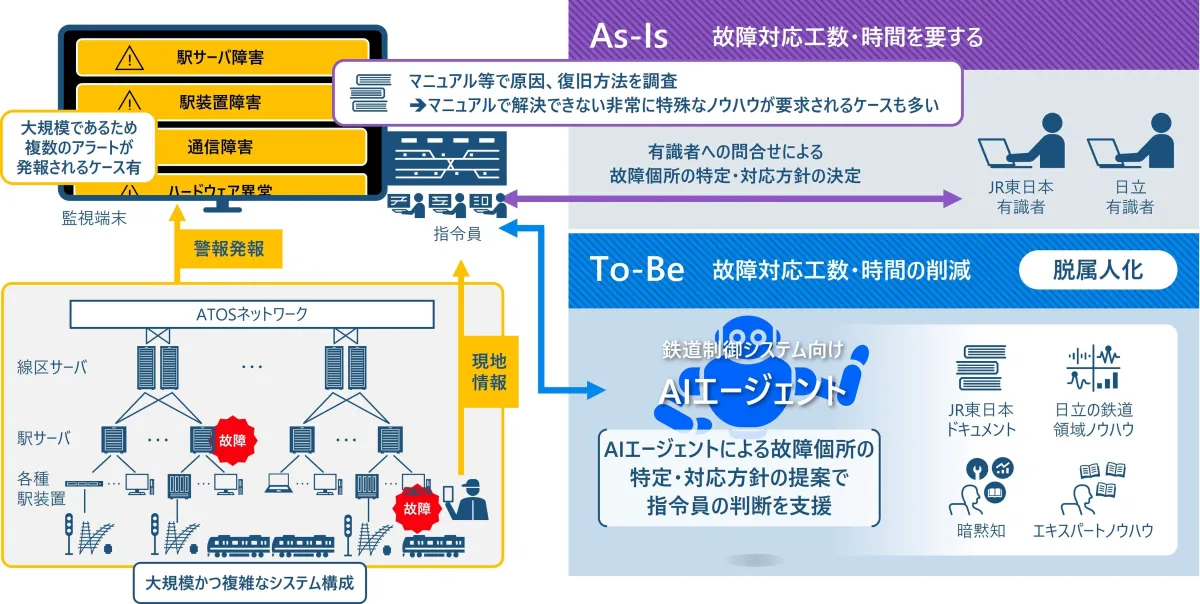
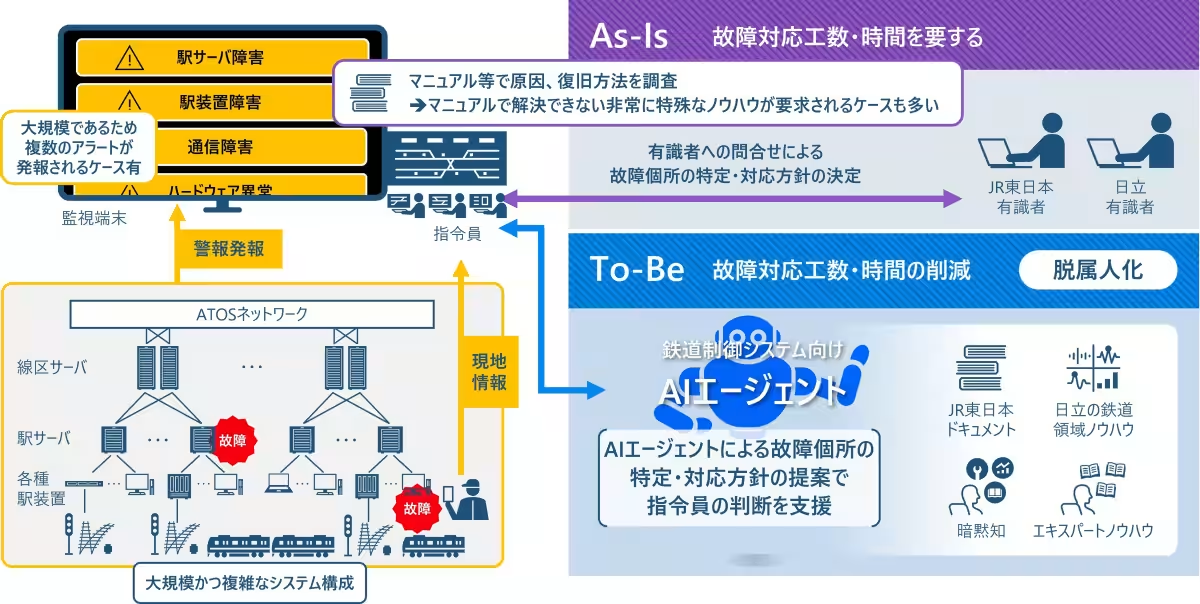
The existing Tokyo Metropolitan Transportation Management System (ATOS) is a complex and large-scale system integrating multiple devices to oversee local train operations. Given this complexity, train operation officers require extensive expertise and knowledge to analyze and respond to troubleshooting incidents and queries effectively. When issues arise that cannot be resolved through manuals or standard procedures, consultation with seasoned experts becomes necessary, often resulting in delayed response times for identifying and rectifying faults.
With Japan's workforce projected to continue shrinking, resulting in a shortage of qualified operation officers, both Hitachi and JR East are committed to enhancing operational efficiency and achieving stable transport systems with fewer personnel. This partnership is particularly crucial as they delve into using DX advancements paired with AI to ensure safe and sustainable railway operations.
The implementation involves leveraging hundreds of case studies and operational knowledge accumulated by Hitachi, alongside the Lumada approach that transforms data and insights into actionable solutions. By integrating the knowledge assets of both companies, including JR East’s system specifications and Hitachi's documentation on control systems and operational know-how, they plan to develop a large language model (LLM) specifically tailored for railway operation management.
In addition, an AI agent designed to emulate the thought processes of experienced personnel will be created. Combining this with the LLM will allow for automated identification of faults and recommendations for corrective measures, which will be tested to assess its effectiveness in assisting operation officers.
Joint Verification Overview
The verification will involve scenarios simulating equipment failures in interconnected systems across multiple operational centers. In the event of a malfunction, corresponding alerts will be generated from associated devices, which will then consolidate all alert information into the operation officers' monitoring terminals. This will also include reports from onsite workers, requiring the operation officers to perform comprehensive analyses of the muddled information to determine fault causes and recovery methods.
Typically, operation officers must reference extensive manuals during troubleshooting, necessitating high levels of specialized knowledge and significant time investment. The current project will assess whether the integration of the AI agent informed by both companies' knowledge can reduce the response time and effort required from operation officers in addressing equipment failures.
Future Prospects
Looking ahead, Hitachi plans to thoroughly analyze the data and insights gained from this joint verification process. By incorporating the tacit knowledge held by JR East’s railway system experts and Hitachi engineers, the accuracy and precision of the AI agent can be further elevated. Continuous collaboration with JR East will drive the ongoing transformation of operational processes using DX, aiming to shorten resolution times and reduce personnel workloads while minimizing the risks associated with railway operation disruptions.
Additionally, the outcomes from this verification are intended to extend beyond just operational management to also benefit maintenance, system specification development, design, and production tasks. By applying such expertise and technology, Hitachi aims to support the transformation of frontline workers' roles in mission-critical operational technology (OT) fields, contributing towards a balanced society that harmonizes environmental concerns, human well-being, and economic growth.
Related Links
- - Press materials from the June 10th JR East conference
- - About Hitachi's Generative AI
- - Business-specialized AI services and solutions
Trademark Notice
- - Company and product names mentioned are trademarks or registered trademarks of their respective owners.
About Hitachi
Hitachi contributes to realizing a harmonized society where environment, happiness, and economic growth coexist through its Social Innovation Business (SIB) utilizing IT, operational technology (OT), and products. With a global business structure spread across digital systems and services, energy, mobility, and connected industries, Hitachi aims to deliver solutions that resolve issues faced by customers and society by generating value from data through its Lumada platform. For the fiscal year ending March 2024, projected revenue is ¥9.78 trillion with consolidated subsidiaries totaling 618 and roughly 280,000 employees worldwide. More information can be found at www.hitachi.co.jp.
Contact Information
Hitachi Ltd. AI CoE Generative AI Center Office
Contact Hitachi
Topics Other)
【About Using Articles】
You can freely use the title and article content by linking to the page where the article is posted.
※ Images cannot be used.
【About Links】
Links are free to use.