




Avatars Influence Risk-Taking Behavior Through Facial Expressions
Exploring the Impact of Avatars on Decision Making
Recent advancements in communication technology have ushered in a new era where interactions increasingly take place through avatars in virtual spaces. Whether in online meetings or virtual shopping environments, avatars are becoming a common part of our daily lives. This shift raises intriguing questions about how avatars, particularly their facial expressions, influence our decision-making processes. A recent study conducted by a research group at the National Institute of Information and Communications Technology (NICT) sheds light on this phenomenon, revealing that individuals are more likely to make riskier choices when faced with the facial expressions of avatars compared to those of real people.
The Research Findings
The study, led by Toshiko Tanaka and Masahiko Haruno at NICT's Brain Information Communication Fusion Research Center, has found that the expressions shown by avatars can significantly sway a person's willingness to engage in risky behavior. Specifically, when participants were presented with expressions signaling praise or contempt from avatars during risk assessment tasks, they displayed a higher likelihood of opting for uncertain choices over guaranteed ones.
In their fMRI experiments, participants were tasked with making judgments related to risk while being observed by an avatar displaying either facial praise or contempt. The results indicated a marked increase in the participants' propensity for risky choices in scenarios where the feedback came from an avatar, particularly when the uncertain choice had a slight edge over the guaranteed option. The variability of the avatar's expressions appeared to create a more favorable assessment of risk, suggesting that the ambiguity associated with facial expressions—being less predictable—could lead to enhanced risk-taking efforts.
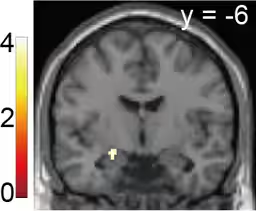
Moreover, analyses of fMRI data revealed that the participants' evaluation of the ambiguity in expressions was closely linked to activity in the amygdala, a crucial brain region involved in emotional processing and decision-making. These findings underscore the intricate relationship between avatar-mediated communication and human behavior in risk assessment, providing valuable insights into not just how we interact within virtual spaces, but also the psychological underpinnings of those interactions.
Importance of the Study
As remote communication becomes more prevalent, understanding the role of avatars in influencing our choices is paramount. This study paves the way for future research into how various factors—like gender and age of avatars, personal traits of individuals, and the nature of decision-making tasks—can further modulate this dynamic. The implications of these findings are particularly relevant for applications in education and interpersonal support environments, where avatars could potentially be utilized to guide decision-making processes.
Potential Applications
Looking forward, the researchers plan to explore how the findings might aid in crafting environments that foster better decision-making through avatar interaction. The development of strategies to align the use of avatars with effective communication techniques could enhance their utility in various fields, including education, therapy, and customer service. Additionally, addressing the potential pitfalls of relying too heavily on avatars for interpersonal communication is an essential aspect of this ongoing investigation.
This study was published on April 23, 2025, in the well-regarded journal PLOS Biology under the title "Feedback from an avatar facilitates risk-taking by modulating the amygdala response to feedback uncertainty". The research represents a significant step in decoding the complexities of social interactions mediated by technology, combining insights from neuroscience with real-world applications in social behavior.
For interested readers, the full paper can be accessed here.
Conclusion
This groundbreaking research underscores the powerful influence avatars can hold over our decision-making processes. As society increasingly leans towards virtual interactions, understanding the psychological mechanisms underpinning these behaviors becomes crucial. The study's findings not only illuminate the effects of avatar facial expressions on risk-taking but also invite further exploration into the vast potential of avatars in enhancing communication and decision-making across diverse platforms and settings.


Topics People & Culture)

【About Using Articles】
You can freely use the title and article content by linking to the page where the article is posted.
※ Images cannot be used.
【About Links】
Links are free to use.