



Exploring the Impact of Generative AI on Management Basket Exercises
Introduction
The Management Services Center (MSC), headquartered in Chiyoda, Tokyo, has released a comprehensive report in collaboration with BAKUTAN, a startup developed by the Matsuo Lab at the University of Tokyo. This report investigates how the use of Generative AI, particularly in management in-basket exercises (IB training), can affect assessment outcomes.
Background
AI's Role and Collaboration
MSC, led by President Sachiko Wakita, has been at the forefront of integrating cutting-edge technology within human resource practices. BAKUTAN, established with a focus on AI research and development in HR, is led by CEO Shudai Komoriya. By combining the expertise of both companies, this report aims to shed light on the implications of AI utilization during management training sessions.
Report Overview
The study focuses on two main aspects:
1. Influence of AI on Assessment Results: The report assesses how assessments differ when participants utilize AI tools versus answering independently.
2. Potential of AI in Grading Support: Evaluates the effectiveness and accuracy of AI in grading and its ability to supplement traditional assessment methods.
Key Findings
Impact on Scores and Ranks
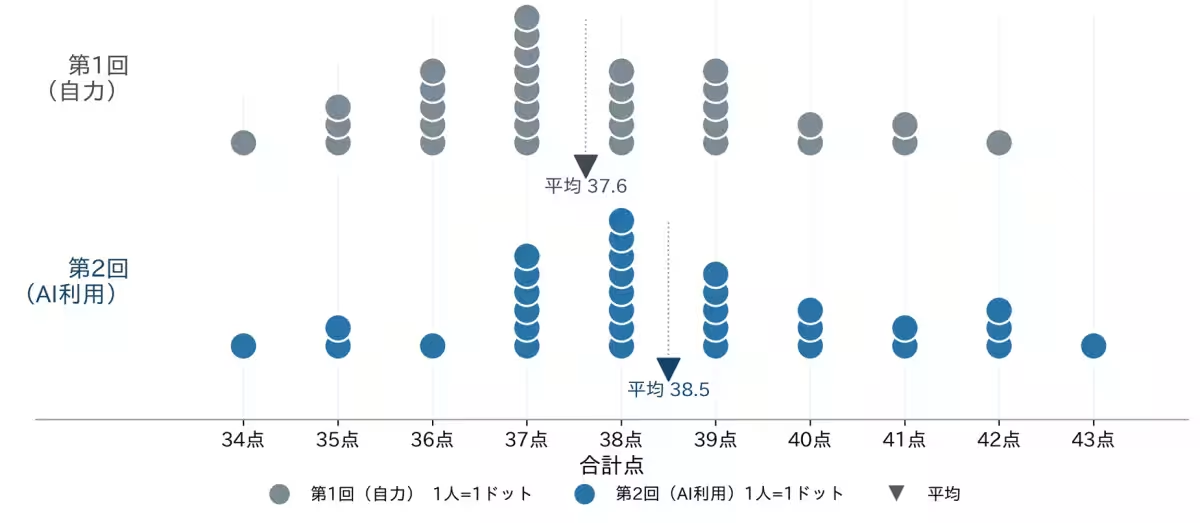
The findings reveal that the use of AI does not lead to a uniform increase in scores. Instead, notable changes in ranking positions were observed. While there was a slight increase in average scores across various dimensions, the results varied significantly among individuals, indicating that AI does not universally enhance performance.
- - AI Benefits and Limitations: The AI demonstrated superior performance in specific dimensions but had limited effectiveness in interpersonal areas. It was evident that the quality of human review on AI outputs significantly affected the outcomes.
Changes in Ranking
Participants' rankings indicated that AI could alter results from traditional assessments. Thus, caution is warranted when AI is employed for candidate selection processes.
Connection with Prompting and Revision
Cross-tabulation with a survey regarding AI usage showed the critical role of the prompts and subsequent review actions by participants in maximizing AI's effectiveness.
Grading Capability of AI
The exploration into AI grading revealed potential for further enhancements. By tailoring the grading rules and assessment manuals to specific training characteristics, the use of AI as a supportive tool for evaluations can be significantly improved.
Implications and Future Directions
As organizations continue to adapt to AI innovations, it is essential to design AI utilization strategies that align with assessment objectives carefully. The report hints at evolving leadership and management behaviors suited for an AI-integrated workplace. Future assessments must consider the changing landscape of management practices in the AI era.
Conclusion
The MSC and BAKUTAN are committed to further exploring assessment methodologies that align with the needs of modern management and leadership in an AI-driven context. They aim to provide insightful, evidence-based recommendations for those navigating these new challenges in their organizational practices.
For more in-depth details, please check the full report!
Contact Information: For inquiries regarding this report, please reach out to:
Strategic Marketing Department,
Management Services Center,
Tel: 03-6266-5950,
Email: [email protected]
Topics Business Technology)

【About Using Articles】
You can freely use the title and article content by linking to the page where the article is posted.
※ Images cannot be used.
【About Links】
Links are free to use.