



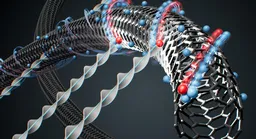
Chirality Observed in Excitons through Carbon Nanotubes: A Revolutionary Insight
Chirality Observed in Charged Excitons
Recent research has unveiled significant findings regarding chirality in quantum states composed of three particles, specifically focusing on charged excitons (trions) in chiral carbon nanotubes. Chirality, a property signifying a mirrored relationship between two entities—much like our hands—plays a crucial role in various materials and their properties. This study has illustrated how this intriguing trait is preserved even when the number of interacting particles changes, establishing a profound connection between structural chirality and quantum particle behavior.
Insights from the Study
The researchers investigated excitons, which consist of a negatively charged electron and a positively charged hole. They discovered that the charged trions derive their chirality properties from the same source as the original excitons. Specifically, an additional charge bound to the exciton to form a positive trion (one electron, two holes) or a negative trion (two electrons, one hole) retains chirality characteristics, shedding light on the intricate relationship between geometrical structures of carbon nanotubes and their many-particle quantum states.
Notably, the geometrical properties of carbon nanotubes, which display right-handed and left-handed characteristics, maintained these chirality properties even within multi-particle systems. This finding highlights the potential applications of chirality in quantum information processing and efficient light energy conversion, paving the way for future advancements in these fields.
The Crucial Role of Chirality
Chirality is significant in various scientific domains, such as chemistry and materials science, influencing processes like light absorption and chemical reactions. For instance, light absorption in chiral materials leads to the formation of excitons with distinct behavior in right-handed and left-handed circularly polarized light. Understanding how chirality influences these phenomena is an ongoing quest in the scientific community.
Research Methodology
To explore these interactions, the team utilized high-purity samples of both right-handed and left-handed carbon nanotubes. Through electrochemical methods, they controlled the number of electrons and holes, forming charged excitons, and meticulously analyzed their circular dichroism characteristics. The groundbreaking result was that charged excitons exhibited circular polarization characteristics nearly identical to those of the original excitons, marking a pivotal moment in quantum state research.
The results revealed a symmetry factor representing the variance in strength between the absorption of right-handed and left-handed circularly polarized light, showing that charged excitons maintain nearly the same value as their two-particle counterparts. This observation indicates that the optical characteristics, rooted in chirality, persist through the transition from a two-particle to a three-particle state.
Future Prospects and Implications
The implications of this research are vast. Chirally-induced optical characteristics are crucial for developing next-generation optical and electronic devices, including quantum information technologies and efficient light energy converters. The study showcases that even in tightly interacting systems, the fundamental traits imparted by chirality remain intact, significantly enriching the understanding of chirality in multi-particle quantum states.
Furthermore, since charged excitons can be generated through electrical injection, this discovery opens new avenues for controlling chiral optical responses via electrical means. Anticipating a symmetry preservation in more complex particle interactions heralds the potential for enhancing circularly polarized responses and spawning novel optical functionalities.
In summary, this research bridges the understanding of chirality with multi-particle interactions, establishing a foundational framework for future advancements in light-detection and modulation devices, as well as next-generation optical technologies.
Conclusion
This study presents an innovative approach to the interplay between structural chirality and quantum interactions. By elucidating the chirality's influence on charged excitons within carbon nanotubes, researchers have set the stage for further exploration into the realm of chiral properties and their applications in next-generation functional materials, elevating the potential for breakthroughs in both fundamental science and technological advancements.
References
- - Article Title: Chiral trions in enantiopure single-wall carbon nanotubes
- - Authors: Hiroyuki Fujinami, Satoshi Kusaba, Satoru Konabe, Weilu Gao, Jana Zaumseil & Kazuhiro Yanagi
- - Published In: Nature Communications
- - DOI: 10.1038/s41467-026-78073-z
- - URL: Nature Communications Article
Topics Other)


【About Using Articles】
You can freely use the title and article content by linking to the page where the article is posted.
※ Images cannot be used.
【About Links】
Links are free to use.