



Development of Fe-Cu-Ag Composite Powder for Enhanced Semiconductor Testing Reliability
Introduction
In an exciting advancement in materials science, a research team from the National Institute of Advanced Industrial Science and Technology (AIST) has created a new composite powder made of iron (Fe), copper (Cu), and silver (Ag). This innovative material boasts both ferromagnetic properties and high electrical conductivity, making it a promising candidate for use as a conductive filler in semiconductor test sockets. The study was led by Principal Researcher Park Kwangjae, Senior Researcher Liu Zheng, and Group Leader Hirayama Yusuke from AIST, in collaboration with Professor Kwon Hansang from the National Pukyong University in South Korea.
Development Process
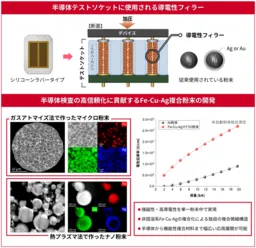
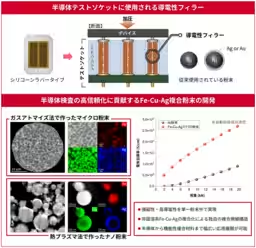
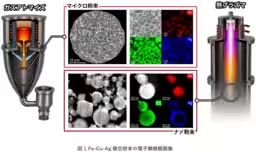
The researchers employed two pioneering techniques: the gas atomization method and the thermal plasma method, to synthesize micro-scale Fe-Cu-Ag composite powders. The gas atomization process allowed for the creation of spherical powders with an average diameter of about 50 µm by rapidly cooling liquid metal that was sprayed into a gas stream. On the other hand, the thermal plasma method yielded nano-sized particles averaging around 100 nm due to the rapid cooling of metal vapor within a plasma environment. The resulting materials exhibited superior mechanical strength and conductivity when compared to conventional nickel (Ni) powders.
Potential Applications
The new Fe-Cu-Ag composite powders could significantly enhance the reliability of semiconductor test sockets, which are essential for verifying the electrical properties and operation of semiconductors post-manufacturing. Typically, these sockets utilize conductive fillers composed of nickel or precious metals that can struggle to maintain stable electric connections under repeated use, especially as semiconductors become increasingly miniaturized and incorporate more pins.
This composite powder offers the potential to replace traditional fillers by maintaining efficient electrical connections while addressing the growing demands of the industry through better performance under repeated stress. The team is optimistic that the enhanced mechanical and electrical properties of the Fe-Cu-Ag composite will improve test reliability, ensuring consistent performance when interfacing modern semiconductor devices with testing equipment.
Significance of the Research
The semiconductor industry faces ongoing challenges, particularly when it comes to testing devices with varied sizes and pin configurations. One common requirement of semiconductor test sockets is that they connect semiconductor terminals to testers securely while minimizing contact resistance, which can impact measurement accuracy. A conductive filler must offer not only high conductivity but also durability and resistance to wear. If the conductive filler possesses ferromagnetic properties, as is the case with the Fe-Cu-Ag composite developed by AIST, it can utilize magnetic fields during the manufacturing process to optimize electrical pathways.
Currently, nickel and its alloyed variants are the common materials used for these conductive fillers, but advances in semiconductor technology have necessitated the search for better alternatives. The AIST team has a long history of research into nanoparticles and composite materials development that emphasizes their ability to merge the magnetic responsiveness and mechanical strength of iron with the high electrical conductivity of silver and copper.
Manufacturing Insights
The focus of this research was on leveraging iron’s characteristics, which not only offers ferromagnetic properties but also exhibits higher saturation magnetization than nickel, thereby improving magnetic responsiveness. The weight ratio was established at Fe:Cu:Ag = 3:5:2 in raw materials, ensuring the most effective chemical composition for achieving the desired properties. Despite iron’s less optimal conductivity compared to copper and silver, which are richer in conductive properties, the research team’s innovation allowed for a fine balance whereby iron’s benefits could be harnessed effectively.
Evaluation Results
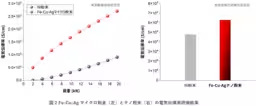
In terms of improving electrical conductivity, the new composite powders have demonstrated enhanced performance compared to nickel powders, independent of load conditions. Additionally, mechanical characteristics like hardness were evaluated through Vickers hardness tests, showing that the Fe-Cu-Ag micro-powder reached values around 127 HV, indicating promising durability and mechanical strength compared to traditional nickel powders.
Future Directions
The team plans to present further findings at the upcoming 87th Annual Meeting of the Japan Society of Applied Physics in September 2026, where they will delve into the comprehensive characterization of the newly developed composite powders. The researchers anticipate that their innovations will translate well into real-world applications, as they continue to verify the properties of these materials in practical semiconductor test socket contexts. The objective is to refine composition, particle size, and microstructure to optimize the materials for enhanced electrical characteristics and durability while reducing contact resistance.
Conclusion
In summary, the development of Fe-Cu-Ag composite powders represents a significant advancement in materials science, with the potential to substantially enhance the reliability of semiconductor testing processes. As the demand for more refined and effective testing solutions grows, the innovations derived from this research could pave the way for significant improvements in semiconductor technology going forward.
Topics Consumer Technology)
【About Using Articles】
You can freely use the title and article content by linking to the page where the article is posted.
※ Images cannot be used.
【About Links】
Links are free to use.