




Theoretical Model of Chiral One-Dimensional Perovskite Semiconductors
Theoretical Model of Chiral One-Dimensional Perovskite Semiconductors
Recent research has brought to light the fascinating properties of chiral one-dimensional perovskite semiconductors, which are hybrid materials combining organic chiral molecules with inorganic frameworks. This innovative structure allows for diverse electronic structures and optical characteristics, influenced by the specific materials used.
A research team, including Assistant Professor Yuya Ominato from Waseda University's Advanced Research Institute, Assistant Professor Tetsuya Furukawa from Tohoku University, Professor Ayumi Ishii from Waseda University, and Professor Tetsuaki Ito from Tokyo University of Science, built a theoretical model that deciphers the complex crystalline structures of these materials through symmetry clues. By using this approach, they successfully replicated the principal features of the electronic structure with only a few critical factors. In particular, they identified the elements that cause spin splitting, where energies are differentiated based on the orientation of electron spins.
Understanding the difference between the right-handed and left-handed forms of chiral crystals is pivotal; it corresponds to a simple flip of the sign of the elements involved in spin. The research aims to expand this model by integrating interactions with light, thereby simplifying the exploration of unique optical responses rooted in the chiral structure, which may contribute to advancements in optical sensing and photovoltaic devices.
Essentials of Chirality in Crystals
Chirality refers to structures that cannot be superimposed on their mirror images. This property is notably present in our right and left hands and is crucial in various biological molecules, such as amino acids and sugars, making it a significant concept across multiple scientific fields.
Challenges in Understanding Chiral Structures
In traditional solid-state physics, studies have primarily focused on inorganic crystals, with little emphasis on the systematically chiral characteristics that organic-inorganic hybrid semiconductors present. Chiral structures, including perovskite semiconductors, influence electron behavior significantly because their crystal symmetry impacts the electronic activity within.
Typically, it is difficult to systematically create right- and left-handed versions of inorganic crystals and manipulate the electronic structures through material selection. However, the chiral one-dimensional perovskite semiconductors, combining organic chiral molecules with an inorganic cage surrounding lead and iodine, enable this manipulation effectively.
Advancements in Research
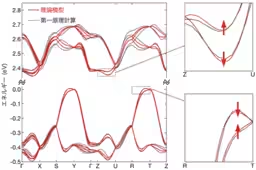
The research group conducted first-principle calculations previously which showed that the most prominent electronic states near the energy band edges were primarily associated with lead and iodine. They further demonstrated that energy bands split depending on electron spin, gaining insight into the electronic behavior observed within the materials.
Despite these advances, several challenges remain, especially in determining the minimal factors responsible for generating these electronic characteristics. The team’s theoretical model aims at simplifying the complexity by identifying these essential components, revealing how the chiral structure interplays with the observed physical phenomena.
Theoretical Framework Developed
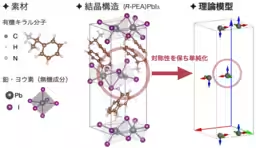
In their study, the researchers constructed a theoretical model fulfilling the symmetry requirements of the crystal structure. This model successfully captured the overall shape of the energy bands and recreated the spin-splitting behavior, estimating the origins of the splitting with respect to the unique structural elements within the crystal.
The model focuses on four sites within a repeating unit bound by symmetry, allowing it to simplify the complexities of individual atomic behaviors into functional, chiral components. By comparing results with previous calculations, they obtained a better understanding of how electron transitions occur between these sites, either moving directly to neighboring sites or skipping one, and how this variability links back to the crystal's handedness.
Societal Implications and Future Directions
The theoretical model not only presents a framework for current materials but also opens avenues for the evaluation of other chiral substances. With a specific parameter adjustment, researchers can quantitatively assess a material’s properties, fostering a unified understanding across various substances. The model's clarity and computational simplicity hold great potential for broad applications within organic-inorganic hybrid materials research.
Chirality strongly relates to the characteristics of electron spins and light polarization, making this model a critical starting point for further discussing how various elements create these connections. Enhanced understanding of these materials can lead to innovations in optics and electronics, introducing new devices that harness light's energy.
In the future, the research team aims to apply the theoretical model to calculate optical responses in these materials, focusing on circular dichroism and bulk photovoltaic effects. Such efforts will reinforce the understanding of how crystal chirality influences light responses.
Conclusion
Through collaboration among experts in physics and chemistry, the study lays a strong foundation for further exploration of how light interacts with chiral characteristics. By fostering connections among researchers focused on ‘light’ and ‘chirality’, the study aims to contribute significantly to the development of next-generation optical technologies.

Topics Consumer Products & Retail)



【About Using Articles】
You can freely use the title and article content by linking to the page where the article is posted.
※ Images cannot be used.
【About Links】
Links are free to use.