


Exploring the Potential of Semi-Natural Ecosystems in Solar Power Plants
Introduction
The transition to renewable energy sources is crucial for achieving a decarbonized society. However, the widespread construction of large-scale solar power facilities raises concerns about their detrimental impact on biodiversity. This article discusses recent findings from a study that highlights the potential for solar power plants to coexist harmoniously with natural ecosystems, particularly in forested landscapes. The research suggests that proper management can result in semi-natural ecosystems developing beneath solar panels, contributing to regional biodiversity.
Key Findings
1. Natural Vegetation Recovery: A large-scale solar power station, surrounded by forests and not covered with concrete, was investigated for its potential in natural vegetation recovery. The findings revealed the formation of plant communities similar to those found in forest edge areas, thriving under solar panels.
2. Biodiversity Maintenance: The diversity and number of plant species beneath the solar panels were comparable to nearby grasslands. Notably, there was no observed decline in biodiversity, nor an increase in invasive species, indicating a successful integration of solar energy production and ecological conservation.
3. Local Contribution to Biodiversity: The research demonstrated that when the ground surface is not covered with hard materials like concrete, solar power plants can help maintain local biodiversity, particularly when vegetation is managed appropriately.
Research Context
The global shift towards decarbonization has accelerated the implementation of renewable energy. Solar power installations have rapidly expanded, but their land use presents challenges, particularly concerning biodiversity loss. In regions such as Japan, solar facilities are frequently established in areas rich in natural environments, leading to societal concerns about biodiversity loss. Recently, the concept of "Ecovoltaics," which seeks to balance energy generation with ecological preservation, has gained traction. However, its applicability in the warm, humid, and rugged regions of Monsoon Asia had not been thoroughly explored until now.
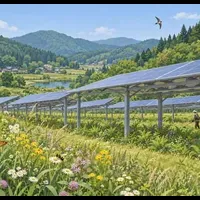
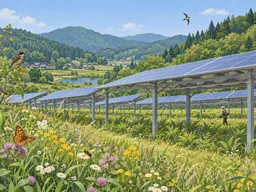
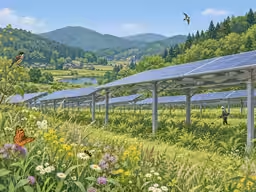
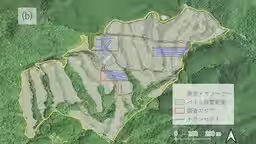
A research team from Tokyo Metropolitan University's Graduate School of Urban Environmental Sciences, led by PhD student Miharu Nakatani, along with Akira Noda and Takeshi Osawa, partnered with Pacifico Energy Co., Ltd. to investigate the forest-surrounded "Minami Mega Solar Power Plant" in Gifu Prefecture. This facility relies on regular grass cutting to maintain vegetation beneath the solar panels. The research revealed that diverse plant communities had naturally established in these areas, similar in diversity to those found at forest edges.
Detailed Research Findings
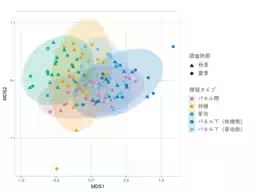
The study focused on the 169-hectare Minami Mega Solar Plant, where the ground is not covered in concrete and the station was managed solely through biannual mowing since its operation began in 2019. The investigation involved assessing vegetation under panels, between panels, and in surrounding grasslands and forest edges, revealing a total of 211 species belonging to 54 families. Significant similarities in species count and diversity were observed across the various environments. However, species compositions varied markedly, with panel areas showing characteristics more akin to forest edges. Particularly, many species of ferns, favoring forest environments, thrived under the panels due to the shading they provided, which appeared to facilitate the establishment of forest-originating plants.
Importance of the Research and Its Implications
This research is significant as it demonstrates that solar power plants can function not only as energy producers but also as contributors to biodiversity conservation, acting as semi-natural ecosystems. Unlike previous Ecovoltaics approaches that emphasized active management like seeding and planting, this study revealed that passive management through minimal interventions, like mowing, can sustain and enhance biodiversity. In regions of Monsoon Asia, including Japan, there are numerous small to medium-sized solar facilities near forests that could maintain natural vegetation without concrete surfaces. This passive approach could offer a low-cost means to integrate renewable energy production with biodiversity preservation, which the research refers to as "Passive Ecovoltaics."
The study aims to establish practical guidelines for coexisting renewable energy and natural preservation in the future. It is vital to evaluate applicable site conditions and effects on other biological groups to further develop this concept.
Conclusion
As the world increasingly turns towards renewable energies like solar power, it is essential to explore methods that balance energy production with environmental stewardship. The innovative findings from this research point towards a future where solar energy generation can help sustain and enhance biodiversity, thus potentially reshaping how we think about renewable energy infrastructures.
References
- - Published in: Journal of Environmental Management
- - Title: Passive Ecovoltaics: Solar power plants as semi-natural ecosystems via spontaneous succession in forest landscapes
- - Authors: Miharu Nakatani, Akira Noda, Takeshi Osawa
- - DOI: 10.1016/j.jenvman.2026.131014
- - URL: Journal of Environmental Management
Topics Energy)

【About Using Articles】
You can freely use the title and article content by linking to the page where the article is posted.
※ Images cannot be used.
【About Links】
Links are free to use.