



New Technology Enables Visual Exploration of Sound Characteristics for Music Production
Exploring Sounds Visually: A Paradigm Shift in Music Production
At the forefront of auditory innovation, a new technology developed by Miwa Yoneda, a graduate student at Kansai University, aims to revolutionize the way musicians and sound designers select audio tones. Collaborating under the guidance of Professor Yoshinori Yamanishi in the Graduate School of Informatics, this groundbreaking system will be unveiled at the upcoming Audio Developer Conference 2026 (ADC 2026) scheduled for June in Akihabara, Tokyo.
The Challenge of Audio Selection
In the realm of music and video production, artists often face the daunting task of sifting through extensive audio libraries that can contain hundreds to thousands of sound options. Unlike text or visual content, sound cannot be easily compared side by side; this unique characteristic creates significant challenges for sound selection. Traditionally, sound artists have relied on memory and repetitive listening, which can be time-consuming and inefficient when searching for the right audio tone.
Moreover, conventional methods tend to limit exploration based on categorical searches linked to specific instruments, such as "piano" or "guitar." This approach can constrict creativity, making it difficult for sound designers to explore sounds based on their qualities or similarities. As a result, the quest for the perfect sound often becomes a rigid and tedious process.
The Innovative Solution
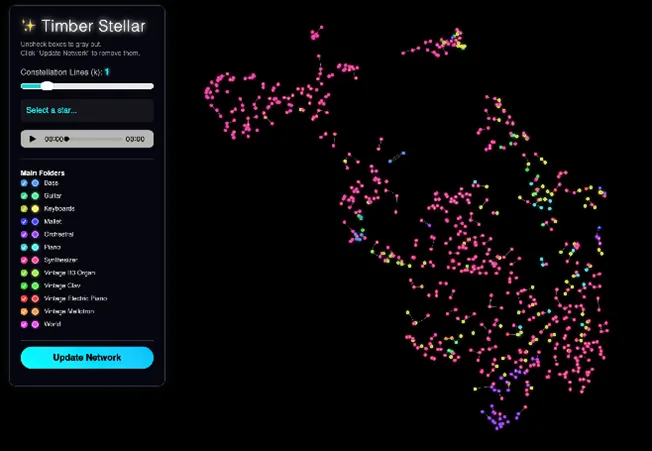
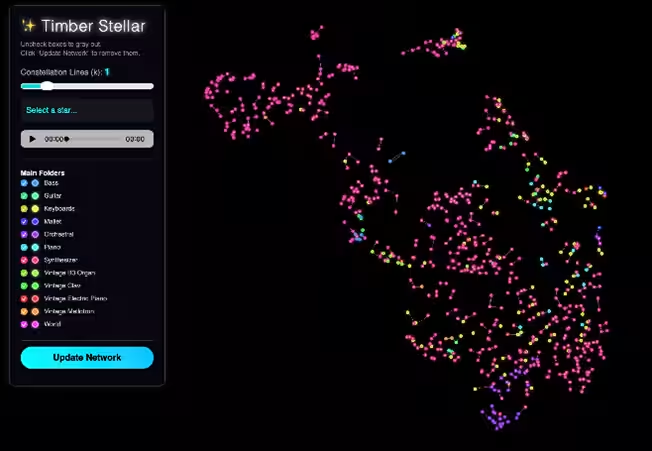
The research team has devised a new system that visualizes the relationships among various sound characteristics by calculating their similarity based on acoustic properties. This visualization operates on a network structure where sounds are represented as points; those that are sonically similar are placed closer together on this map. As a result, users can intuitively explore sound relationships and identify their desired audio more efficiently without the need for endless trial and error.
This system allows a more holistic view of sound exploration beyond traditional categories, promoting innovative combinations and discoveries across different genres. It not only facilitates rapid access to desired sounds but also encourages creativity by allowing users to think outside the conventional boundaries of sound classification.
Future Prospects
The implications of this technology extend far beyond music production. Industries that require meticulous sound design, such as automotive, industrial, and consumer electronics, can benefit from this innovative approach. For instance, designing alert sounds for vehicles or customizing the auditory environment in factories will rely on understanding the nuances of sound characteristics such as clarity and impression.
By visualizing relationships among different sounds, this technology has the potential to streamline audio design processes, reducing dependency on experience or trial-and-error methods. This alignment can lead to more precise sound selection and the creation of unique sound combinations.
Future directions include incorporating this technology into music production software and evolving it into a platform specifically aimed at sound design and exploration. The focus will be on optimizing the interface according to the needs of various industries while expanding the underlying data to meet specific applications.
Conference Presentation Details
- - Event: Audio Developer Conference 2026 (ADC 2026)
- - Presentation Title: An Interface That Expands the Possibilities of Tonal Selection by Transcending Fixed Concepts of Instrument Categories
- - Date & Time: June 3, 2026, from 14:00 to 15:00
- - Presenter: Miwa Yoneda, Graduate student, Kansai University
- - Advisor: Professor Yoshinori Yamanishi
This pioneering advancement in sound technology is poised to reshape how both artists and producers approach sound selection, ultimately enhancing the creative process within the music industry and beyond.
Topics Entertainment & Media)








【About Using Articles】
You can freely use the title and article content by linking to the page where the article is posted.
※ Images cannot be used.
【About Links】
Links are free to use.