



Exploring the Connection Between Culture and Japan's Economy through Data Insights
Understanding Japan's Economy Through Culture and Events
In today's world, economic discussions often feel daunting, particularly to those who lack specialized knowledge. However, the truth is that economics is fundamentally grounded in the everyday activities of people. These human actions are not merely mechanical; they are influenced by various factors beyond pure economic conditions. When certain social phenomena—those that resonate with national interests—come into play, they can significantly impact the overall economy. Conversely, economic trends can also reflect in these seemingly trivial occurrences.
This insight is drawn from my early experiences shortly after the establishment of Japan's bond futures market, where I served as an economist responsible for forecasting long-term interest rates at a major urban bank. Long-term interest rates fluctuate due to a mix of influences, including bond supply and demand, monetary policies, and the underlying fundamentals such as economic growth, prices, exchange rates, and global economic trends. Therefore, it's crucial to quickly grasp how these various factors will interact when making long-term interest rate forecasts.
Japan is renowned for its meticulously prepared economic statistics, which are incredibly useful for retrospective analyses. However, if such data isn't released in a timely manner, it becomes less beneficial for long-term interest rate forecasts. Thus, I began to explore prompt data sources and looked to everyday societal occurrences, uncovering numerous valuable datasets.
For instance, in the world of sumo wrestling, before each match, a white-robed attendant carries prize banners around the ring. Since only companies can sponsor these prizes, the abundance of banners often indicates an increase in corporate advertising spending and reflects a healthy corporate profitability backdrop. Furthermore, during the broadcasting of sumo matches on NHK, viewers can see changes in the number of prize banners in real time, acting as a litmus test for corporate spending trends—albeit with a reporting lag for other types of service industry data.
This approach can be likened to having warning signals when driving; if a driver sees signs indicating a red light up ahead, they can slow down preemptively to prepare for a full stop. While no dataset can guarantee perfect correlation, combining multiple accessible data points significantly improves forecasting accuracy.
I invite readers to delve into these everyday data sources that serve as accessible predictors of economic trends and see how they can reveal intriguing aspects of our economy.
Overview of the Book
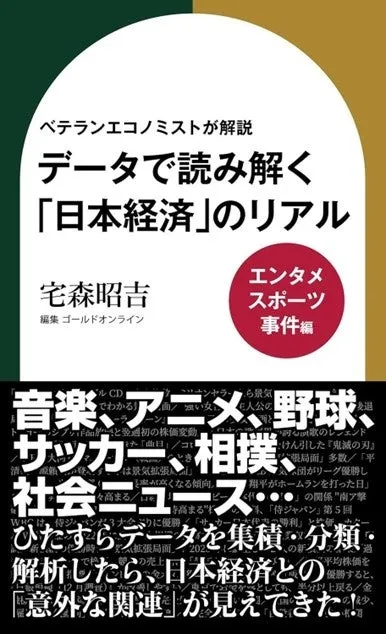
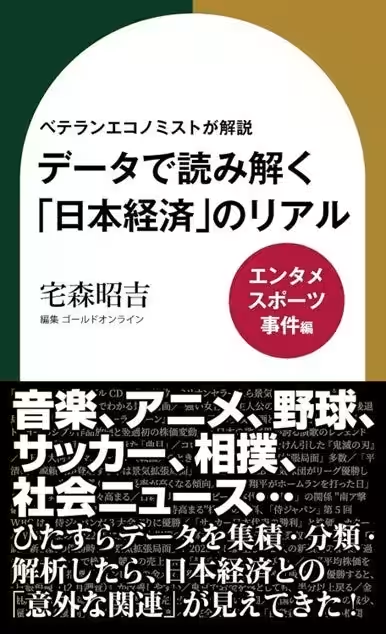
The eBook titled "Veteran Economists Analyze Data to Uncover Japan's Economic Reality [Entertainment, Sports & Events Edition]" published by Gentosha Gold Online explores this relationship and is set to be available for purchase on Amazon Kindle from December 2025.
Table of Contents
1. Introduction
2. Chapter 1: Nine Entertainment-Related Indicators
3. Chapter 2: Ten Sports-Related Indicators
4. Chapter 3: Four Key Indicators Related to Events
5. Conclusion
Who This Book Is For
- - Those interested in economics but find it challenging to grasp
- - Business professionals wanting to understand the connection between news, societal movements, and economics
- - Individuals keen on investment and asset management
Author Profile
Akio Takumori
An economist and economic explorer, Takumori has specialized in economic analysis after joining Mitsui Bank, followed by his appointment as Chief Economist at Sakura Securities. He has held similar chief economist roles at several prominent firms and became a freelance economist in April 2023. Currently, he is actively involved with the Economic Cycles Society of Japan.
Book Information
- - Title: "Veteran Economists Analyze Data to Uncover Japan's Economic Reality Entertainment, Sports & Events Edition]"
- - Publication Date: December 2025
- - Formats Available: Kindle eBook, Paperback
- - Purchase Link: [Amazon
Topics Other)
【About Using Articles】
You can freely use the title and article content by linking to the page where the article is posted.
※ Images cannot be used.
【About Links】
Links are free to use.