




Deciphering the New Mechanism Behind Fish Fin Diversity: A Study on Spiny Rays
Understanding the Evolution of Fish Fin Diversity
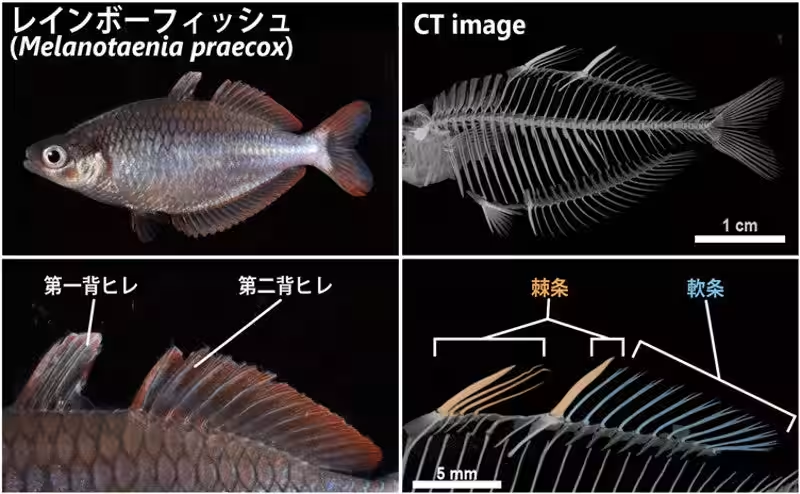
A collaborative research effort between Tohoku University and Okayama University has recently unlocked the secrets behind the remarkable variety of fish fin shapes. Focusing on the skeletal structure known as spiny rays, this groundbreaking study has provided detailed insights into their formation mechanisms at the cellular and molecular levels.
Innovations in Research Methodology
The research team, including graduate student Tomohiro Miyamoto and professor Koji Tamura from Tohoku University, partnered with various institutions such as Osaka University and Kyoto University to explore how spiny rays allow fish to develop unique forms. Unlike the traditional bone structure that typically forms in a rod-like shape, spiny rays exhibit an extraordinary diversity in their morphology, seen in species such as the suckerfish and anglerfish.
Through experimental studies utilizing rainbow fish as a model organism, researchers uncovered that the formation of spiny rays does not rely on the rod-like collagen typically essential for the development of standard fin scaffolding. This finding indicates that during the evolution of spiny rays, the growth processes can occur without the constraints imposed by this collagen structure.
Fascinating Observations on Ray Structures
To further elucidate these findings, the team observed the spiny rays in filefish, identifying that the absence of rod-like collagen offers the capacity for unrestricted growth directions. This crucial aspect serves as a key to understand how fish fins have evolved to adopt such diverse and complex shapes, paving the way for adaptive functionality in different aquatic environments.
Significance of the Study
Published on March 25, 2026, in the esteemed journal Nature Communications, the implications of this study extend beyond the realm of ichthyology. Understanding the underlying mechanisms of biological diversity holds potential insights into evolutionary processes, structural biology, and possibly even innovative applications in biomimicry and tissue engineering.
Conclusion
This innovative research marks a significant advancement in our grasp of fish fin evolution, particularly spiny rays. By delineating the unique developmental mechanisms that allow for diverse morphologies, the study sets the stage for continued exploration in evolutionary biology and related fields, highlighting the importance of interdisciplinary collaboration in scientific research.
For more detailed information on this research, visit the Nature Communications link here and for ongoing updates from Okayama University, check here.





Topics Other)







【About Using Articles】
You can freely use the title and article content by linking to the page where the article is posted.
※ Images cannot be used.
【About Links】
Links are free to use.