



The Theoretical Discovery of Angular Momentum Inversion in Magnetovortical Matter
Introduction
A recent study led by Kazuya Mameda from Tokyo University of Science and supported by prominent physicists such as Kenji Fukushima and Koichi Hattori has made a remarkable theoretical discovery regarding the behavior of angular momentum in magnetovortical matter under extreme conditions. This discovery highlights how in environments with strong magnetic fields and high rotation, the conventional understanding of angular momentum polarization is overturned.
Research Background
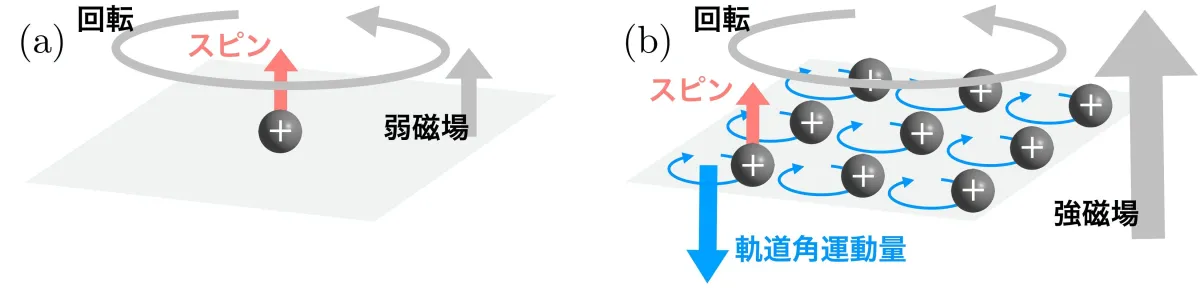
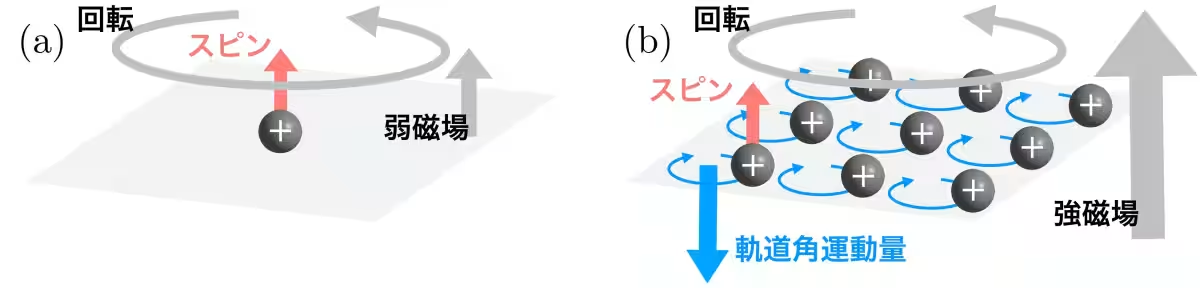
Angular momentum is a fundamental concept in modern physics that describes how rotating particles align in response to external magnetic fields. Traditionally, it has been believed that spin, which refers to a particle's inherent angular momentum, predominantly determines this polarization phenomenon. This understanding has shaped various fields, from material sciences to high-energy physics. Specifically, particles have been thought to align their spin with external magnetic fields, leading to what is called spin polarization (Figure (a)).
However, the new research suggests that in magnetovortical systems, where strong magnetic fields and rapid rotation coexist, the contribution of orbital angular momentum (the angular momentum due to the particle's motion through space) becomes more dominant than that of spin, resulting in a reversal of expected polarization direction (Figure (b)). This theoretical shift in understanding can lead to novel applications and experiments in physics.
Theoretical Framework
In order to understand the properties of magnetovortical matter, the researchers established a distribution function that maintains both gauge invariance and thermodynamic stability. This involved identifying the microscopic balance conditions that charged particles experience in such quantum systems. By doing so, they successfully derived a distribution function that eliminates non-physical divergences. This advancement plays a crucial role in bridging gauge theory and thermodynamics, demonstrating that these two foundational principles are intrinsically linked.
The newly derived distribution function allows for the calculation of various thermodynamic quantities, including the scenario where Dirac fermions—particles that include electrons and quarks—are analyzed in the context of strongly magnetic conditions. The results revealed a new type of polarization that runs counter to traditional expectations: rather than aligning with an external magnetic field, the system exhibits a polarization that opposes it due to the dominance of orbital angular momentum.
Implications of Research Findings
The implications of this research are profound. The inversion of angular momentum polarization leads to a reevaluation of physicists’ understanding of fundamental principles governing particle dynamics in extreme conditions. Furthermore, it suggests the potential for experimental validation through solid-state experiments and numerical simulations using supercomputers. Not only does this contribute to theoretical physics, but it may also influence practical applications in fields such as spintronics and orbtironics.
Additionally, this research could pave the way for exploring phenomena in relativistic nuclear collisions, where orbital angular momentum plays a significant role. The concept of the 'reverse Einstein-de Haas effect,' where systems could induce rotation in the opposite direction to expected outcomes in magnetic fields, is also put forth for experimental verification.
Conclusion
The study, which has been published online in the Physical Review Letters, represents a significant advancement in understanding angular momentum in quantum systems, offering a new theoretical platform for future investigations across a multitude of fields in physics. As research continues, this could lead to discoveries that not only enhance academic pursuits but also revolutionize technology in quantum materials and high-energy physics.
Acknowledgments
This research was made possible through support from the Japan Society for the Promotion of Science (JSPS) with several grant numbers (20K03948, 22H01216, 22H05118, 24K17052).
- ---
About the Authors
- - Kazuya Mameda: Assistant Professor at Tokyo University of Science, Research Fellow at RIKEN
- - Kenji Fukushima: Professor at the University of Tokyo
- - Koichi Hattori: Research Fellow at Zhejiang University
This comprehensive exploration into angular momentum inversion not only deepens theoretical perspectives but may also trigger novel experimental inquiries into the intricate dynamics of magnetovortical matter.
Topics Other)
【About Using Articles】
You can freely use the title and article content by linking to the page where the article is posted.
※ Images cannot be used.
【About Links】
Links are free to use.