




New Perspectives on the Origins of Life Through RNA Self-Replication and Molecular Mixing Dynamics
Introduction
In the quest to decipher the origins of life, researchers have long speculated about the roles played by self-replicating molecules and parasitic entities in evolutionary dynamics. A recent international research collaboration involving Waseda University and the Paris City Institute of Physics and Chemistry has revealed critical insights into how these molecules interact within droplet-like cellular structures and how their past states influence their current behaviors.
Findings
The study elucidates that while it has been posited that self-replicating RNA molecules evolve through interactions within microenclosed spaces, the specifics of how mixing dynamics among these compartments affects molecular replication had remained obscure. The researchers combined experimental models of self-replicating RNA and parasitic RNA with theoretical models, demonstrating that both the mixing characteristics of these compartments and their compositional memory—how past states influence current properties—play significant roles in the behavior of such molecular systems.
Published in the Proceedings of the National Academy of Sciences of the United States of America (PNAS) on April 15, 2026, this work advances our understanding of how life could emerge under specific environmental conditions. The findings also hold promising implications for innovative biotechnological applications such as artificial cell design.
Previous Understanding
Historically, it was understood that self-replicating RNA molecules form the building blocks of primitive life, evolving complexity over time. Nevertheless, the emergence of parasitic variants that could disrupt the preservation of genetic information posed significant challenges. The concept of compartmentalization—dividing molecules into smaller, cell-like spaces—has been proposed as a potential solution to mitigate these disruptors. By limiting interactions within compartments, the adverse effects of parasitic RNA could be curtailed.
Traditionally, theoretical models assumed that the contents of compartments completely mixed, neglecting the complexities of partial mixing and the retention of molecular composition over time. This oversight limited our understanding of the critical dynamics at play in molecular systems.
New Directions and Insights
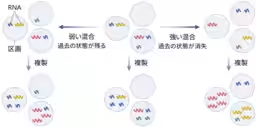
The researchers expanded conventional theoretical models to incorporate scenarios where compartments do not fully mix, introducing continuous parameters for mixing dynamics. This innovative framework allowed a coherent description of molecular behaviors ranging from completely unmixed to uniformly mixed states. Particularly noteworthy was the realization that the degree of mixing could dictate how compositional memory influences molecular interactions.
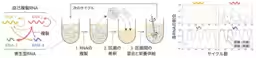
Creating an experimental setup using self-replicating RNA and parasitic RNA dispersed in oil droplets allowed for discrete compartmental behavior while facilitating RNA replication. Manipulating the mixing level across droplets revealed a fascinating trend: under conditions of weak mixing, pronounced variability in molecular compositions emerged, leading to a dominance of parasitic RNA. In contrast, stronger mixing resulted in spatial separation that favored the sustainability of self-replicating RNA. These experimental results validated the theoretical predictions, demonstrating consistency across both experimental and theoretical models.
In an extended replication experiment with multiple RNA types, dynamic coexisting behaviors were observed. Four RNA types demonstrated periodic population shifts, aligning with earlier predictions but previously lacking clarity. The research verified that moderate mixing conditions between droplets is crucial for fostering cohabitation, emphasizing the influence of compartment mixing dynamics on molecular coexistence.
Societal Implications
The implications of this study reach far beyond academic circles. By identifying specific factors that influence molecular behavior in the context of life's primordial environments, the research paves the way for more concrete discussions regarding early Earth conditions suitable for life's emergence. Moreover, the insights gleaned about the impact of controlled molecular mixing on behavior enhance the prospects of applications in synthetic biology and artificial cell design, particularly in the creation of evolving cellular systems.
Future Directions and Challenges
While this groundbreaking research has unveiled the implications of mixing dynamics on RNA self-replicating systems, future inquiries must address the long-term evolutionary influences of these mixing characteristics. Investigating how varying degrees of mixing affect RNA diversity evolution is essential. Moreover, exploring whether similar phenomena occur with different types of compartmental structures will be vital to understanding the origins of life further.
Conclusion
Ultimately, this research emphasizes the importance of understanding not only the compartmentalization of molecules but also their mixing interactions and historical contexts in unveiling the origins of life. By focusing on the interplay of these factors, we unlock essential clues to the conditions that sustained early molecular systems and may contribute to the future design of synthetic life forms.
Topics Other)
【About Using Articles】
You can freely use the title and article content by linking to the page where the article is posted.
※ Images cannot be used.
【About Links】
Links are free to use.