



Discovery of New MoSi2 Thermoelectric Material for Enhanced Efficiency Without Magnetic Field
Discovery of MoSi2: A Novel Thermoelectric Material
Researchers from Tokyo University of Science have unveiled a new thermoelectric material, MoSi2, which operates effectively without the need for magnetic fields. This groundbreaking discovery presents new possibilities for the field of thermoelectric conversion, which can convert waste heat into usable electric energy.
Summary of the Findings
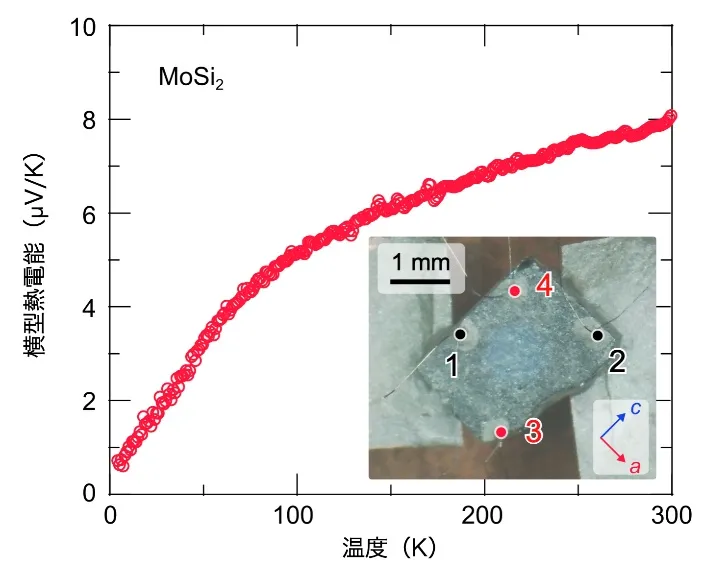
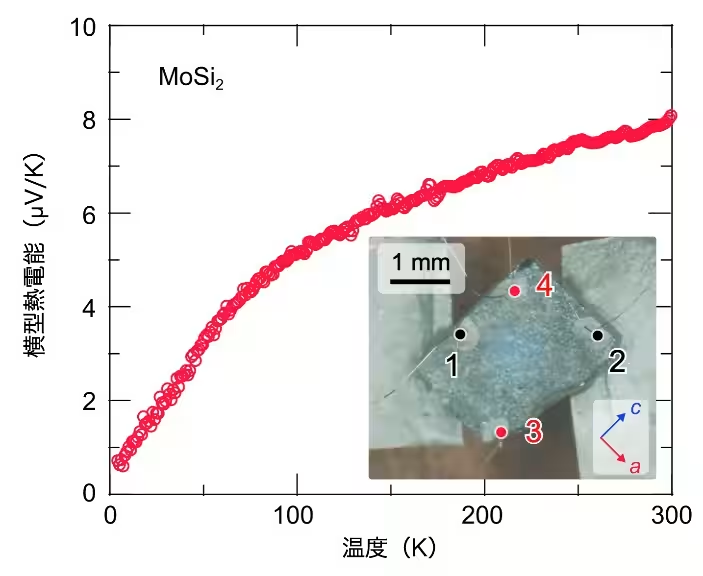
The study led by graduate students Hikari Manako and Shoya Ohsumi, along with assistant and associate professors Shogo Yoshida and Ryuji Okazaki, introduced MoSi2 as a promising candidate for horizontal thermoelectric conversion materials. Notably, MoSi2 achieved a thermoelectric power of 8 μV/K at room temperature, outpacing other materials, especially in low-temperature applications.
The team demonstrated that MoSi2 is a unique material as it does not require a magnetic field for its thermoelectric properties. This was a significant finding, as traditional thermoelectric materials often depend on external magnetic fields for their performance.
Research Context
Thermoelectric conversion, which refers to the process of turning temperature differences into electrical voltage, is gaining traction as a sustainable energy solution. Historically, thermoelectric materials utilized a vertical thermoelectric effect characterized by complex circuitry that introduces resistance and energy loss. In contrast, horizontal thermoelectric conversion has the potential to simplify manufacturing processes and resolve thermal loss issues by generating power perpendicular to the temperature gradient.
Previous studies have explored materials such as LaPt2B and WSi2, which also achieved thermoelectric conversion without external magnetic fields, but the search for suitable materials continued. MoSi2, a well-known refractory industrial material, has been suggested as a mixed-dimensional conductor, exhibiting aligned conduction polarities dependent on its crystal structure.
The research team utilized first-principles calculations to confirm the mechanisms behind MoSi2’s properties, establishing its potential for effective thermoelectric conversion.
Detailed Findings
To validate their hypothesis, the researchers synthesized high-quality single crystals of MoSi2. Measurements demonstrated that along the a-axis, the thermoelectric power was positive (p-type), while along the c-axis, it was negative (n-type), showcasing a clear axis-dependent conduction polarity. This polarity independence is crucial for enhancing thermoelectric efficiency.
Their calculations revealed two Fermi surfaces within MoSi2, contributing to its mixed-dimensional conductor characteristics. The performance of MoSi2 was compared to WSi2, highlighting that the 4d orbitals of molybdenum resulted in narrower band widths, leading to superior thermoelectric power.
As a result, the material exhibited a room temperature thermoelectric power that was almost double that of WSi2, setting a new standard for horizontal thermoelectric materials.
Furthermore, the measurements confirmed that MoSi2 generated significant electromotive force perpendicular to the temperature gradient, further validating its effectiveness as a horizontal thermoelectric material. The results indicate impressive performance over a wider temperature range, particularly at lower temperatures compared to existing materials.
This innovative research signals a pivotal advancement towards developing efficient horizontal thermoelectric modules and sets the stage for further exploration and application of mixed-dimensional conductors in thermoelectric conversion.
Conclusion
The implications of this study are vast as it not only introduces a new material with outstanding thermoelectric properties but also ignites interest in future research directions focusing on materials that can effectively operate in both low and high-temperature environments. This new discovery is a step forward in creating more efficient systems for converting waste heat into electricity, aligning with global efforts toward sustainable energy consumption.
The findings were published in December 2025 in the prestigious journal Communications Materials and showcase the innovative spirit of the research group at Tokyo University of Science.
References
- - Axis-Dependent Conduction Polarity and Transverse Thermoelectric Conversion in the Mixed-dimensional Semimetal MoSi2
- - Authors: Hikari Manako, Shoya Ohsumi, Shogo Yoshida, Ryuji Okazaki, Yoshiki Sato
- - DOI: 10.1038/s43246-025-01050-4
Topics Consumer Technology)
【About Using Articles】
You can freely use the title and article content by linking to the page where the article is posted.
※ Images cannot be used.
【About Links】
Links are free to use.