




Space Quarters Selected for Lunar Infrastructure Project with JAXA's Space Strategy Fund
Space Quarters Selected for Innovative Lunar Infrastructure Project
Space Quarters, based in Shibuya, Tokyo, has recently been selected as a collaborative organization in the second phase of the Space Strategy Fund project announced by the Japan Aerospace Exploration Agency (JAXA). The project, titled "Development of Elemental Technologies to Contribute to Lunar Infrastructure Construction," is led by Professor Kazuya Yoshida from Tohoku University and focuses on utilizing lunar regolith to construct essential infrastructure for future lunar activities.
Overview of the Project
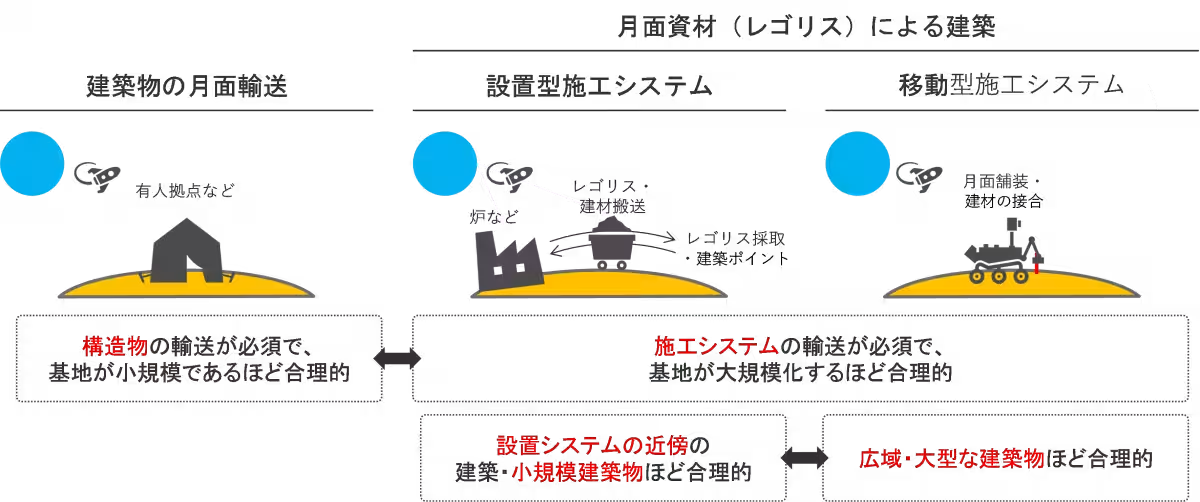
In recent years, there has been a surge in exploration initiatives aimed at establishing sustainable bases on the Moon, driven by both national space agencies and private enterprises. A significant challenge for future lunar activities is the extremely high cost of transporting materials from Earth. To overcome this obstacle, it is crucial to develop technologies that can utilize widely available lunar regolith on-site to construct necessary structures.
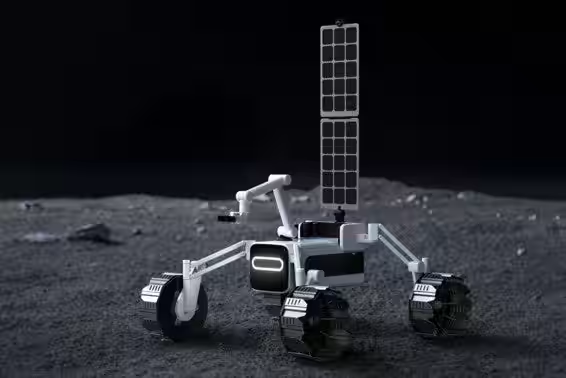
The primary objective of this project is to demonstrate the production of construction materials directly on the lunar surface by melting and solidifying regolith using an electron beam. This method aims to establish foundational technologies for forming infrastructure like landing pads and roadways directly on the Moon. Additionally, a multifunctional lunar mobile construction robot will be developed to perform construction tasks under simulated real-environment conditions, working toward a comprehensive technological framework necessary for creating a lunar base.
To ensure the project's success, the research will be led by Professor Kazuya Yoshida, who has previously spearheaded Team HAKUTO in the Google Lunar XPRIZE competition and managed a recent moonshot-type research and development project. The collaborative team consists of Space Quarters and four other private enterprises, all dedicated to advancing technological development for this initiative.
Moreover, this project will also explore the potential integration of high-precision landing technology under development by other entities into innovative, high-precision landing vehicles tasked with lunar demonstrations.
In this endeavor, Space Quarters will be responsible for developing the core technology of electron beam irradiation devices as well as the melting and solidifying techniques for regolith using electron beams. Leveraging the high-voltage electron beam technology that the company has refined since its founding and its pioneering efforts in the electron beam melting of regolith, Space Quarters aims to significantly contribute to the success of this mission, reinforcing humanity's efforts in lunar exploration and enhancing Japan’s international competitiveness.
The Superiority of the Mobile Robot and Electron Beam-based Regolith Melting and Solidification Technology
The motivation behind developing construction techniques utilizing lunar regolith lies in addressing the exorbitant costs associated with transporting materials to the Moon. Current estimates suggest that transporting one kilogram of materials from Earth to the Moon could cost between 150 million and 200 million yen. There are limitations regarding the weight and dimensions of goods that can be transported. Additionally, one must also consider transportation costs on the lunar surface due to complexities ranging from communication and energy issues to the environmental and geographical challenges of lunar soils.
This brings us to an ideal scenario of using lunar regolith, a resource abundantly available on the Moon, to develop construction techniques that do not rely on materials transported from Earth. However, using regolith presents challenges primarily due to its low thermal conductivity. Composed of a fine mix of ceramics, regolith’s thermal conductivity properties are particularly problematic in vacuum conditions. Previous studies utilizing lasers showed that even tests at outputs greater than 10 kW struggled to penetrate deeper layers, resulting in only surface-level heating and significant thermal challenges.
On the contrary, our project’s electron beam technology has distinct advantages. It utilizes high energy density to move through the melting area, allowing for direct heat penetration into the material, irrespective of its thermal conductivity. This capability enables efficient melting of regolith to substantial depths in a much shorter timeframe, leading to the creation of thick solidified materials, thus establishing construction techniques that leverage local resources on the lunar surface.
About Space Quarters
Space Quarters is an innovative startup established to further humanity's potential by developing technologies to make space a viable living environment. Focused on paving the way for space construction—an area yet to be fully realized by humankind—the company is engaged in creating pioneering space infrastructure through the development of high-voltage electron beam systems and robotic construction technologies.
- - Established: June 2022
- - CEO: Masahiro Onishi
- - Employees: 20
- - Headquarters: Shibuya, Tokyo
- - Laboratory Location: Kawasaki, Kanagawa
- - US Branch: Palo Alto, CA, USA
- - Website: Space Quarters
For media inquiries, please contact:
- - Public Relations Team
- - Email: [email protected]

Topics Consumer Technology)
【About Using Articles】
You can freely use the title and article content by linking to the page where the article is posted.
※ Images cannot be used.
【About Links】
Links are free to use.