




New Breakthrough in Paleoproteomics: Visualizing Ancient Proteins in Fossils
A Milestone in Paleoproteomics: Unveiling Ancient Proteins
In a groundbreaking study, researchers from Okayama University, together with academics from the University of Manitoba and several institutions in Japan, have made a significant advancement in the field of paleoproteomics. They developed a novel technology that can detect and visualize ancient proteins in fossils without altering their structural integrity. This innovative technique not only applies to fossils of several thousand years old but could also hold the promise of extracting proteins from dinosaur remains, potentially reshaping our understanding of ancient life.
The unveiling of proteins that have survived in fossils has garnered increasing attention in recent years through the emerging discipline of paleoproteomics, which examines how extinct organisms evolved over time. However, the challenge lies in the scant amount of such proteins remaining in fossils and the risk of contamination from external sources. Consequently, verifying whether the analyzed proteins are indeed endogenous (originating from the fossil itself) has remained a significant hurdle.
To tackle this issue, the research team implemented a specialized staining technique on thin slices of fossils, referred to as 'polished specimens.' They applied a staining method tailored to specifically highlight collagen—an essential protein found in bones. This approach allowed the researchers to successfully visualize the presence and distribution of proteins in the fossils while maintaining their microstructural integrity. This achievement marks the first instance of such a technique being utilized worldwide.
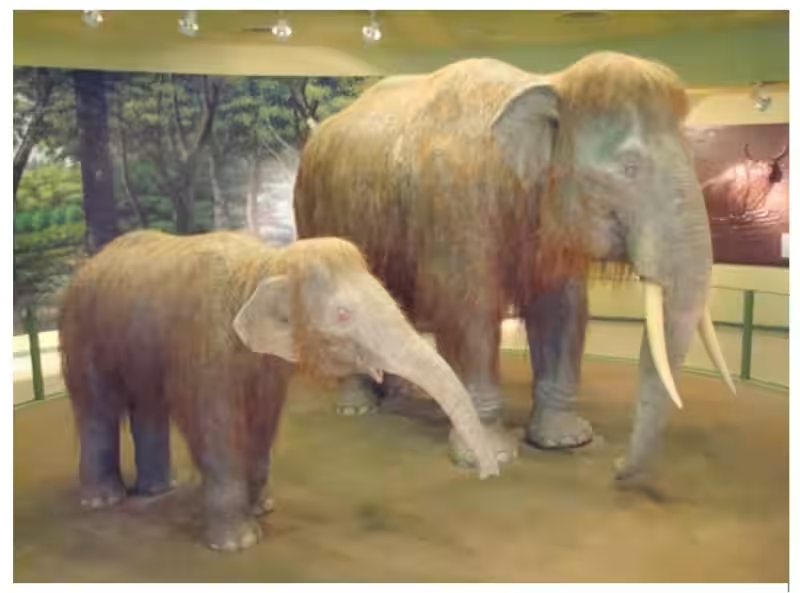
Moreover, by combining this visualization with quantitative and mass spectrometry analyses, the team was able to robustly demonstrate that the stained proteins were, indeed, endogenous to the ancient elephants that lived tens of thousands of years ago. This finding not only validates their method but also enhances its credibility as a screening tool for selecting fossils that are likely to retain proteins well before engaging in costly and complex analyses.
This new approach holds immense promise for paleoproteomics, significantly facilitating further research into ancient life forms. By allowing scientists to identify well-preserved specimens, they can pave the way for potentially extracting proteins from even older fossils, including those of dinosaurs. This could vastly improve the accuracy of species identification and deepen our insights into the evolutionary pathways of extinct organisms.
Implications for Future Research
The successful application of this technique could lead to a paradigm shift in our understanding of the evolutionary history of dinosaurs and other long-extinct creatures. As the technology matures, it offers exciting possibilities for reconstructing ancient biological information, which has long been constrained by the limits of traditional fossil analysis. Notably, the interdisciplinary collaboration among the involved institutions is crucial in driving research forward, fostering innovation, and enhancing knowledge transfer across fields.
Conclusion
In summary, this collaborative effort by Okayama University and its partners has laid down a crucial foundation for the future of paleobiological research. By enabling the visualization and identification of ancient proteins in fossils, researchers are equipped with a powerful tool that opens the doors to innumerable discoveries regarding our planet's biological heritage. As we stand on the brink of redefining our understanding of ancient life, the implications of this breakthrough will likely reverberate through various domains of science for years to come.
References:
- - Inaba, H., Chiba, K., Saneyoshi, M., et al. (2025). Journal of Proteome Research. DOI: 10.1021/acs.jproteome.5c00078
This technique was successfully announced on July 18, 2025, and further inquiries can be addressed to the research departments at Okayama University.




Topics Other)
【About Using Articles】
You can freely use the title and article content by linking to the page where the article is posted.
※ Images cannot be used.
【About Links】
Links are free to use.