



Creating an AI Optical Network to Drive New Growth During the AI Era
The AI-ON Summit: A New Era for Optical Networks
On June 26, 2026, the AI-ON Summit was successfully hosted at MWC Shanghai. Gathering leaders from multiple sectors, including China's Ministry of Industry and Information Technology, the summit focused on the theme "Networks for AI, AI for Networks." High-profile speakers and industry experts presented insights on the burgeoning field of AI-optical networks, highlighting the potential and challenges of incorporating advanced technologies into telecommunications.
The event's agenda included discussions on the trends surrounding optical networks as they align with token monetization strategies. Numerous participants shared practical experiences focusing on innovative service packages, boasting speeds up to 10 Gbps, alongside crucial advancements in network and computing integration.
One of the key highlights was Huawei's presentation of ten groundbreaking AI-ON products and solutions designed to empower operators to develop fully AI-oriented optical networks, thereby accelerating the adoption of AI services. Kim Jin, Vice President of Huawei’s Optical Business Product Line, led the discussions and emphasized the importance of merging optical technology with artificial intelligence.
Vision for the Future of Optical Networks
In October 2025, the International Telecommunication Union (ITU) unveiled its ION-2030 vision, setting a strategic direction for next-generation optical networks. Insights from Ao Li, the CAICT vice president, underscored a future where optical technology and AI synergistically boost efficiency. "The interplay of optical networks and AI will enable us to advance towards autonomous high-level networks that support widespread computing applications," he shared.
As the Chinese telecommunications landscape transitions from broad 'gigabit everywhere' connectivity toward expansion into 10G services, the focus on ultra-gigabit broadband and enhanced service quality is paramount. The introduction of millisecond-level computing signals a shift towards large-scale deployments, which are vital for establishing robust purely optical infrastructure to support the digital economy.
Operators Transitioning to a Value-Driven Operation Era
The gathering served as a platform for telecommunications giants like China Mobile, China Telecom, China Unicom, Zain Jordan, and Shunwang Technology to exchange their latest AI-driven operational strategies. With significant advancements in bandwidth speeds, these companies are enhancing their home broadband offerings through improved connectivity, yielding smarter services and proactive support. This transformation offers superior AI application experiences and premium broadband services, aligned with high-quality access and computing capabilities crucial for businesses.
The operational edge afforded by AI allows for an exciting avenue where operators can access greater value in their existing frameworks, expanding their value-added services and navigating avenues for sustainable growth. By integrating intelligent enhancements, they are maximizing the potential of their installed bases.
Huawei's Technological Innovations
To facilitate the swift transition into the token monetization era, Huawei has strategically revamped its range of ten innovative AI-ON products and solutions. Kim Jin remarked, "We are advancing our optical and AI convergence strategy to promote collaborative development across technologies. Our AI-FAN and AI-OTN product series empower operators to create AI-targeted optical networks that achieve high-value ultra-gigabit operations, improving user access to high-quality computing and promoting widespread adoption of AI services."
To further democratize ultra-gigabit technology, Huawei unveiled a new suite of AI-FTTR products, including an AI-enabled home hub and smart box, along with dual- and tri-band Wi-Fi 7 FTTR products. In a bid to lead the 10 Gbps market, Huawei has released the industry's first high-density 50G PON service card for large-scale commercial use, accompanied by updates of the 50G PON FTTR for tri-band Wi-Fi 7 compatibility.
For one-millisecond computing needs, Huawei introduced three solutions—Mini OXC, end-to-end OSU/fgOTN, and integrated OTN and QKD technology. To seize emerging opportunities in both national and international Data Center Interconnect (DCI), Huawei rolled out the sole sector's ultralarge OTN cluster solution coupled with an integrated submarine-terrestrial cabling solution. Production innovations also featured new resilient network solutions like AI DAS, designed to ensure network resilience.
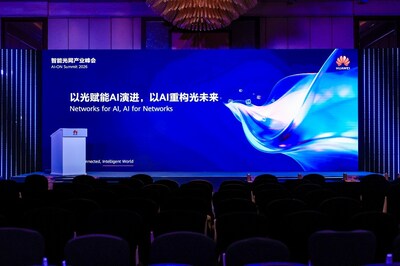
These developments and discussions from the AI-ON Summit paint an optimistic picture for the role of AI in shaping the future of optical networks. As operators and stakeholders align their strategies and technologies, the coming years will undoubtedly witness significant advancements in this critical sector.
Topics Telecommunications)
【About Using Articles】
You can freely use the title and article content by linking to the page where the article is posted.
※ Images cannot be used.
【About Links】
Links are free to use.