



First Visualization of Monolayer Ice Structure Reveals Unique Ferroaxial Order of Water Molecules
A Pioneering Insight into Monolayer Ice Structure
A significant advancement in understanding the interplay of molecular structures and their behavior has emerged from a collaborative research effort involving Shizuoka University, Tokyo University, Okayama University, Hiroshima University, and several other esteemed institutions.
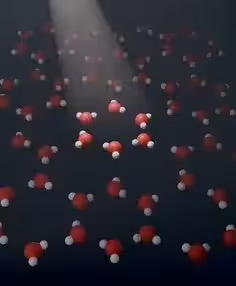
On February 21, 2026, a remarkable finding was announced: for the first time, researchers have visualized the structure of monolayer ice, revealing a previously unobserved arrangement known as ferroaxial order. This phenomenon occurs through the establishment of a swirling orientation of water molecules trapped in a two-dimensional format.
Key Highlights of the Research
The research group, led by Associate Professor Hajihiro Nomura from Shizuoka University, unearthed crucial insights into how single-layer ice retains its unique configuration. The study emphasizes that the molecules are arranged on a honeycomb lattice within a mineral called martyite. Unlike regular three-dimensional ice, these water molecules spin freely at room temperature. However, as temperature decreases, they align themselves into a swirling structure, demonstrating a distinct ferroaxial order.
- - Mineral Context: The research shines a spotlight on the role of martyite as a medium that constrains water molecules in a two-dimensional space, resembling monolayer ice.
- - Experimental Techniques: Through a combination of synchrotron X-ray diffraction and molecular dynamics calculations, the team meticulously examined the structural order of the 2D water.
The study's surprising revelation indicates that the 2D ice structure is complex, raising intriguing questions about the fundamental nature of water itself. This work serves as a vital stepping stone for future ice research, especially with implications for both theoretical and applied sciences.
Importance of Findings
This discovery not only expands our understanding of water's molecular behavior but also sets the stage for exploring how two-dimensional ice can influence the properties of three-dimensional ice structures. Given that water is essential to life on Earth, these insights exemplify the intricate mysteries that lie within this ubiquitous substance.
Indeed, the research team, including co-authors from various prestigious institutions, expressed immense satisfaction with shedding light on such a critical yet enigmatic aspect of water. They conveyed that understanding this new form of ice might help unlock solutions to longstanding questions in both basic and applied research focusing on water.
The results of this significant study were officially published in the Journal of the American Chemical Society on February 13, 2026, under the title "Ferroaxial order of the monolayer ice in martyite". The work was supported by several grants from the Japan Society for the Promotion of Science, demonstrating a commitment to advancing scientific research in this area.
Contribution to Future Research
Hajihiro Nomura comments, "Water, as a source of life, has been at the core of many scientific inquiries. The opportunity to illuminate a new facet of water through the study of 2D ice fills us with joy and excitement.” The road ahead promises further exploration of the implications of these findings, highlighting the continuing challenges and marvels present within such a common yet extraordinary substance.
This innovative research represents a critical milestone in the scientific community's ongoing endeavor to unravel the complexities surrounding water, a vital resource for all living beings. The knowledge gained here not only enhances academic understanding but may also lead to practical applications across various scientific fields. As research continues to unfold, we anticipate further discoveries that could influence both fundamental science and real-world applications, elevating our comprehension of water's role in our lives and the broader environment.
Further Exploration
For those interested in delving deeper into this fascinating research, additional details are available in the published paper here.

Topics Other)
【About Using Articles】
You can freely use the title and article content by linking to the page where the article is posted.
※ Images cannot be used.
【About Links】
Links are free to use.