



Unveiling the Meaning of Clinical in Clinical Organizational Science Through Schein's Process Consultation
Understanding the Clinical Aspect of Clinical Organizational Science (COS)
In the realm of Clinical Organizational Science (COS), the term 'Clinical' transcends its conventional ties to clinical neuroscience. Instead, it encapsulates a continuous involvement with organizations in alignment with Schein's process consultation approach. This integration positions COS as a pioneering field that draws from complex systems science and neuroscience to analyze and design the 'invisible interaction structures' within organizations.
The Tokyo-based research firm, DroR, led by CEO Makoto Yamanaka, has contributed significantly to this field, presenting a paper titled Clinical Organizational Science: An Integrative Framework for Structural Intervention in Complex Organizations. This important work has been published in the organizational psychology section of the international journal Frontiers in Psychology. The research addresses the core issues within COS and outlines how these clinical principles connect to existing theoretical frameworks while also paving the way for potential new inquiries within the domain.
The Fixed Definition of COS
COS is characterized as an integrative framework that synthesizes complex systems science, neuroscience, organizational psychology, and behavioral science to theorize interaction structures that actively reproduce the stable state of organizations. By perceiving organizational change not merely as a transformation of individual behaviors but as a transition of organizational attractors, COS offers methodologies such as Field Gradient Theory, Loop Conversion Design, and Neural Base Design. Moreover, it introduces the concept of the 'emergence bridge' as a connection between individual habits and changes at the organizational level.
Schein’s Process Consultation Approach
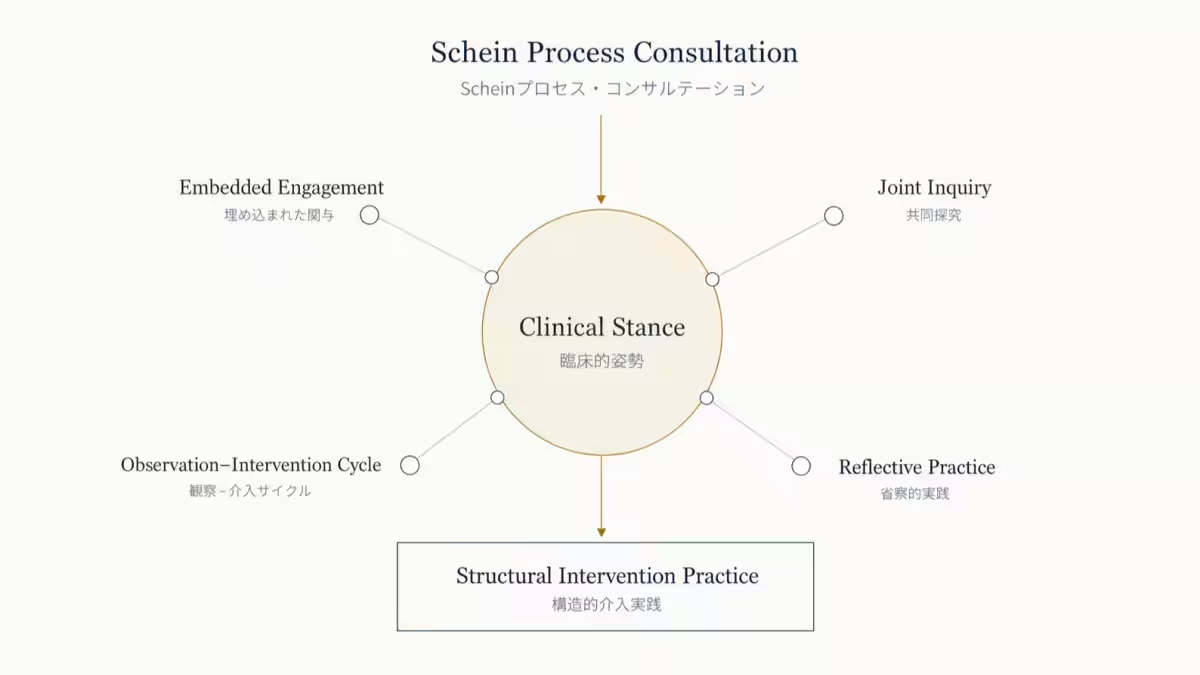
Edgar H. Schein's process consultation introduces an alternate paradigm for organizational support that diverges from traditional models wherein an outside expert diagnoses issues and prescribes solutions. According to Schein, organizational problems should not be unilaterally defined by outsiders. Instead, they require a collaborative exploration with organizational members to observe, understand, and intervene in the dynamics at play. The essence of COS's 'Clinical' aspect is deeply intertwined with this philosophy, emphasizing an enduring, participatory stance rather than merely applying medical or neurological interventions.
Embracing COS's Clinical Stance
Practitioners within COS do not practice from a distance, diagnosing and prescribing solutions from above. They immerse themselves within the organization—engaging continuously through BPO contracts and participating in daily meetings, feedback sessions, and problem-sharing discussions to observe interaction structures closely. This clinical approach underscores Makoto Yamanaka’s commitment to intertwining organizational practice and societal implementation. DroR emphasizes that research should not end with the publication of papers; instead, it must involve observing within the field, returning theory to practice, and iteratively enhancing theory through practical insights.
Clarifying the Meaning of 'Clinical'
In the COS framework, 'Clinical' does not denote methodologies associated with clinical neuroscience or medical interventions. COS is not engaged in neuro-measurements, neuro-stimulations, or pharmacological interventions. Rather, it signifies a profound commitment to immersive observation and iterative intervention within organizational systems. This distinction is crucial for avoiding misinterpretations of COS, as the term 'Clinical' speaks more to the depth of involvement in organizational contexts rather than any direct medical or physiological applications.
Statement from CEO Makoto Yamanaka
Makoto Yamanaka emphasizes the significance of the term 'Clinical' in COS: "For us, it is vital not to simply diagnose from the outside and leave after providing a report. We must remain embedded within the organization, continually observing interactions and making adjustments as necessary. While this may not align with traditional consulting efficiencies, we believe that achieving a true understanding of organizational interaction structures necessitates such deep involvement. We connect the clinical stance derived from Schein’s heritage with the architectural framework of structural interventions in COS."
Positioning This Release as a Conceptual Analysis
The recent paper published by DroR serves as a conceptual analysis proposing a theoretical framework intended to integrate existing scattered scientific knowledge while redefining organizational change as a structural intervention challenge. Each technique presented in this paper does not claim to have undergone complete validation at this point. Rather, it aims to set forth propositions that require future verification and refutation, outlining the connection COS has with existing theories without asserting its displacement of them.
Moreover, it actively repositions knowledge from fields such as psychological safety, organizational routines, complex adaptive systems, field theory, cybernetics, behavioral science, and implementation science through the lens of structural interventions.
Upcoming Series Highlight
On June 2nd, a next session entitled Clinical Organizational Science (COS) and Fogg's Tiny Habits – Conditions Underlying Change in Organizational Structures will be released. This will provide a detailed analysis of habit formation principles within the context of Neural Base Design.
About the Publication
The paper titled Clinical Organizational Science: An Integrative Framework for Structural Intervention in Complex Organizations has been published in the organizational psychology section of Frontiers in Psychology, an international peer-reviewed journal covering psychology, cognitive science, and organizational psychology. It is presented as a Conceptual Analysis.
For more information on DroR and their commitment to COS, please visit their official site: DroR.
Topics Business Technology)
【About Using Articles】
You can freely use the title and article content by linking to the page where the article is posted.
※ Images cannot be used.
【About Links】
Links are free to use.