



The Hibiya Music Festival 2026: A Sustainable Approach and CO2 Emission Analysis
Hibiya Music Festival 2026: Eco-Friendly Initiatives and Emission Findings
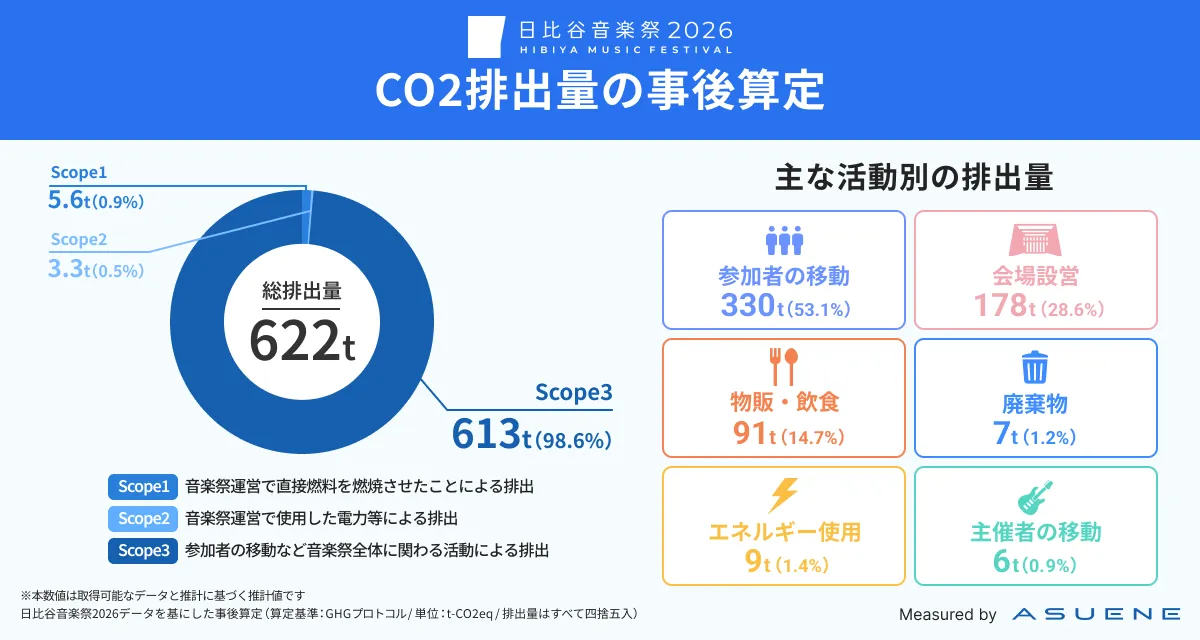
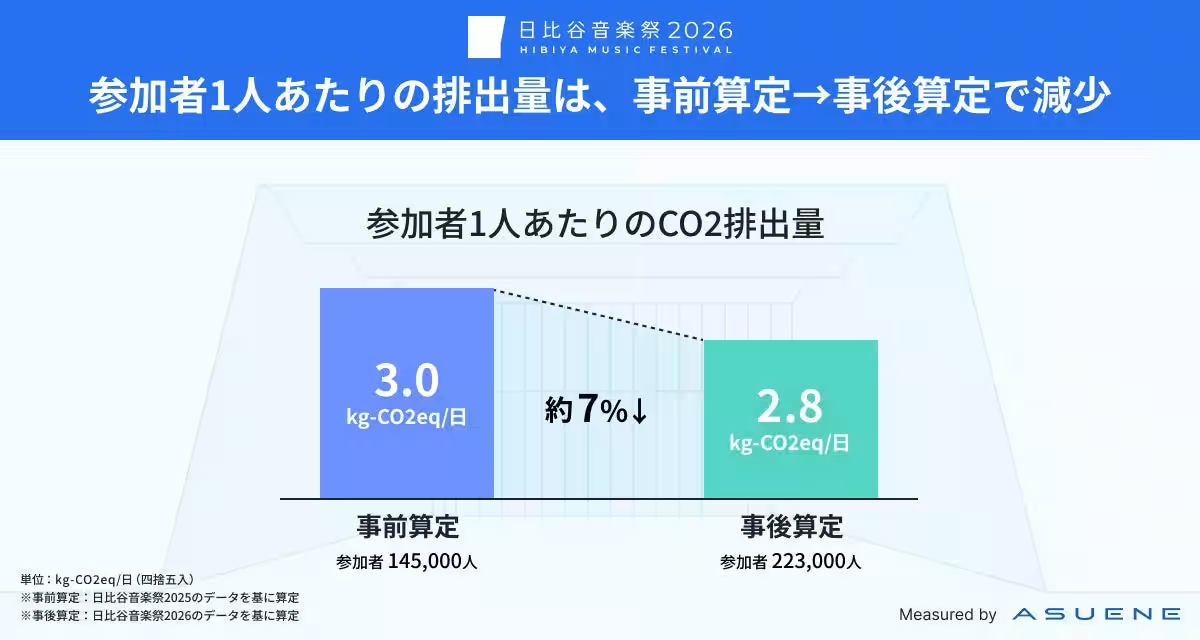
Asuene Co., Ltd., headquartered in Minato Ward, Tokyo, has announced the carbon dioxide (CO2) emissions for the Hibiya Music Festival 2026, where they served as the first environmental partner of the event. Held on May 30 and 31, the festival saw a remarkable increase in attendance, drawing over 220,000 visitors—more than a 50% increase from 145,000 attendees in the previous year. This tremendous turnout led to a total CO2 emission of 621.60 metric tons CO2 equivalent (t-CO2eq), exceeding the pre-calculated estimate of 436.32 t-CO2eq based on the 2025 festival's attendance.
Despite the increase in total emissions, the per capita CO2 emissions decreased from 3.0 kg-CO2eq to 2.8 kg-CO2eq. This figure demonstrates a significant reduction in the environmental impact per attendee, suggesting that it is possible to deliver an enriching music experience while minimizing individual carbon footprints.
Detailed Breakdown of CO2 Emissions
For the calculations, Asuene focused on Scopes 1, 2, and 3 emissions, which encompass direct emission sources from the event organizers, electricity consumption at the venue, as well as emissions linked to participant and organizer movements, venue setup, food and merchandise sales, and waste management. By gathering available data and using estimations for challenging calculations, they achieved an accurate assessment of the festival's carbon emissions.
- - Total CO2 Emissions: 621 t-CO2eq
- Venue Setup: 178 t-CO2eq (28.6%)
- Food and Merchandise Sales: 91 t-CO2eq (14.7%)
- Energy Consumption: 9 t-CO2eq (1.4%)
- Waste: 7 t-CO2eq (1.2%)
- Organizer Movements: 6 t-CO2eq (0.9%)
The increase in attendance significantly impacted the overall emissions. The festival's capacity expanded as the venue was moved to accommodate construction at the Hibiya Open-Air Music Hall, utilizing the Tokyo International Forum Hall A for the first time, and connecting the surrounding areas of Hibiya Park and Tokyo Midtown Hibiya.
Visitor Impact and Emission Efficiency
The remarkable growth in attendee numbers directly influenced the per capita emissions, as the rate of increase in visitors surpassed the overall emissions hike. Reducing individual emissions to approximately 2.8 kg-CO2eq puts the festival's sustainability approach within one-fourth of the global average of 11 kg-CO2eq for music festivals, a significant achievement that reflects successful environmental measures implemented this year.
Notably, the Hibiya Music Festival is popular for its accessibility, featuring no ticket fees and an open invitation to anyone wishing to enjoy live music. Many attendees arrive by walking or utilizing public transport, further contributing to the lower per capita emissions.
Moving forward, the festival organizers plan to make the event more sustainable by implementing carbon offset strategies aimed at achieving a carbon-neutral outcome through continuous adaptation and assessment of emission metrics.
Special Dialogue Release
In conjunction with the emission report, Asuene Media has published an exclusive dialogue discussing the connections between events, companies, and consumers. The conversation involves key insights from the festival organizers, partner corporations like Suntory Co., Ltd., and Asuene, focusing on how events can promote understanding and action regarding sustainability within society.
For detailed information on the Hibiya Music Festival 2026:
- - Event Name: Hibiya Music Festival 2026
- - Dates: May 30 and 31, 2026
- - Admission: Free (some paid programs available)
- - Organizer: Hibiya Music Festival Executive Committee / General Incorporated Association Hibiya Music Festival
- - Venue: Hibiya Park / Tokyo Midtown Hibiya / Tokyo International Forum Hall A
For more details about Asuene:
- - Company Name: Asuene Co., Ltd.
- - Capital: 15.1 billion yen (including capital surplus)
- - CEO: Kohei Nishiwada, Founder
- - Services: AI sustainability integration platform, Supply chain management AI platform, AI energy reduction platform, etc. Globally operational across Japan, the U.S., the UK, Singapore, Thailand, and the Philippines.
Topics Entertainment & Media)









【About Using Articles】
You can freely use the title and article content by linking to the page where the article is posted.
※ Images cannot be used.
【About Links】
Links are free to use.