



Breakthrough in Chirality-selective Optical Transport Using Evanescent Circular Polarization
Breakthrough in Chirality-selective Optical Transport
Recent advancements in optical technology have led researchers from Tokyo University of Science to successfully achieve the selective transport of chiral nanoparticles using evanescent circular polarization. This significant development marks a crucial step towards establishing non-contact optical separation techniques for chiral molecules, which hold immense potential in the pharmaceutical industry.
The research team, led by Professor Mark Sadgrove and including Assistant Professors Georgiy Tkachenko and Yining Xuan, alongside graduate students, utilized evanescent light from nanoscale optical fibers to enable the directional control of nanoparticle transport. By employing two opposing light beams to cancel out non-chiral force components, the researchers demonstrated that the direction of nanoparticle transport could be adjusted simply by switching the circular polarization.
In essence, this method effectively isolates the unique chiral optical forces acting on nanoparticles, enabling the selective manipulation of particle movement, even within populations of particles varying in size and shape. The ability to achieve this at the nanoscale opens exciting avenues not only for optical manipulation of nanoparticles but for potential applications in separating chiral molecules in drug formulations, where one enantiomer may offer therapeutic benefits while its counterpart could cause adverse effects.
Historically, the separation of enantiomers – compounds that are mirror images of each other, akin to left and right hands – has posed substantial challenges in pharmaceutical manufacturing. A compound may consist of two enantiomers, one of which may be beneficial while the other can be harmful or non-effective. The precise separation in production has thus been a longstanding dilemma.
Recent theoretical approaches have highlighted the potential of employing light pressure, generated from the interaction between light and matter, to achieve non-contact separation based on chirality. However, the light forces relevant to these tiny particles are intrinsically weak and typically overwhelmed by thermal noise in experimental settings, hindering practical applications. This has limited the experimental demonstrations available, reinforcing the gap between theoretical concepts and practical implementations.
In their study, the researchers exploited the evanescent light found at the surface of nanoscale optical fibers. This light, localized around the fiber's surface, offers a novel, efficient way to apply the optical forces necessary to control particle movement in a one-dimensional system. This uniqueness allows for precise measurements of particle speeds and the direct observation of chiral-dependent effects on light pressure.
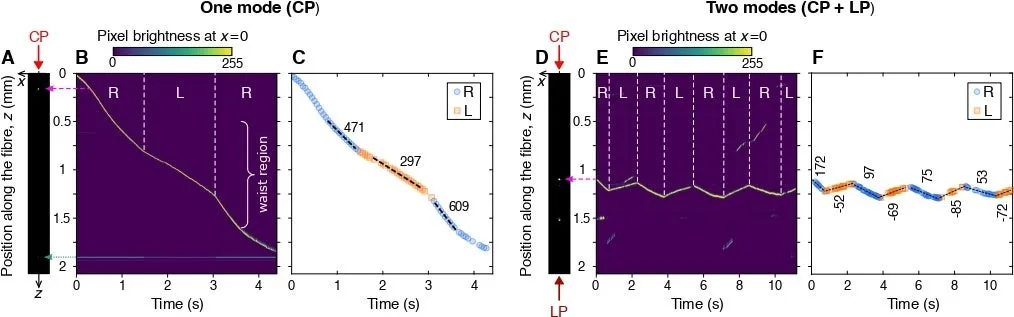
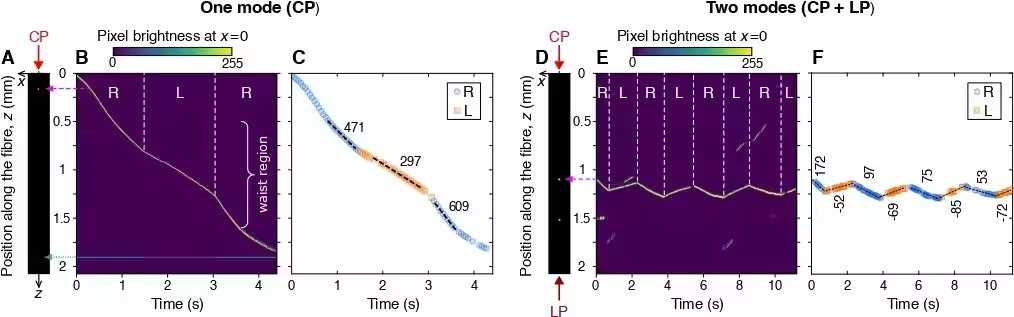
Through their meticulous experiments, the team distributed chemically synthesized chiral nanoparticles within a solution and positioned them close to the nanofiber while adjusting the input light to circular polarization. By observing the movement of these particles along the fiber, they noted distinct changes in transport speed dictated by the chiral properties of the light employed; right circular polarization resulted in a transport speed of approximately 471 µm/s, while switching to left circular polarization reduced this speed to 297 µm/s. When reverted to right circular polarization, the speed surged back to 609 µm/s, illustrating a direct relationship between light chirality and particle transport.
Moreover, the innovative introduction of the 'counter-propagating mode,' where two light beams entered from opposite directions, allowed for the complete negation of non-chiral force components. This advancement ensured that the transport of nanoparticles could be effectively inverted based on the light polarity – a finding that was not only experimentally verified but also supported by simulations, attesting to the validity and universality of their approach.
Such research is not merely theoretical; by advancing these principles, the application of this technique could evolve into a non-contact enantiomeric separation method for chiral molecules in drug development and chemical synthesis, revolutionizing how pharmaceuticals are manufactured.
The research findings were published online in the prestigious journal, Nature Communications, on April 16, 2026. This work represents a promising risk to bridge the existing gap between laboratorial theory and real-world applications in the realm of molecular science and beyond.
This study was conducted with the support of the Japan Society for the Promotion of Science (Grants JP22H05135, JP21H04641).
Topics Consumer Technology)
【About Using Articles】
You can freely use the title and article content by linking to the page where the article is posted.
※ Images cannot be used.
【About Links】
Links are free to use.