



Developing Ultra-Fast 180 Gbit/s Low Power Optical Transmitter for AI Data Centers
Introduction
The recent advancements in AI have accelerated the need for efficient communication technologies, particularly within data centers. With the demand for high-speed data transfer skyrocketing, researchers have developed an ultra-fast optical transmitter capable of 180 Gbit/s while significantly reducing power consumption. This article details the innovative features of this technology and its implications for the future of AI data center communication.
Development of the Optical Transmitter
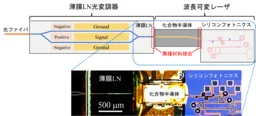
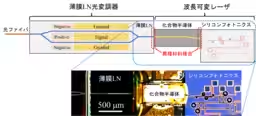
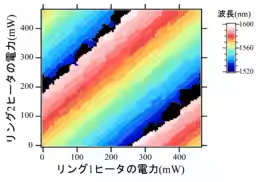
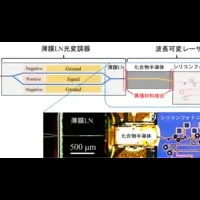
A research team led by Professor Tomohiro Kita from Waseda University has integrated a tunable laser with a high-speed optical modulator to produce a versatile optical transmitter. This device operates over a broad wavelength range of 67 nm (1529.1 to 1595.8 nm) without requiring the traditional cooling methods used for lasers. The use of Thin-Film Lithium Niobate (TFLN) in the optical modulator allows efficient conversion of electrical signals into optical signals with minimal voltage requirements.
Impact of AI on Data Transmission
The rapid growth of generative AI has led to an exponential increase in the volume of data exchanged between data centers. Optical communication technologies are crucial in meeting the requirements for both high bandwidth and low power consumption. The newly developed transmitter not only meets these criteria but also allows for the miniaturization of essential optical components, further supporting the compactness of data centers.
Technical Specifications
The transmitter achieves maximum speeds of 180 Gbit/s, which translates to a staggering 180 Gbaud. This speed is approximately three times that of the widely used 400G inter-center communication, indicating the potential for significant improvements in data handling capacity. With a power consumption reduced to approximately 0.6 V, this technology is expected to notably decrease energy use across large data centers, where thousands of optical transmitters are employed.
The research team overcame challenges posed by the inherent differences in operational requirements of the two key components. By designing and harmonizing their wavelengths, the team successfully eliminated the need for cumbersome additional optical elements or complex controls.
Experimentation and Results
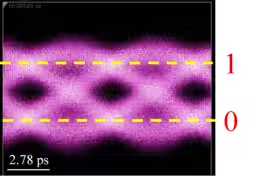
Experimental tests confirming the performance of the transmitter revealed a clear eye pattern at the 180 Gbit/s rate, a critical factor indicating reliable signal transmission quality. The eye pattern’s visual clarity suggests that even at high speeds, the device maintains signal integrity without substantial distortion.
Additionally, the conventional requirement for digital signal processing (DSP) to manage waveform distortion was bypassed due to the high linearity of the TFLN modulator. This innovation drastically cuts down on power requirements, presenting a compelling avenue for energy-efficient designs moving forward.
Broader Implications
Looking ahead, this optical transmitter is seen as a significant contributor to evolving data center technologies. As the demand for high-speed intercenter connectivity, driven by advancements in AI and cloud services, continues to rise, the development of low-power and high-density solutions is essential.
The research highlights the importance of integrating different materials while simultaneously recognizing their operational characteristics, which sets a valuable precedent in optical integrated circuit design. Future endeavors may facilitate the creation of even higher-function optical communication chips, aligning with the continuous quest for efficiency and performance in an increasingly data-driven world.
Conclusion
The advancements demonstrated by the development of this low-power optical transmitter establish a critical milestone in the realm of optical communication technologies. As we continue to witness the proliferation of data and demand for faster, more efficient systems, innovations such as this will play a pivotal role in shaping the future of communication technology in AI-driven data centers. The team, comprising experts from Waseda University and Sumitomo Osaka Cement, emphasizes their goal of realizing compact and high-function optical technologies that resonate with the needs of modern data processing environments.
Topics Consumer Technology)
【About Using Articles】
You can freely use the title and article content by linking to the page where the article is posted.
※ Images cannot be used.
【About Links】
Links are free to use.